Post
2027 Trademark Filings: Why Businesses Rush Registrations Before Year-End, and Why That's a Mistake
 Business Corporate Law
Every December, founders and finance teams rush trademark applications so the brand feels "protected" before the new year begins. The urgency is understandable, but Indian law sets no trademark registration deadline 2027 India filers must meet at year end. Filing volumes keep climbing: the IP India Annual Report 2024-25 records 552,190 trademark applications, up from 476,089 a year earlier. A crowded register is unforgiving of rushed paperwork. If you plan to file before the calendar turns, speak with the TGC Legal team about a proper clearance search first. This guide explains why the rush happens, what it costs and how to file properly instead.
Key Takeaways
- There is no trademark registration deadline 2027 India law attaches to the calendar year. The deadlines that really matter begin after you file, and they are short.
- Rushed filings often carry template specifications, the wrong applicant name or no clearance search, which invites objections and oppositions.
- A good IP protection law firm for year end filing will help you file a searched, documented application, not just a fast one.
Why Businesses Rush Trademark Filings Before Year-End
The year-end rush is driven by budgets, launch calendars and investor checklists, not by any rule in the Trade Marks Act, 1999.
Several pressures meet in the last quarter. Marketing budgets need to be spent, new product lines are planned for January, and investors ask whether the brand is protected. Marketplaces also ask for a registration or a pending application before they enrol a brand. None of this creates a legal cut-off. Most Indian companies follow an April to March financial year, so December is not even a fiscal year end for them. What does matter is the filing date itself. Under the Act, a mark is registered as of the date the application was made, so filing early helps. That benefit only holds if the application survives examination. A weak filing made in a hurry can cost more time than it saves.
The pattern is easy to recognise. A name is chosen in a November workshop, a logo is approved in early December, and an online form is submitted in the final week of the year. Nobody checks the register properly, and nobody asks which classes the business will trade in next year. Treating a self-imposed trademark registration deadline 2027 India planning cycle as fixed often means the search, the specification and the evidence are all squeezed into a few days.
What the Registry Numbers Say About Rushed Applications
The latest official data shows a busy register in which many applications never reach registration.
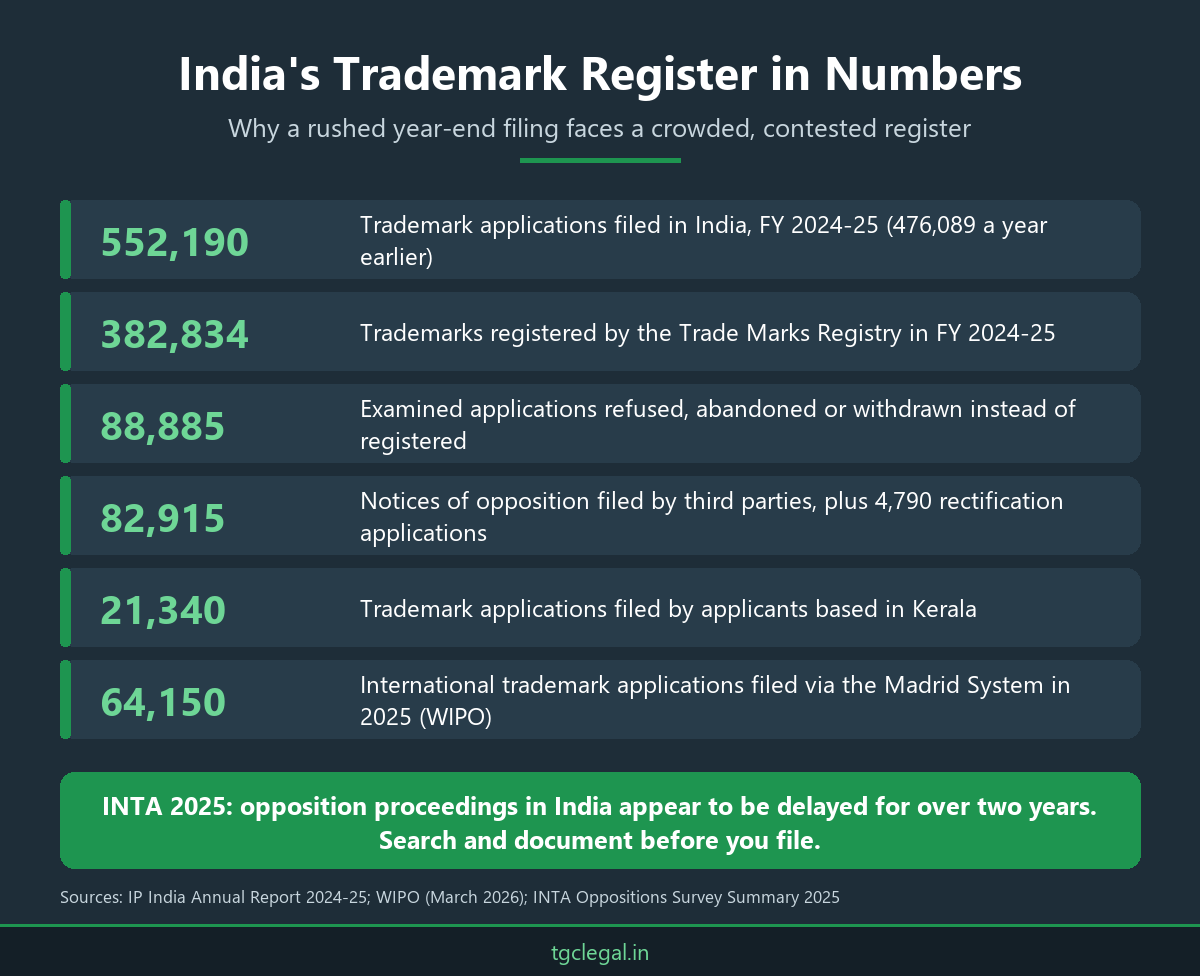
The IP India Annual Report 2024-25 shows that the Trade Marks Registry registered 382,834 marks during the year. In the same year, 88,885 examined applications were disposed of other than by registration, through refusal, abandonment or withdrawal. Third parties filed 82,915 notices of opposition and 4,790 rectification applications. Kerala applicants alone filed 21,340 trademark applications, so local businesses compete for distinctive names with a large and growing pool. Activity also continues at the international level. WIPO reported that applicants filed an estimated 64,150 international trademark applications through the Madrid System in 2025, a 1.5% decline on 2024. For a brand that plans to export, an Indian filing often becomes the base for those international applications, so its quality matters twice.
The numbers do not show how many failed applications were rushed, and they should not be read that way. They do show how much can go wrong after filing. Every refusal, abandonment or withdrawal represents fees, time and sometimes a rebrand. The same report notes that 96,636 registered marks were renewed during the year, a reminder that a well-built registration keeps its value for decades.
Five Mistakes Rushed Trademark Filings Make
Most problems in a rushed application are avoidable with a few days of preparation before filing.
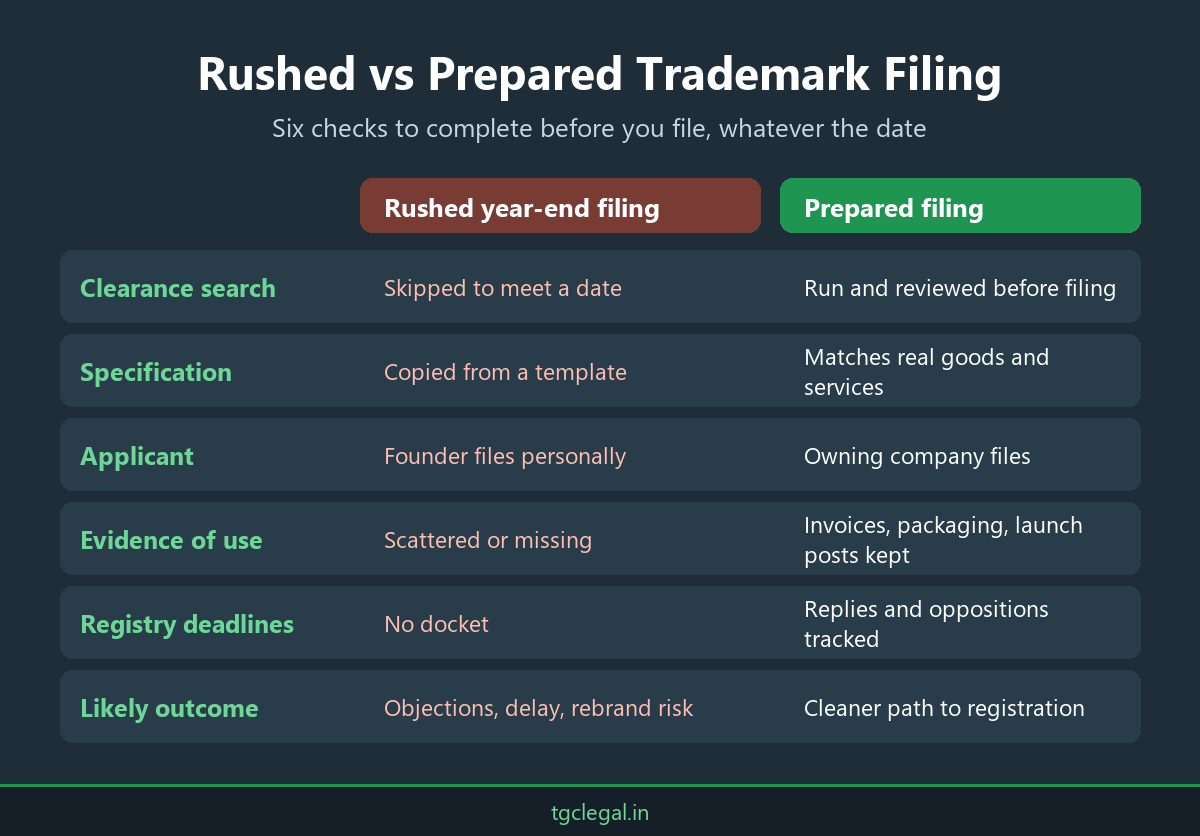
- Skipping the clearance search. The Registrar can cite earlier similar marks under Section 11. A search before filing shows these conflicts while the name can still change. Our trademark objection reply case study shows how an unsearched filing took close to two years across registry stages.
- Copying a template specification. A wide list of goods copied from a template invites objections and weakens the claim. The specification should match what the business actually sells or genuinely plans to sell.
- Filing in the wrong name. A founder who files personally may later need a formal assignment to the company. Investors notice this during diligence.
- No evidence of first use. A claimed user date needs invoices, packaging and advertising to support it. Without records, the claim is hard to defend.
- No deadline tracking. Under the Trade Marks Rules, 2017, a reply to an examination report is generally due within one month of receipt. A notice of opposition can be filed within four months of advertisement. Missing either can sink the application.
These mistakes appear again and again in our list of common legal mistakes startups make.
The Opposition Risk Lasts Longer Than Founders Expect
A rushed application that attracts an opposition can keep a brand in limbo for years, which defeats the purpose of filing early.
The INTA 2025 Oppositions Survey Summary reviewed opposition systems in 72 jurisdictions. It found that in India, Nepal and Pakistan, opposition proceedings appear to be delayed for over two years. It also notes that India requires documentary evidence in oppositions. A business that filed without a search or proof of use enters that process at a disadvantage. Patents carry a different timing risk. Showing an invention publicly before filing can damage its novelty, so many inventors file a provisional application first and complete the specification within twelve months. Anyone searching for a patent filing consultant near me for 2027 should plan that sequence before demo days and investor pitches, not after them.
The practical lesson is to prepare for a contest even if you never face one. Keep the clearance report, the reasons for choosing the name and dated proof of use in one file. If an opposition does arrive, that file becomes the core of the counter statement and the evidence. When a search for a patent filing consultant near me for 2027 leads an inventor to an IP firm, the same kind of records help show when an idea was first developed and shared.
How to File Properly, Whatever the Date
A calm, documented filing process protects the brand better than any year-end sprint.
Start by listing the assets that need protection: the word mark, the logo and any product names. Run a clearance search and review the results with counsel. Map each class to real goods and services, and file in the name of the entity that will own the brand. Gather evidence of use, such as dated invoices, packaging artwork and launch posts. Then set up a docket for examination replies, hearings and opposition windows, and plan renewals for the ten-year term. If the brand will be licensed to distributors or franchisees, prepare written licensing contracts once the application is on record. Working with an IP protection law firm for year end filing is useful precisely because it turns a deadline-driven task into a planned one. A filing made in January with a clean search is usually stronger than one made on December 31 without it.
If the year-end date genuinely matters, for example because a product launches in the first week of January, start the work in October or November. That leaves time for a search, a review of the results and a decision on which marks to file first. Where several names are shortlisted, file the strongest one rather than all of them in haste.
Conclusion
The year-end trademark rush is a habit, not a legal requirement. India's register is growing quickly, many applications fall away after examination, and oppositions can run for years. Businesses that search first, describe their goods accurately, file in the right name and track every registry deadline get stronger rights from the same filing fee. Treat any trademark registration deadline 2027 India planners set for themselves as a target for preparation, not a reason to cut corners. Explore TGC Legal's IPR protection services to plan your 2027 trademark and patent filings properly.
Frequently Asked Questions
Is there a trademark registration deadline 2027 India businesses must meet before year end?

Does filing a trademark before December 31 give extra protection?
Why do rushed trademark applications attract objections?
How long do I have to reply to a trademark examination report?
How long does a trademark opposition take in India?
Should a trademark be filed in the founder's name or the company's name?
When should I speak to a patent filing consultant near me for 2027?
What evidence of use should I keep for a trademark application?
Can TGC Legal help if my rushed application has already been objected to?
Do businesses in Kerala need a local IP firm for trademark and patent filings?