Post
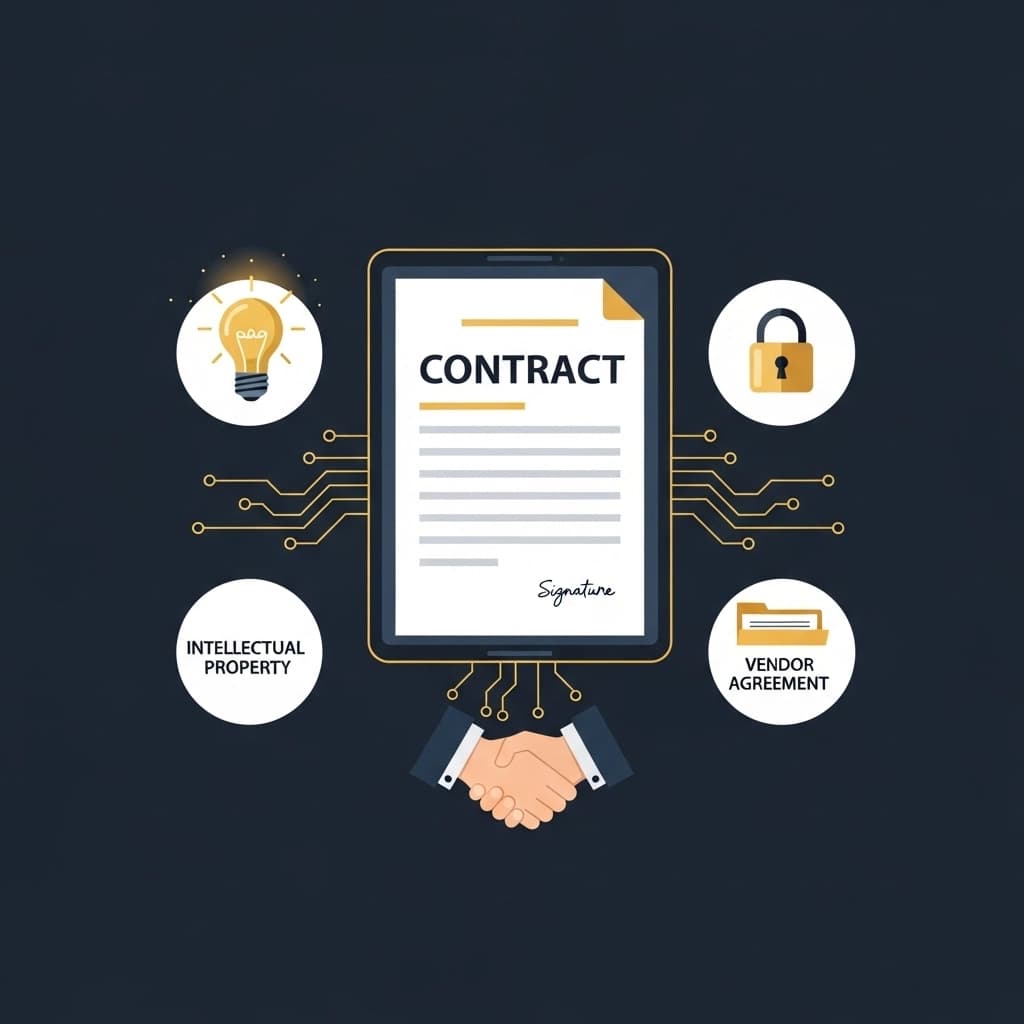
Information Technology Contracts: Protecting IP in Vendor Agreements
 Business Corporate Law
 Introduction
When businesses engage technology vendors, the exchange of proprietary systems, source code, and sensitive data makes intellectual property protection a fundamental concern. Yet many organisations sign information technology contracts without fully examining the clauses that determine who owns what, and under what conditions. The consequences can include IP disputes, data exposure, and a measurable loss of competitive advantage. This blog outlines the critical components that should be present in every IT vendor agreement, from software licensing terms to confidentiality frameworks, to help corporate decision-makers protect their business interests effectively.
Key Takeaways
Information technology contracts must explicitly define IP ownership, particularly when custom development or system integration is involved.
Software licensing agreements and mutual non-disclosure agreements are foundational legal instruments in every vendor engagement.
Engaging a technology lawyer during contract negotiation reduces the risk of ambiguous clauses that can expose your organisation to IP disputes or financial loss.
Why IP Ownership Is the Core Issue in IT Vendor Agreements
When a vendor develops, integrates, or customises a technology solution for a business, the question of who owns the resulting intellectual property is not always straightforward. Without a clearly drafted IP assignment clause in your information technology contracts, ownership may revert to the vendor by default under Indian intellectual property law. The Copyright Act, 1957 grants ownership to the author or creator unless a written agreement states otherwise. This creates real risk for businesses that commission software development or system integration without documenting IP transfer in a binding instrument.
A well-structured vendor agreement must explicitly state whether intellectual property is assigned outright, licensed back to the client, or retained by the vendor, and under what specific conditions each scenario applies. Businesses that assume IP ownership without a formal assignment clause often discover the error only when disputes arise. At that point, remedies are both costly and uncertain. IP ownership should be treated as a negotiable commercial term from the earliest stages of vendor engagement, not as an afterthought addressed at the contract review stage.
Software Licensing Agreements: Setting the Legal Boundaries for Use
Software licensing agreements define the scope, duration, and conditions under which a vendor's software product may be used within your organisation. In an IT vendor relationship, these agreements govern not just access rights, but also modification permissions, sublicensing conditions, and restrictions on reverse engineering. Businesses frequently underestimate the significance of licensing terms, particularly when adopting enterprise software platforms, cloud-based services, or integrated development environments.
Limitations on the number of users, permissible deployment environments, and data handling obligations are all embedded in licensing language that demands careful review. For organisations in regulated industries, or those handling personal data, non-compliance with licensing restrictions can introduce data privacy and regulatory risk alongside contractual liability. Engaging legal counsel before execution ensures that your business retains the operational flexibility it requires while remaining compliant with the terms your vendor has stipulated. Many disputes in this area originate from assumptions about permitted use that were never confirmed in writing.
Key Licensing Clauses That Require Close Attention
Several specific provisions within software licensing agreements carry significant operational and legal weight. The scope of the licence determines whether usage is perpetual or subscription-based and sets out the conditions for renewal or early termination. Modification rights dictate whether the licensee may adapt the software for internal purposes and, critically, who owns the adapted version. Data portability provisions clarify what happens to your organisation's data if the licence is terminated or lapses. Vendor audit rights can impose ongoing compliance obligations that affect routine business operations. Each of these provisions must be assessed against your business model, regulatory framework, and long-term technology strategy before any agreement is signed.
Mutual Non-Disclosure Agreements: Protection Before and During Engagement
Many technology engagements involve sharing sensitive information well before a formal contract is executed. During vendor evaluation, proof-of-concept phases, or commercial negotiations, businesses routinely share business plans, proprietary data, system architectures, and trade secrets. A mutual non disclosure agreement establishes a binding obligation of confidentiality on both parties, ensuring that information shared in good faith cannot be disclosed, reproduced, or used for competitive purposes outside the scope of the engagement.
Unlike a unilateral NDA, a mutual structure acknowledges that both the business and the vendor may be sharing sensitive material, which is common in complex IT projects involving platform access or integration with existing systems. For the agreement to be legally enforceable, it must precisely define what constitutes confidential information, specify the duration of the confidentiality obligation, and set out the remedies available in the event of a breach. Vague or template-based mutual non-disclosure agreements often fail at enforcement precisely because these elements are poorly drafted. A mutual non-disclosure agreement must clearly define confidential information, duration, and remedies to remain enforceable under Indian law.
IP Indemnification and Liability Provisions: What Businesses Often Overlook
IP indemnification clauses protect your organisation in the event that a vendor's deliverable infringes the intellectual property rights of a third party. This is a particularly significant concern in software development, where open source components, commercial code libraries, and third-party integrations are commonly incorporated. Without a clearly drafted IP indemnification clause, your business may face claims from third parties over software or systems your vendor supplied, with no legal recourse against the vendor who caused the infringement.
Limitations on liability are equally consequential. These provisions define the maximum financial exposure of each party in the event of a breach, loss, or failure to perform. Overly restrictive liability caps can leave your organisation without an adequate contractual remedy if the vendor's default results in significant business disruption or data loss. Planning IPR protection at the drafting stage is far more efficient than resolving disputes after a breach. Indemnification and liability provisions must be treated as priority negotiation points, not boilerplate.
Governing Law, Jurisdiction, and Dispute Resolution in IT Contracts
In information technology contracts involving both domestic and cross border vendors, governing law and jurisdiction clauses determine where and how disputes will ultimately be resolved. Businesses entering agreements with foreign technology vendors must ensure that these clauses reflect practical enforceability, particularly when disputes involve IP ownership claims or service delivery failures. Indian courts hold jurisdiction over contracts executed in India, governed by the principles of the Indian Contract Act, 1872. However, arbitration is increasingly adopted for its procedural efficiency and confidentiality in technology disputes.
A clearly defined dispute resolution mechanism reduces ambiguity substantially if the vendor relationship deteriorates. The arbitration clause should specify the seat of arbitration, the applicable institutional rules, and the number of arbitrators. Absent these details, even well-intentioned dispute resolution provisions become the subject of further disagreement. For corporate clients evaluating whether arbitration or litigation better serves their interests in commercial disputes, our analysis of arbitration versus litigation provides structured guidance that is directly applicable to IT and commercial contract settings.
When to Involve a Technology Lawyer in Vendor Contract Negotiations
The complexity of information technology contracts means that standard templates are rarely adequate for high-value or technically sensitive vendor engagements. A technology lawyer brings the sector-specific knowledge required to identify IP ownership gaps, assess licensing risk, and negotiate terms that accurately reflect the technical realities of the project. This is especially relevant for businesses that depend on third-party software or infrastructure for core operations, where licensing terms and service agreement conditions directly affect continuity and data security.
Early involvement of a technology lawyer during the contract drafting phase is significantly more efficient than retrospective review or dispute resolution once a relationship has broken down. Gaps in IP assignment, ambiguous licensing scope, and missing indemnification provisions are far easier and less costly to address before execution than after a dispute has emerged. For businesses in Kerala and across India, access to legal guidance with a background in technology law ensures that vendor agreements are structured to protect intellectual property, limit liability, and maintain operational control from the outset.
Conclusion
Information technology contracts are not administrative formalities. They are the primary legal instruments that determine who owns your software, who can access your data, and what recourse your organisation has when obligations are not met. Businesses that approach vendor agreements with rigour, backed by clearly drafted IP clauses, appropriate software licensing terms, and enforceable confidentiality obligations, are better positioned to protect their commercial interests. In high-value technology engagements, contract precision is not optional but it is a critical business safeguard.
Frequently Asked Questions
What is an information technology contract?

An information technology contract is a legally binding agreement between a business and a technology vendor . It defines the scope of services, IP ownership, software licensing terms, confidentiality obligations, and remedies for non-performance. It governs all aspects of the technology engagement from access rights to dispute resolution.
Why is IP ownership important in IT vendor agreements?
What should a software licensing agreement include?
What is a mutual non-disclosure agreement in IT contracts?
How does a technology lawyer help in vendor agreement negotiations?
What is IP indemnification in an IT contract?
What governing law should apply to IT vendor agreements in India?
What are the risks of not having a mutual NDA before a tech project?
Can a vendor claim ownership of software developed for a client?
What dispute resolution mechanism works best for IT contract disputes?