Post
SaaS License Management: Liability Risks in Multi-Tenant Agreements
 Business Corporate Law
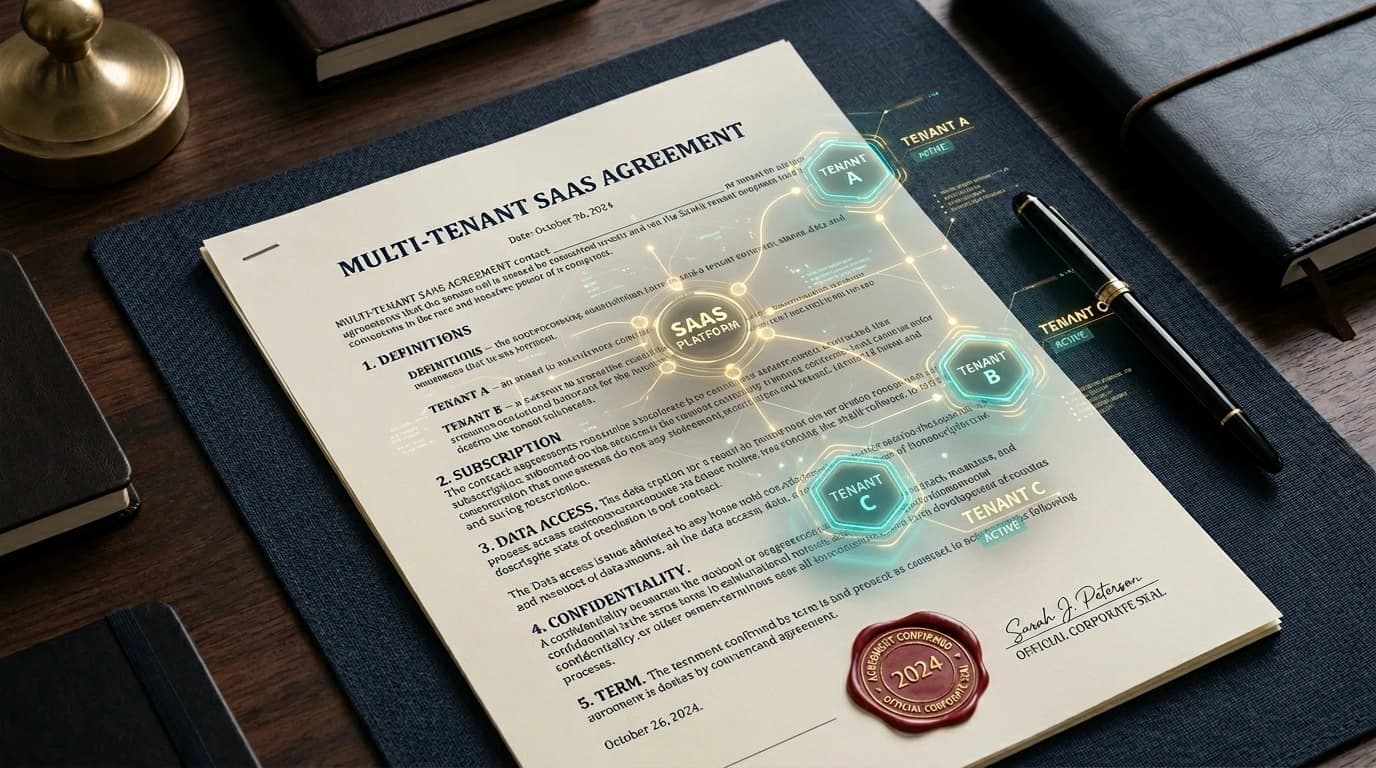
 SaaS license management has become a critical operational and legal responsibility for businesses that rely on cloud-based software platforms. When multiple tenants share a single software infrastructure, the contractual boundaries between usage rights, data ownership, liability exposure, and service continuity become difficult to define and even harder to enforce. For businesses entering or operating within multi-tenant environments in India, the legal architecture of the underlying SaaS license agreements in India directly determines who bears risk when things go wrong.
Key Takeaways
SaaS license management in multi-tenant models introduces complex liability gaps that standard contracts frequently fail to address, making structured legal review essential before signing any software application development agreement.
Poorly drafted software development agreements can strip vendors of IP protections and expose clients to unintended indemnification obligations, with long-tail risks including data segregation failures and restrictive termination clauses.
Engaging a technology lawyer during contract negotiation rather than after a dispute is the most effective risk mitigation strategy for B2B technology businesses operating in India.
Why SaaS License Management Creates Unique Legal Exposure in Multi-Tenant Architectures
Shared Infrastructure, Divided Liability: The Core Problem in Information Technology Contracts
In a multi-tenant SaaS deployment, the same application instance serves multiple clients simultaneously. The cost efficiency of this model is widely understood. What is less appreciated is that this shared architecture creates layered liability scenarios that standard information technology contracts are often not drafted to handle.
When a data breach occurs, when service levels are not met, or when one tenant's actions affect another's data environment, the contract must answer one question clearly: who is responsible? If the agreement lacks specific language around tenant isolation, incident response, and cross-tenant liability waivers, courts and arbitration panels will apply default principles under the Indian Contract Act, 1872, which may not produce outcomes favorable to either party.
Under the Information Technology Act, 2000, multi-tenant deployments create layered liability scenarios that standard contracts frequently fail to address. Liability allocation in SaaS agreements remains one of the most contested areas in technology contract disputes in India. Contracts drafted without accounting for multi-tenancy risks are structurally incomplete.
IP Ownership Gaps in Software Application Development Agreements
A common but underestimated risk arises when a software application development agreement does not clearly define who owns custom modules, integrations, or configurations developed for a specific tenant within a shared platform. If a vendor builds tenant-specific features during the contract term, and the agreement is silent on IP assignment, those features may legally belong to the vendor under Indian copyright law.
This ambiguity has direct consequences. A tenant who has invested in the development of specialized functionality may discover upon contract termination that it cannot take that functionality to a new vendor. Alternatively, a vendor who has customized the core platform for one tenant may unintentionally expose those customizations to other tenants on the same infrastructure.
The question of who owns IP when development work is outsourced is one that surfaces repeatedly in technology law disputes. For multi-tenant environments, this question becomes even more acute because the IP exists within a shared architecture rather than a standalone system.
How Software Development Agreements in India Handle Liability Caps and Indemnification
A well-structured software development agreement India will typically include a mutual indemnification clause, a liability cap tied to contract value, and a carve-out for gross negligence or willful misconduct. In multi-tenant SaaS agreements, however, these standard provisions often create ambiguity rather than clarity.
Consider a scenario where a SaaS vendor's infrastructure failure exposes the confidential data of three tenants simultaneously. If the liability cap is calculated per contract, each affected tenant may only recover a fraction of its actual loss. If the indemnification clause does not explicitly cover cross-tenant data exposure, the vendor may argue it is not liable under the specific terms of each individual agreement.
These are not hypothetical concerns. Disputes between Indian SaaS firms over licensing and liability have highlighted this gap precisely. The failure to tailor liability frameworks to the realities of multi-tenant architecture results in prolonged disputes and uncertain recoveries.
Data Segregation, Audit Rights, and Compliance Obligations in SaaS Agreements
For regulated industries such as fintech, healthcare, and logistics, SaaS license management carries an additional compliance dimension. Multi-tenant platforms must be able to demonstrate data segregation, provide audit logs on request, and satisfy sector-specific data residency requirements. If the SaaS agreement does not obligate the vendor to maintain these capabilities, a tenant may face regulatory penalties for its vendor's operational shortcomings.
The Information Technology Act, 2000, and its associated rules place obligations on data processors and intermediaries operating in India. When a multi-tenant SaaS vendor qualifies as an intermediary or data processor, its contractual obligations to tenants must align with these statutory duties. Gaps between the statutory framework and the contractual arrangement are a source of regulatory and legal liability that many businesses overlook at the time of onboarding.
For a detailed breakdown of how SaaS agreements address these compliance obligations in practice, the case study on how a global SaaS company achieved data privacy compliance in India offers instructive analysis.
Termination, Data Portability, and Vendor Lock-In Risks in Multi-Tenant SaaS Contracts
One of the most consequential but frequently overlooked areas of SaaS license management is what happens when the contract ends. Multi-tenant SaaS agreements that do not include robust termination and data portability provisions can effectively trap a tenant on a platform even when the commercial relationship has deteriorated.
Key provisions that must be addressed in any software development agreement India include the following:
A defined data extraction window post-termination, with the vendor obligated to provide data in a usable format.
Clarity on whether tenant-specific configurations or integrations survive termination and in what form.
Obligations on the vendor to support data migration to a successor platform for a specified transition period.
Explicit prohibition on the vendor retaining or using tenant data after the termination date.
Without these provisions, a tenant may find itself in a position where its operational data is effectively held by a vendor until a negotiated exit is reached, creating significant leverage in favor of the vendor and against the tenant's interests.
The Role of an Information Technology Lawyer in Structuring Multi-Tenant SaaS Agreements
Why an Information Technology Lawyer Is Essential Before Signing, Not After Disputes Arise
An information technology lawyer brings two distinct capabilities to SaaS contract negotiations: technical legal drafting precision and an understanding of how technology systems translate into contractual risk. Generic legal counsel without technology law exposure will frequently miss the operational nuances that create liability gaps in multi-tenant agreements.
Specific areas where legal consultancy services add measurable value in SaaS agreement review include liability cap structuring and IP ownership clause drafting. Data processing addendum alignment with the IT Act and indemnification carve-out negotiations are equally critical. Each of these areas requires a working understanding of both the legal framework and the technical realities of SaaS deployment.
For businesses operating in Kerala and across India, how technology lawyers safeguard businesses in IT agreements has become increasingly relevant as SaaS adoption accelerates in the domestic market.
Reviewing Software Development Agreements: A Practical Checklist for B2B Businesses
Before executing any multi-tenant SaaS agreement or software application development agreement, B2B businesses should confirm the following contractual elements are addressed:
Tenant isolation obligations and the vendor's liability for cross-tenant data exposure.
IP ownership for custom modules, integrations, and configurations developed during the contract term.
Liability cap structure and whether caps apply per incident, per tenant, or in aggregate.
Data residency and audit rights provisions that satisfy applicable regulatory requirements.
Termination notice periods, data portability timelines, and post-termination data deletion obligations.
Service level agreements with financial remedies for downtime or performance degradation.
Governing law and dispute resolution clauses that specify jurisdiction and mechanism.
This checklist is not exhaustive, but it reflects the most common areas where multi-tenant SaaS agreements fail to protect tenant interests adequately.
Conclusion
SaaS license management in multi-tenant environments is not a procurement exercise. It is a legal and risk management discipline that demands careful attention to contract structure, IP ownership, liability allocation, and regulatory compliance. Businesses that treat SaaS agreements as standard commercial contracts without technology-specific legal review are exposed to liability risks that can have significant financial and operational consequences.
Engaging legal consultancy services with a focus on information technology contracts before signing is the most practical way to protect business interests. Acting before a dispute materialises, rather than after, reduces both exposure and remediation cost. For businesses seeking to understand their current contractual exposure, a structured review of existing software development agreements is a productive starting point.
Frequently Asked Questions
What is SaaS license management and why does it matter in multi-tenant environments?

How does a multi-tenant SaaS agreement differ from a standard software license agreement?
What are the most common liability gaps in SaaS license management contracts?
What should a software development agreement in India include for SaaS deployments?
A software development agreement India for SaaS deployments should include mutual indemnification clauses, liability caps per incident, data residency obligations, IP assignment provisions for customizations, service level commitments, and dispute resolution mechanisms. Each element should reflect the multi-tenant architecture rather than a standalone software model.
Does Indian law specifically regulate multi-tenant SaaS agreements?
Who owns the IP created in a custom SaaS integration or module?
How does an information technology lawyer help in SaaS contract negotiations?
An information technology lawyer reviews SaaS agreements for technical liability gaps, drafts precise IP ownership clauses, structures liability caps for multi-tenant risks, and aligns data processing terms with Indian law. Their role is to ensure the contract reflects the operational realities of the platform, and businesses can benefit from understanding IP ownership provisions in software development agreements in India.
What happens to a tenant's data when a SaaS agreement is terminated?
If the agreement does not specify data portability obligations, the vendor has no contractual duty to return data in a usable format or support migration. Tenants should negotiate defined extraction windows, data format specifications, and post-termination deletion obligations before signing any multi-tenant SaaS or software application development agreement.
Can a SaaS vendor limit its liability for data breaches affecting multiple tenants?
Yes, a SaaS vendor can contractually limit liability for data breaches if the agreement includes a valid liability cap. However, gross negligence, willful misconduct, and statutory obligations under the IT Act may override contractual caps. Tenants should negotiate carve-outs to ensure meaningful recovery in the event of a significant multi-tenant incident.
What role do legal consultancy services play in ongoing SaaS license management?
Legal consultancy services support ongoing SaaS license management by reviewing contracts at renewal. It advises on regulatory changes affecting data obligations, and assists with dispute resolution when service failures occur. Periodic legal review of SaaS agreements ensures contractual protections remain aligned with the business's evolving operational and compliance requirements.