Post
Enforcing an Arbitral Award: Execution Timeline Kerala
 General
A favourable award is a milestone, not a conclusion. Between the tribunal signing and money arriving sits a challenge window, an execution petition and the ordinary machinery of attachment. Arbitration law firms in Kochi routinely find that clients budgeted carefully for the reference and not at all for this stage. This article sets out what the enforcement path actually looks like and how to shorten it.
Key Takeaways
- An award is enforced as if it were a decree of a civil court, but only after the challenge window closes or a challenge fails.
- The execution petition is filed where the assets are, which need not be the seat of the arbitration or the place the award was made.
- Asset information gathered during the reference shortens enforcement more than anything done after the award is signed.
The Award Is Not the End of the Matter
Indian arbitration law treats an award as final on the merits and then requires a separate process to convert it into money. The award itself creates no charge over anything the losing party owns. Until execution begins, the debtor remains free to deal with its assets in the ordinary course.
That gap creates a practical risk. A party facing an adverse award has notice of it and may reorganise its affairs before enforcement commences. This is why urgent protection remains available after the award and before enforcement, and why a claimant who anticipates difficulty should consider it rather than assuming the award is self executing.
The other reason the award is not the end is the challenge. The losing party has a statutory right to apply to set it aside, and while the grounds are narrow the application itself takes time. Planning that assumes recovery within weeks of the award is planning for the uncontested case only.
The Three Month Challenge Window
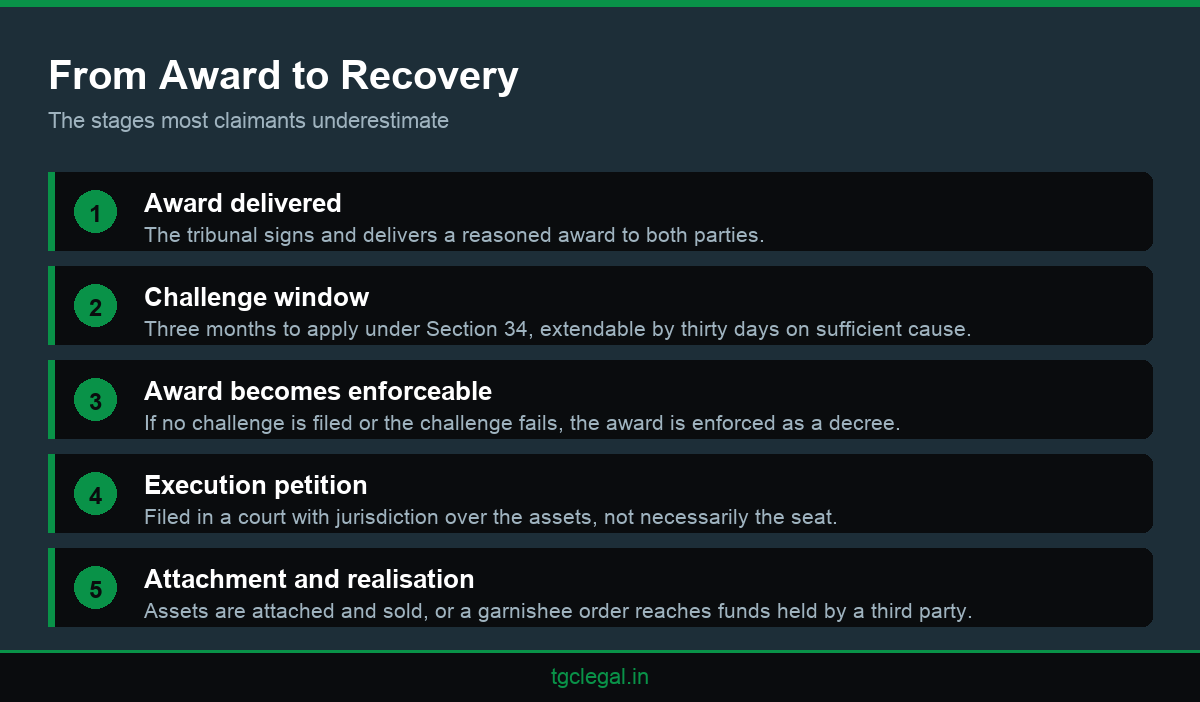
An application under Section 34 must be filed within three months of the date on which the party received the award. A court may extend that by a further thirty days where sufficient cause is shown, and it has no power to extend beyond that. The limit is strict, which cuts both ways: a defaulting challenger loses the right entirely, and a claimant knows precisely when the risk period ends.
The three months run from the date the party received the award, not from the date the tribunal signed it. That distinction occasionally matters where delivery was delayed or disputed, and it is worth recording the date and manner of delivery at the time rather than reconstructing it later. Where a party applies to the tribunal to correct a computational or clerical error in the award, the period runs from the disposal of that application instead, which can extend the window in practice.
The grounds are confined to matters such as incapacity, an invalid arbitration agreement, lack of proper notice, an award exceeding the scope of the reference, irregular constitution of the tribunal, non arbitrability and conflict with the public policy of India. Courts have repeatedly declined to use the public policy ground as a route to reconsider the evidence.
Filing a challenge does not by itself suspend enforcement. The challenging party must apply separately for a stay, and a court granting one will frequently require security or a deposit. Our note on strategies for resolving business and contract disputes covers how this stage fits into the wider commercial picture.
Filing Execution in the Right Court
Enforcement is by execution petition, and the award is treated as a decree for that purpose. The important practical point is that the petition may be filed directly in any court where the assets are located. There is no need to return to the court at the seat first and then transfer the decree.
For a Kerala business this matters when the debtor operates elsewhere. An award made in a Kochi seated arbitration can be executed against property or bank accounts in another state by filing in the court with jurisdiction there. Equally, an award from a reference seated elsewhere can be executed in Kerala where the assets sit here.
Where the amounts involved cross the specified value, the matter engages the framework of the Commercial Courts Act, 2015, which applies tighter procedural timelines than an ordinary civil court. Case status can be followed through the eCourts services portal.
One consequence of being able to file directly where the assets sit is that a claimant can run more than one execution at the same time. Where a debtor holds a bank account in one state and immovable property in another, separate petitions can proceed in parallel rather than sequentially. This is worth planning deliberately, because pursuing one asset at a time gives a reluctant debtor the opportunity to move value ahead of each new application.
Attachment, Sale and Realistic Timelines
Execution follows the ordinary civil procedure. The decree holder identifies property, applies for attachment, and where the debtor still does not pay, the attached property is sold and the proceeds applied to the award. Money held by a third party for the debtor, such as a bank balance or a receivable, can be reached through a garnishee order.
Timelines vary enormously, and the main variable is not the court. It is the quality of the asset information the decree holder brings and how much resistance the debtor offers. A petition naming a specific bank account with the branch identified moves very differently from one asking the court to discover what the debtor owns. Where holdings are genuinely opaque, the court can be asked to examine the judgment debtor on oath about its assets. That is a slower route, but it is sometimes the only one available.
Objections extend matters further. Third parties may claim an interest in attached property, and those claims are decided before sale can proceed. A debtor who is determined to delay has procedural opportunities to do so, which is why claimants are generally better served by targeting liquid assets first. Our case study on resolving a commercial contract dispute shows how recovery strategy is shaped from the outset.
Building the Asset Picture Early
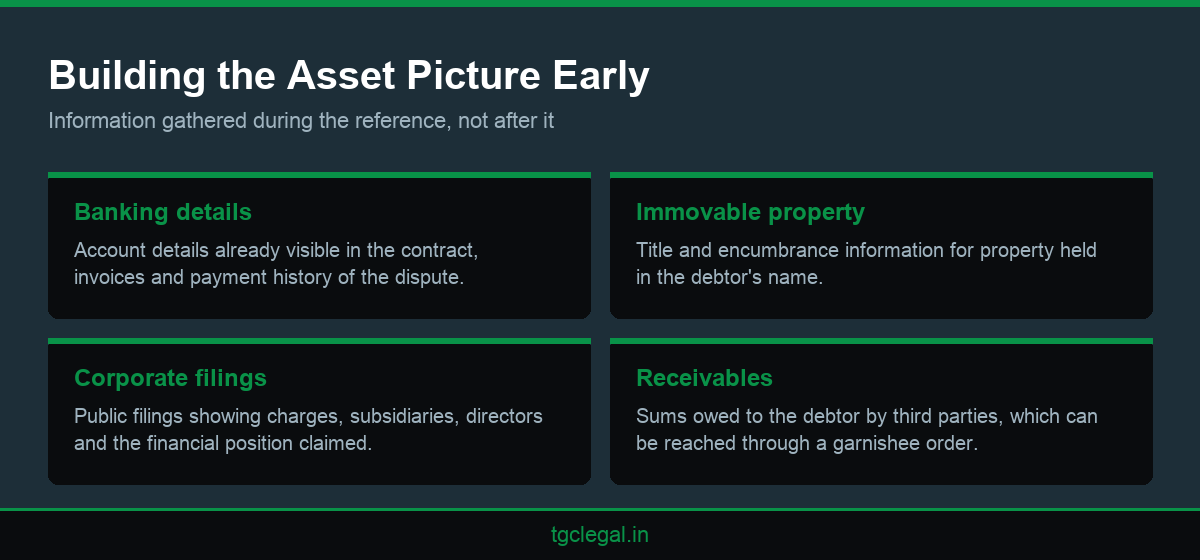
The single most effective way to shorten enforcement is to start gathering asset information during the arbitration rather than after it. Much of it is already in the file. Bank details appear on invoices and in the payment history. Registered office and directors appear in public filings. Property holdings may be discoverable through registry searches.
Corporate filings repay attention. Charges registered over a company's assets show which lenders rank ahead, which affects whether attachment will realise anything. Group structure shows where value may actually sit. None of this requires anything unusual, only that somebody looks while the reference is running.
The reference itself is a source as well. Witness statements, disclosed documents and the respondent's own submissions about its financial position frequently reveal where value sits, and that material is already in the file at no additional cost. A claimant who reads the record with enforcement in mind, rather than only with liability in mind, usually finishes the arbitration knowing exactly where to file.
Where the debtor's property holdings are relevant, title and encumbrance work runs in parallel with the enforcement itself, and our property documentation page covers that groundwork. The wider principle is simple. Enforcement is an information problem more than a legal one, and the information is cheapest to gather before the debtor has any reason to make it harder to find.
Conclusion
Enforcing an arbitral award in Kerala is straightforward in structure and demanding in practice. The challenge window is fixed, the execution route is clear, and the award can be taken directly to whichever court has the assets. What separates a quick recovery from a slow one is preparation: knowing what the debtor owns, targeting liquid assets first, and treating enforcement as part of the dispute strategy rather than an afterthought. To read how these matters are handled, explore our commercial dispute case studies.
Frequently Asked Questions
How long after an award can we start enforcement?

Does filing a challenge stop enforcement automatically?
Where should the execution petition be filed?
Can an award be enforced against assets in another state?
What can be attached in execution?
How long does execution usually take?
Can interest be recovered as well as the principal?
What if a third party claims the attached property?
Is a foreign award enforced the same way?
What should we collect during the arbitration to help later?