Post
International Investment Disputes: Treaty Protection
 General
Indian companies now hold significant assets abroad, from manufacturing plants to technology subsidiaries. When a host government changes the rules, revokes a licence or takes an asset, the ordinary contract remedies are of little use because the counterparty is a state. International investment disputes address that gap through treaties rather than contracts. This article explains how the protection works, what it covers, and what an investor should document from the outset.
Key Takeaways
- Investment arbitration is brought against a state under a treaty, not against a company under a contract. Consent comes from the treaty, so no clause with the government is needed.
- Most treaties require a notice period and, in India's model, an attempt at local remedies before an international claim can be commenced.
- The evidence that decides these claims is created during the investment, in approvals, correspondence with regulators and records of what the state represented.
How Investment Arbitration Differs from Commercial Arbitration
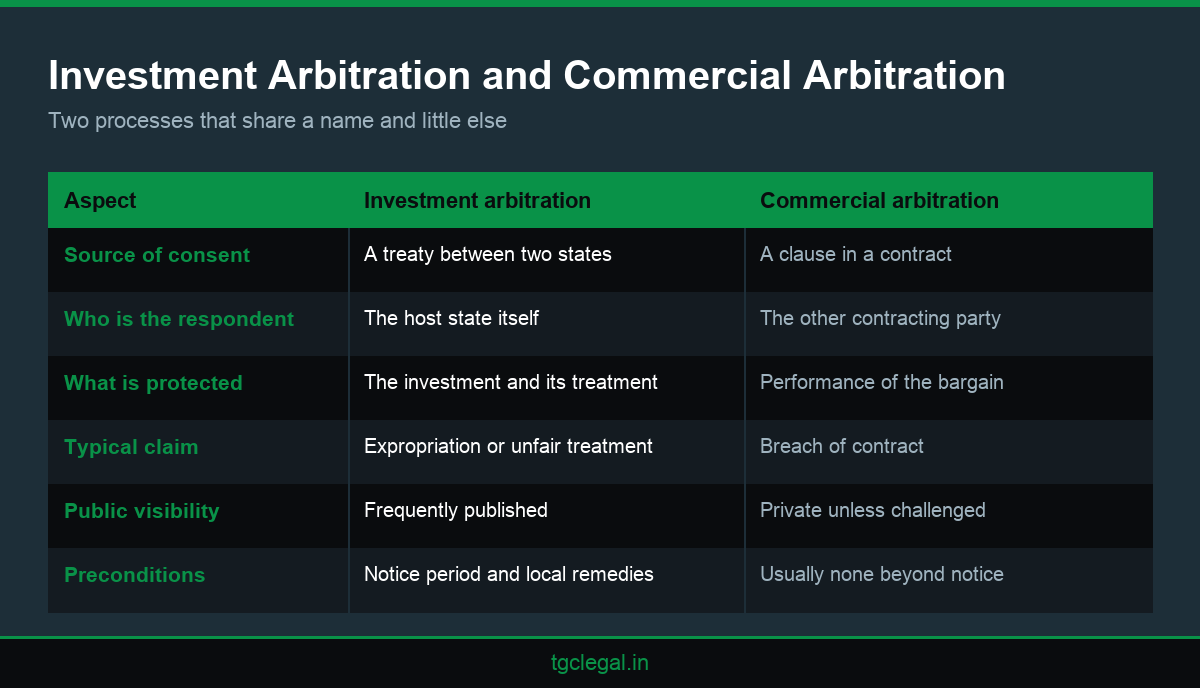
Commercial arbitration resolves a dispute between two private parties who agreed to arbitrate in their contract. Investment arbitration resolves a dispute between a foreign investor and the state hosting the investment. The consent that makes it possible does not come from a contract at all. It comes from a treaty in which the host state offered, in advance, to arbitrate with investors from the other signatory country.
That difference changes the nature of the claim. A commercial claim asks whether a party performed its bargain. An investment claim asks whether a state treated an investment in the manner its treaty obligations require. The conduct complained of is often lawful under domestic law, because the question is not domestic legality but compliance with an international standard.
Visibility differs too. Commercial arbitration is private. Investment arbitration frequently becomes public, because awards against states attract attention and many institutions publish them. An investor weighing a claim should assume the dispute will become known, which affects both negotiating strategy and the relationship with the host government going forward.
There is a further structural difference worth understanding. In commercial arbitration both parties chose the forum together and both are bound by the same clause. In investment arbitration the state made a standing offer to a whole class of investors, and the investor decides unilaterally whether to accept it. That asymmetry shapes how states defend these claims. Jurisdictional objections are raised in almost every case, and it is common for a tribunal to spend its first year deciding only whether it can hear the dispute at all. A claimant should budget for that phase as a distinct exercise rather than treating it as a preliminary formality. Our note on strategies for resolving business and contract disputes covers the parallel discipline in commercial matters.
What a Bilateral Investment Treaty Protects
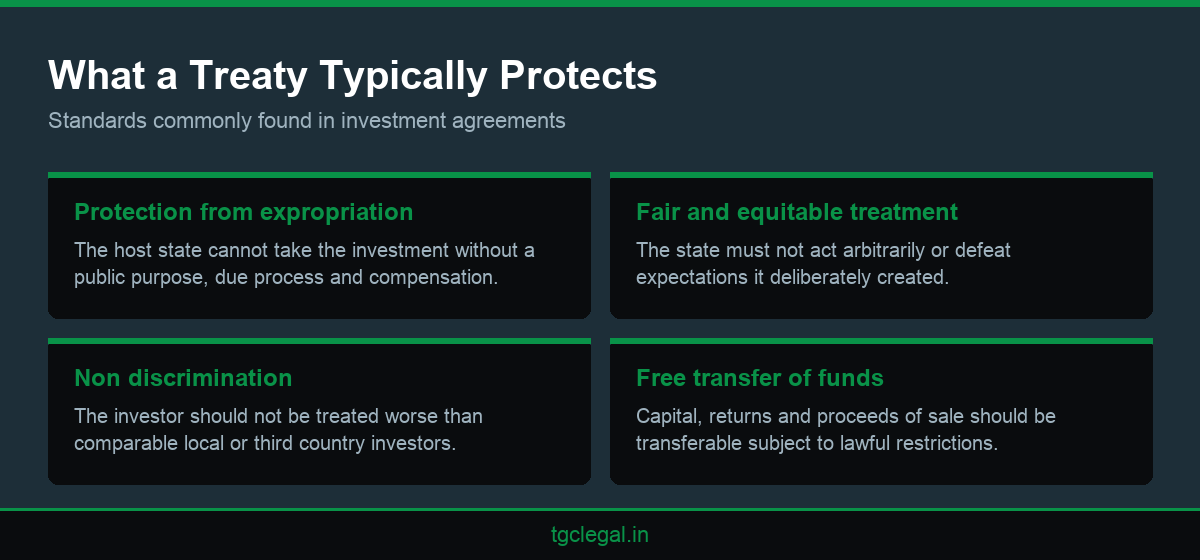
Treaties differ in wording, but a recognisable set of protections recurs. The first is protection against expropriation. A state may not take an investment without a public purpose, due process and compensation. This covers direct seizure and also indirect measures whose cumulative effect destroys the value of the investment, such as withdrawing an operating licence the business cannot function without.
The second is a standard of fair and equitable treatment. It restrains arbitrary conduct, denial of justice and the deliberate defeat of expectations the state itself created, for instance where an investor built a plant in reliance on written assurances that were later reversed without explanation.
Beyond these, treaties commonly include protection against discrimination relative to local or third country investors, guarantees of full protection and security, and the right to transfer capital and returns out of the country. Whether a particular measure breaches any of these standards is intensely fact specific, which is why the contemporaneous record matters so much.
India's Model Treaty and the Local Remedies Requirement
India revised its approach to investment treaties following a series of claims against it, and terminated or renegotiated many older agreements. The current model text is considerably narrower than the treaties of the previous generation. It defines investment more restrictively, excludes certain regulatory measures such as taxation from the scope of claims, and is careful to preserve the state's right to regulate in the public interest.
The most consequential feature for a claimant is the requirement to pursue local remedies first. Under the model text an investor must ordinarily use domestic courts and authorities for a defined period before commencing an international claim, followed by a further notice period. An investor who moves straight to arbitration risks having the claim dismissed on admissibility grounds without any consideration of the merits.
Because these instruments change, the operative question for any specific investment is which treaty was actually in force at the relevant time and whether it contains a survival clause protecting investments made before termination. The Department of Economic Affairs is the authority for India's investment agreement framework.
Where These Claims Are Heard
Investment claims are typically heard under one of a small number of procedural frameworks. Many proceed under the arbitration rules of the International Centre for Settlement of Investment Disputes, which sits within the World Bank group and has its own enforcement regime. Others proceed under the UNCITRAL arbitration rules administered ad hoc or by an institution.
The choice is generally dictated by the treaty rather than by the investor, and it carries practical consequences. Awards under one regime are enforced through a bespoke mechanism, while awards under other rules are enforced through the ordinary framework applicable to foreign awards. Timelines are long by commercial standards. A claim running five years from notice to award is unremarkable.
Cost follows scale. Tribunal fees, counsel and quantum consultants on a treaty claim usually run well beyond the budget for a commercial reference. This is one reason investors often use the notice period to negotiate rather than to prepare for a hearing, and why many claims settle before an award.
Funding arrangements have become part of the landscape as a result. Third party funders sometimes finance treaty claims in exchange for a share of any recovery, and some treaties and rules now require disclosure of such arrangements. An investor considering a claim should understand both the option and the disclosure obligation before committing, because the structure chosen at the outset is difficult to unwind later. Our note on how a technology lawyer safeguards a business worldwide touches on the wider question of managing cross border legal exposure.
What Indian Investors Abroad Should Document
Treaty claims are won on the record created while the investment was being made. Every approval, licence, incentive letter and written assurance from a ministry or regulator should be retained in its original form with its date. Where an official gives an assurance orally, a short confirming letter turns an unprovable recollection into a document.
Corporate structure deserves attention at the outset rather than after a problem emerges. Treaty protection depends on the nationality of the investor, so the jurisdiction through which an investment is held determines which treaty, if any, applies. Restructuring after a dispute has become foreseeable is generally treated as an abuse of process, so the planning has to be genuine and early.
Finally, keep the commercial and treaty layers distinct. A dispute with a state owned counterparty under a supply contract is a commercial arbitration governed by the contract. A measure taken by the state in its sovereign capacity may found a treaty claim. The same facts can generate both, and the strategy for each is different. See our page on commercial suits and dispute resolution.
Conclusion
International investment disputes give a business protection that no contract with a private party can supply, but the protection is conditional. It depends on which treaty applies, on how the investment is held, and on whether the investor followed the notice and local remedy steps the treaty requires. Most of what decides these claims is created long before a dispute, in the ordinary paperwork of making an investment. To read how cross border matters are structured in practice, explore our commercial dispute case studies.
Frequently Asked Questions
What are international investment disputes?

Do we need an arbitration clause with the government?
What counts as expropriation?
Must we go to the local courts first?
How long does a treaty claim take?
Are these proceedings confidential?
Does the holding structure affect our protection?
Can a tax measure be challenged under a treaty?
What if our dispute is with a state owned company?
How does this connect to our ordinary contract work?