Post
Legal Opinion for Land vs Flat: How the Document Set Differs
 General
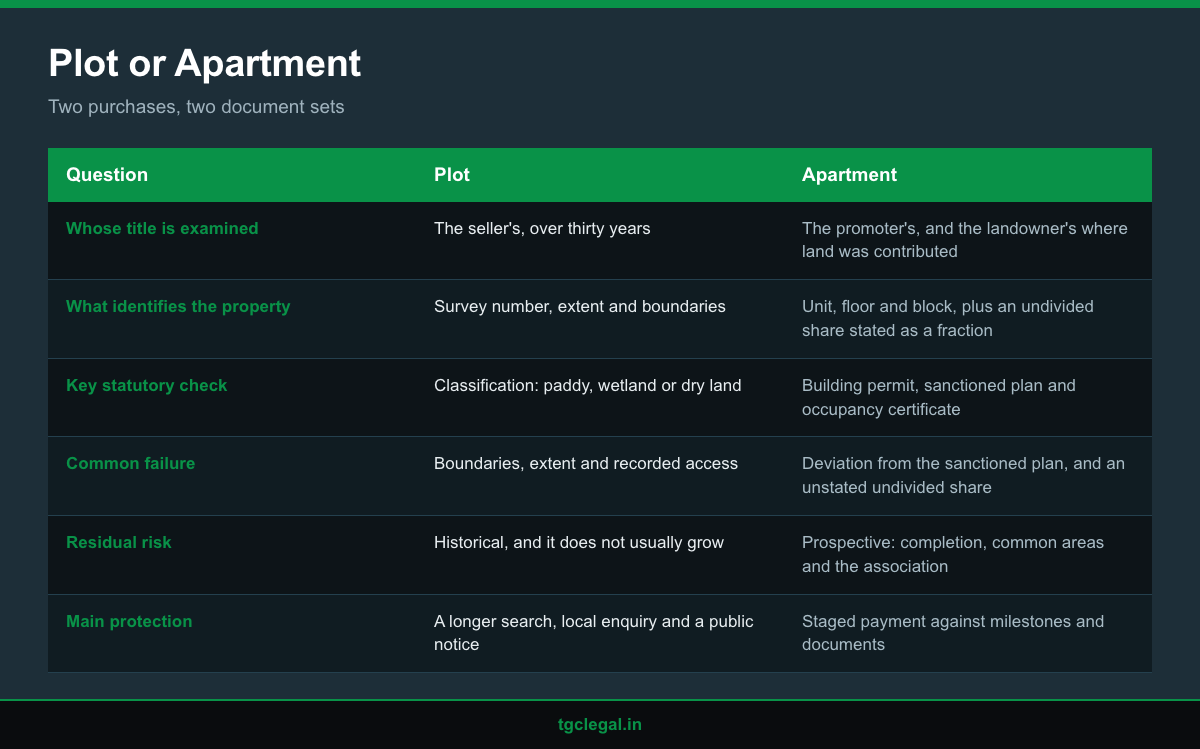
A plot and an apartment are both immovable property, and the similarity ends there. The buyer of a plot is examining one chain of title to one identified piece of land. The buyer of an apartment is examining the promoter's title to a larger parcel, the promoter's right to build on it, the approvals under which it was built, and a bundle of rights in common areas that the buyer will share with everyone else in the building.
A legal opinion for land and one for an apartment answer different questions, and this note sets out what each document set contains, where each one typically fails, and which questions an apartment buyer simply cannot answer from their own papers.
Key Takeaways
- A plot review runs on a single chain of title. An apartment review runs on the promoter's chain plus the development approvals plus the sharing structure.
- For land, the recurring failures are boundaries, extent and classification. For apartments, they are approvals, deviations and undivided share.
- The undivided share in the land is the part of an apartment purchase most often left unchecked, and it is the part that matters on redevelopment.
- Project registration with the state regulator carries the promoter's own declarations about title and encumbrances, and is a five-minute check.
- An apartment buyer inherits the promoter's title defects. Reviewing the promoter's chain is not optional.
The Plot: One Chain, Read Carefully
A legal opinion for land is the more traditional exercise and the more self-contained one, and it is the one most Kerala buyers have seen before. The reviewer traces the chain of title over thirty years, obtains the encumbrance certificate for the full period, reconciles the deeds against the revenue record, checks the survey position and reports.
The failures cluster in three places. Boundaries and extent come first: a deed that describes the property by reference to neighbours' names that changed decades ago, an extent stated in a unit that does not match the revenue entry, or a resurvey that renumbered the plot without anyone updating the deeds. These are correctable, but they are correctable before completion and awkward afterwards.
Classification comes second, and in Kerala it is decisive. Land recorded as paddy or wetland in the statutory data bank cannot simply be filled or converted, and a plot being marketed as a house site may be nothing of the kind on the record. The classification is checked in the revenue record and the data bank, and it is checked before the price is agreed.
Access is the third. A plot with no recorded right of way to a public road is worth substantially less than the same plot with one, and an access enjoyed in practice for twenty years is not the same as an access granted by a registered instrument. Our note on the checklist a buyer works through before registering land in Kochi covers the mechanics.
The Apartment: Three Layers Instead of One
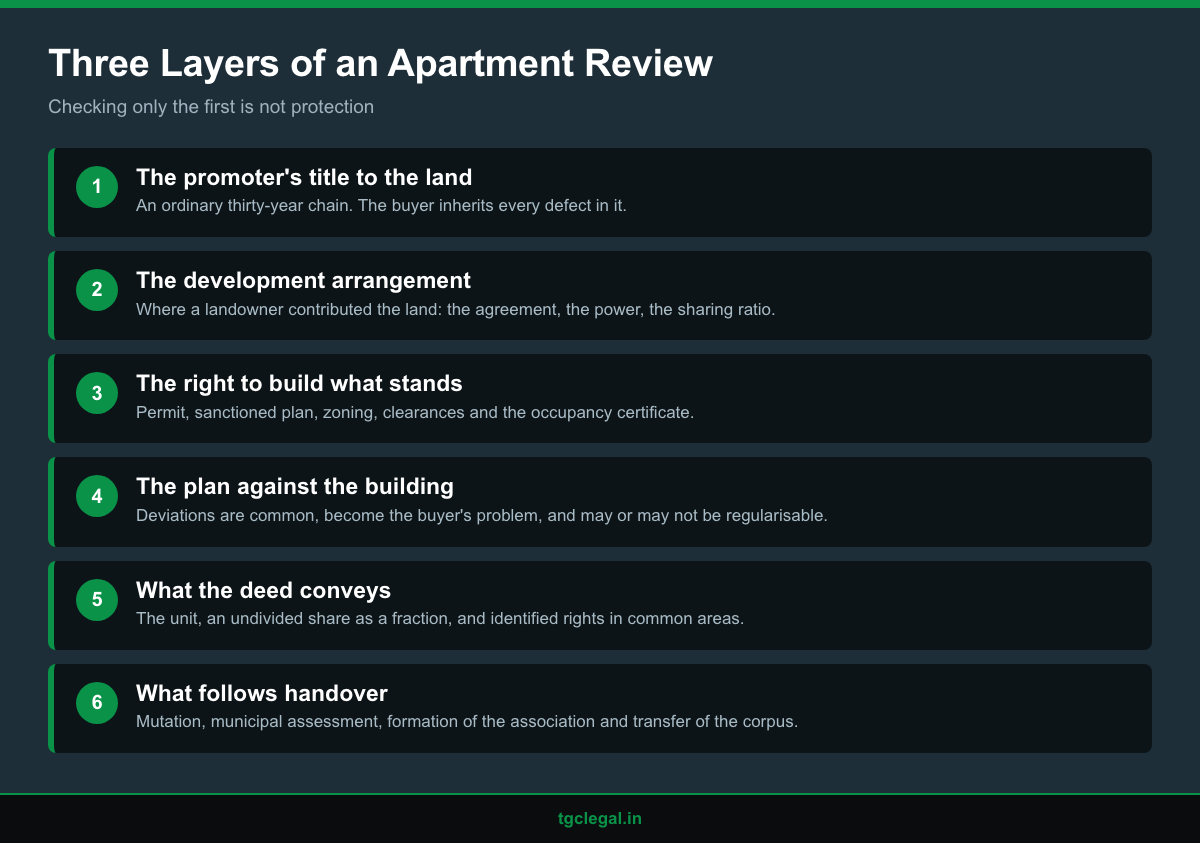
An apartment review has to establish three separate things, and a buyer who checks only the first is not protected.
The first layer is the promoter's title to the land on which the building stands. That is an ordinary thirty-year chain examination, and the buyer inherits every defect in it. A promoter who acquired the parcel under a joint development arrangement with a landowner has a further layer again: the development agreement, the power of attorney granted under it, and the sharing arrangement between promoter and landowner.
The second layer is the right to build what was built. That means the building permit, the sanctioned plan, the land use and zoning position, environmental and coastal clearances where applicable, and the occupancy certificate. The single most useful thing an apartment buyer can do is compare the sanctioned plan with what is physically standing.
The third layer is what the buyer is actually acquiring: an identified apartment, an undivided share in the land, and rights in the common areas and facilities. The deed should describe all three, and the undivided share should be stated as a specific fraction rather than left to inference.
A matter on ownership conflict in a Kochi apartment block shows what happens when the third layer is left vague.
The Undivided Share Nobody Reads
Every apartment carries an undivided proportionate share in the land beneath the building. It is not a formality. It is what the owner actually holds in the land, and it governs what they receive if the building is redeveloped, demolished or acquired.
Three problems recur. The share is not stated at all, and the deed conveys the apartment without specifying the fraction. The shares across the building do not add up to the whole, either because the promoter retained a portion or because the arithmetic was never done. Or the share stated does not correspond to the apartment's area relative to the total built area, which is the ordinary basis for calculating it.
The consequence surfaces decades later, usually at the point of redevelopment, when the value each owner receives is calculated on the undivided share. An owner whose deed understates it is arguing about arithmetic that was settled by a document they signed without reading.
The check is simple: the deed should state the fraction, the promoter should be able to show how it was calculated, and the total across all apartments should account for the whole parcel with nothing unexplained left over.
The Regulator, and What Registration Actually Tells You
A real estate project above the notified size must be registered with the state regulator before it is marketed. For a buyer, the registration is useful for a reason that has little to do with compliance: the promoter has to file declarations about title, about encumbrances on the land, about approvals obtained and about the completion date.
Those declarations are made by the promoter, on the record, in advance. Comparing them with what the promoter's sales team is saying is a five-minute exercise that regularly changes a buyer's mind, and a discrepancy between the two is more informative than either taken alone.
Registration also fixes the project's declared timeline and the carpet area basis on which the apartment is sold, which is the ground on which most later disputes about delay and area are argued.
What registration does not do is verify the promoter's title. The regulator records what the promoter declares. The buyer still has to examine the chain.
Joint Development, and the Landowner Nobody Meets
A large share of apartment projects in Kerala are built on land the promoter does not own outright. The landowner contributes the parcel, the promoter builds, and the completed units are divided between them under a development agreement. The buyer usually never meets the landowner and often does not know they exist.
That structure produces its own questions. Which party is selling this particular apartment, and does that party hold it under the sharing arrangement? Where the promoter is selling a unit that falls in the landowner's share, or the reverse, the conveyance needs the right executant or a valid power of attorney from them.
The development agreement itself should be examined, not merely noted. It sets out the sharing ratio, the timeline, what happens on default, and whether the landowner retained any consent right over sales. Where it was registered, it will appear on the encumbrance certificate for the parcel. Where it was not, it may not appear anywhere.
The power of attorney granted by the landowner to the promoter is the other document to read. Its scope decides whether the promoter can convey at all, and powers granted for development purposes are sometimes narrower than the promoter's sales documentation assumes. A power that has been revoked, or whose principal has died, conveys nothing.
None of this makes joint development a problem. It makes it a structure that has to be understood before a buyer signs, and the questions are simple enough to ask at the sales office. A promoter who cannot answer them is telling you something.
Two Documents, Two Different Risks
The practical difference between the two exercises is where the residual risk sits after the review is complete.
On a plot, the residual risk is historical. Something in the chain, a partition, a power, an omitted heir, may be defective in a way the documents do not disclose. That risk is reduced by a longer search, local enquiry and a public notice, and it does not usually grow after completion.
On an apartment, a significant part of the risk is prospective. The building may not be completed. Common areas may not be handed over. The association may not be formed. The promoter may retain unsold units and with them a controlling voice. Deviations from the sanctioned plan may be regularised, or may not. These are risks about future conduct, and they are managed through the agreement for sale and the payment schedule rather than through the title search.
That is why an apartment buyer should stage payments against construction milestones and against delivery of specified documents, and should resist a schedule that front-loads payment against dates rather than against progress. Our note on the clauses that keep a commercial purchase out of court makes the same argument for commercial premises.
Conclusion
The difference between the two reviews is not depth but shape. A plot is one chain read carefully, with classification and access as the local traps. An apartment is a promoter's chain, a set of approvals and a sharing structure, with the undivided share and the deviation from the sanctioned plan as the traps that surface later.
A buyer who understands which exercise they are commissioning will ask better questions of it. The title verification practice page sets out how each is normally scoped.
Frequently Asked Questions
Is reviewing an apartment simpler than reviewing a plot?

Do we inherit the promoter's title problems?
What is the undivided share and why does it matter?
Does project registration with the regulator confirm clear title?
What is the most important land-specific check in Kerala?
How important is recorded access to a plot?
Should we compare the sanctioned plan with what is built?
How should payment be staged on an apartment purchase?
What happens if the promoter retains unsold units?
Which risk is larger, a plot or an apartment?