Post
POSH Internal Committee Calendar: Training, Records and Reporting
 General
Most employers treat workplace harassment law as something that happens only when a complaint arrives, but the Act also imposes a steady set of routine duties that run through the whole year. A posh compliance lawyer will usually start a review not with the policy document but with a simple question: what did the organisation actually do, and record, in each month of the last calendar year? The Sexual Harassment of Women at Workplace (Prevention, Prohibition and Redressal) Act 2013 and the 2013 Rules expect training, display, record keeping and reporting to happen on a cycle, and gaps in that cycle tend to surface at the worst possible moment.
This article sets out those recurring obligations as a working calendar that a Kochi employer, or any employer in Kerala, can adapt to its own year. For the complaint stage itself, our note on what employers must know about POSH complaints covers the inquiry process.
Key Takeaways
- The Act places continuing duties on employers, not only duties that arise when a complaint is filed.
- Members of the Internal Committee hold office for a period not exceeding three years, so tenure must be tracked and renewed.
- Awareness programmes for employees and orientation for Internal Committee members are separate obligations and should be recorded separately.
- The Internal Committee must prepare an annual report for each calendar year, which the employer forwards to the District Officer.
- Companies must also disclose POSH information in the Board's report, so the POSH year and the financial year need to be reconciled.
Why a Calendar Approach Works for POSH Compliance
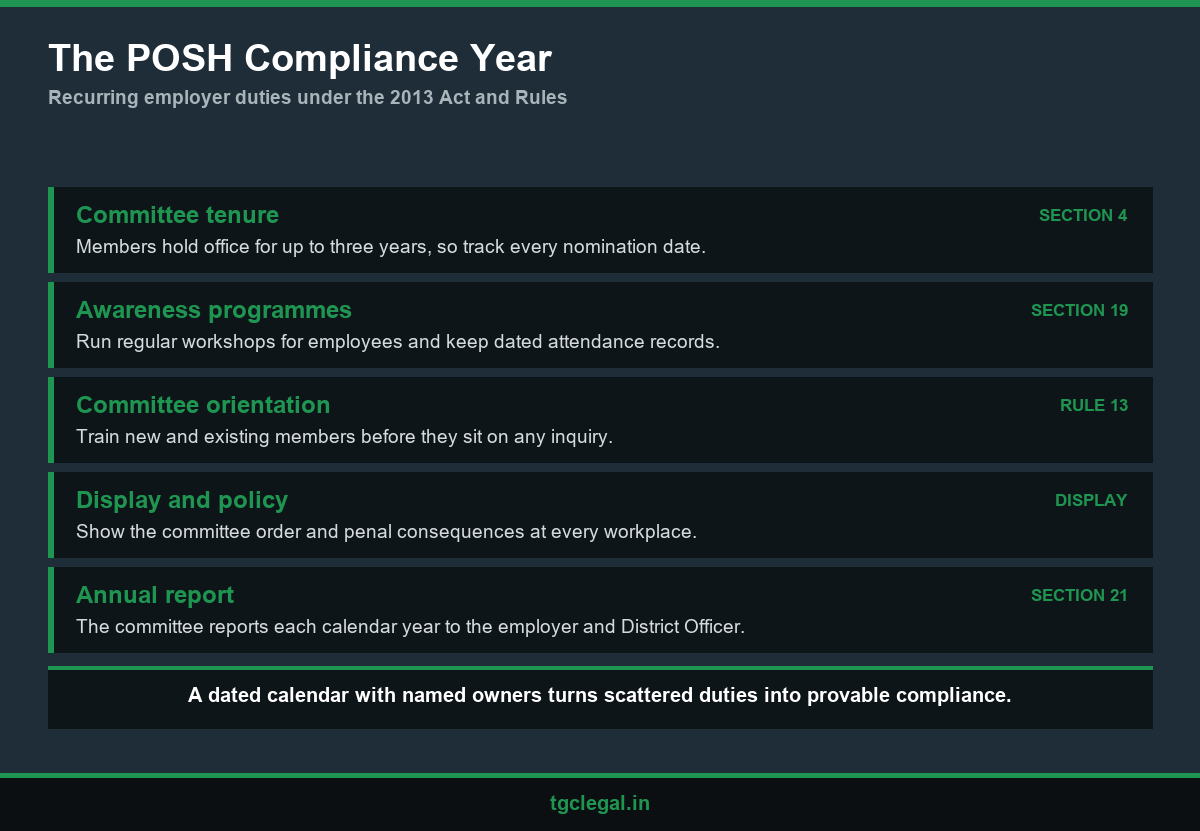
The 2013 Act on sexual harassment at the workplace is short, but its duties are spread across several sections and the Rules. Section 4 deals with constituting the Internal Committee, section 19 lists the duties of the employer, section 21 requires the annual report, and section 22 deals with the employer's own reporting. Rule 13 adds further detail on policy, orientation and capacity building. Read together, they describe an ongoing programme rather than a single event.
A calendar turns that programme into dates and owners. When each duty has a month attached to it and a named person responsible, the organisation can show what it did and when. That evidence matters because an inspection, a complaint, or a dispute about the fairness of an inquiry will often turn on whether the employer can produce dated records rather than general assurances.
It also helps where POSH sits partly with HR, partly with the secretarial team and partly with management, because a shared calendar removes the assumption that someone else has handled a filing.
Employers with ten or more employees must constitute an Internal Committee under section 4 at each office or administrative unit. Smaller workplaces fall under the Local Committee framework, but they still benefit from keeping a written policy and records.
Constituting and Reconstituting the Internal Committee
The composition of the Internal Committee is fixed by section 4. The Presiding Officer must be a woman employed at a senior level in the workplace. There must be at least two members from among the employees, preferably people committed to the cause of women or with experience in social work or legal knowledge. There must also be one external member drawn from a non governmental organisation or association committed to the cause of women, or a person familiar with issues relating to sexual harassment. At least one half of the members nominated must be women.
Each member holds office for a period not exceeding three years from the date of nomination. This is the detail most often missed. A committee constituted at incorporation can quietly lapse, and any inquiry conducted by a committee whose term has expired invites a challenge to its validity. The calendar should therefore carry the nomination date and expiry date of every member.
Reconstitution is also needed when a member leaves the organisation, is transferred, or becomes disqualified. Section 4 provides for removal of a member who breaches confidentiality, is convicted of an offence, has a disciplinary proceeding pending, or has abused the position. The vacancy must be filled by a fresh nomination, and the order constituting the committee should be updated and displayed again.
The external member is entitled to fees or allowances for holding proceedings, as the Rules prescribe. Employers should record the engagement terms in writing, including confidentiality and conflict of interest undertakings.
Awareness Programmes and Training for the Committee
Section 19 requires the employer to organise workshops and awareness programmes at regular intervals for sensitising employees, and orientation programmes for members of the Internal Committee in the manner prescribed. Rule 13 adds capacity building and skill building programmes for committee members. These are two distinct strands of POSH training for employers, and records should be kept for each.
Employee awareness sessions should cover what conduct falls within the Act, how and to whom a complaint can be made, the timelines involved, and the protection against retaliation. A session at induction, followed by an annual refresher, is a common pattern. Attendance sheets or learning platform logs should be retained, because the annual report asks for the number of programmes conducted.
Committee training is different in content. Members need to understand how to receive a complaint, attempt conciliation where the complainant requests it, conduct an inquiry consistent with natural justice, record evidence, and write a reasoned report. New members should complete orientation before they sit on an inquiry, which makes the timing of reconstitution and training closely linked.
Our earlier guide on POSH policy and training for Indian and global companies discusses session design. In the calendar, both strands should appear as dated entries with a named owner.
Displaying the Policy and Keeping Confidential Records
Section 19 requires the employer to display, at a conspicuous place in the workplace, the penal consequences of sexual harassment and the order constituting the Internal Committee. Rule 13 requires the employer to formulate and widely disseminate an internal policy and to declare the names and contact details of committee members. In practice, this means notices at each office, a page on the intranet, and a copy in the employee handbook.
The display obligation is not a one time task. Whenever the committee is reconstituted, contact details change, or the policy is revised, the notices must be updated. A quarterly walk through of each location, with a photograph of the notice on file, is a simple way to evidence compliance across branches.
Confidentiality is governed by section 16. The contents of the complaint, the identity of the parties and witnesses, the inquiry proceedings, the recommendations and the action taken must not be published or made known to the public or the media. The Act allows information about the justice secured to be shared without disclosing names or identifying particulars.
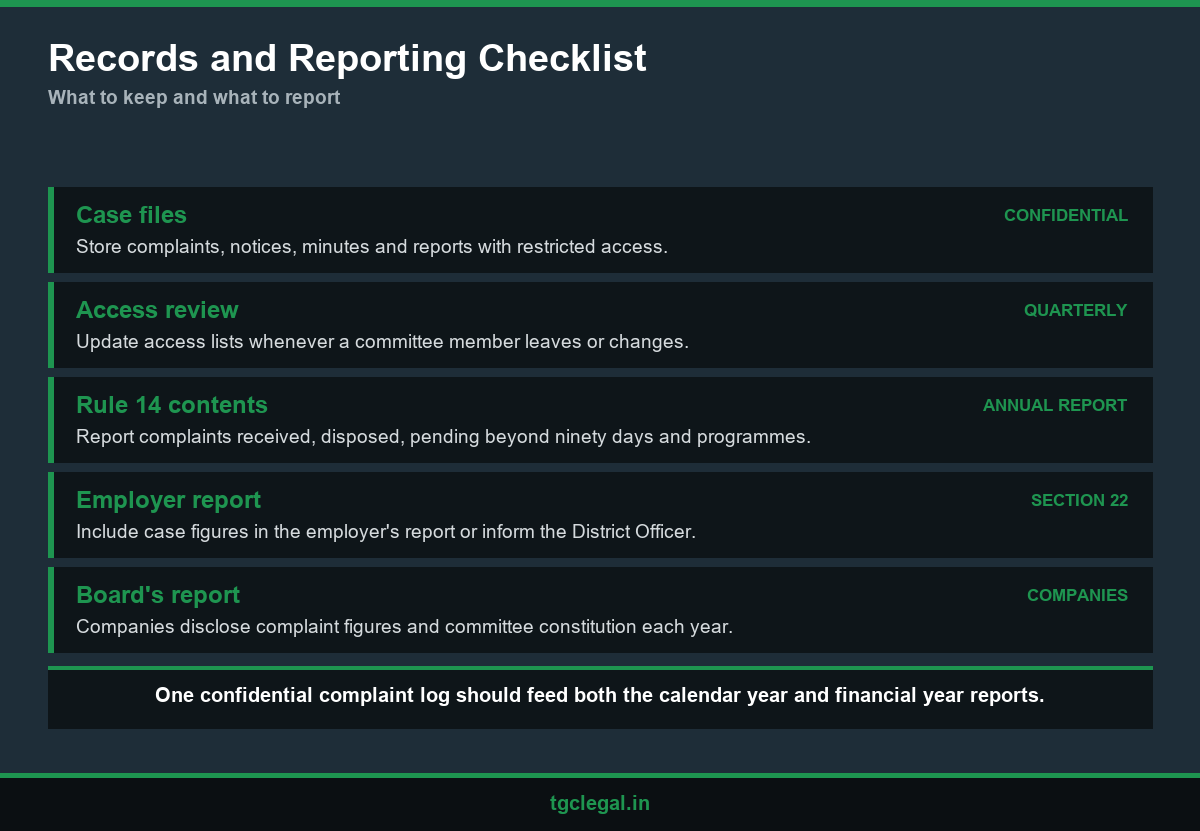
Case files therefore need controlled storage. A sealed physical file or a restricted digital folder, with access limited to committee members and a designated officer, is the usual arrangement. The calendar should include a periodic check that access lists are current, especially after a member leaves.
- Complaint, written statements and documents produced by the parties
- Notices issued, minutes of hearings and witness records
- Inquiry report, recommendations and the employer's action taken
The Annual Report and the Board's Report
Section 21 requires the Internal Committee, in each calendar year, to prepare an annual report and submit it to the employer and the District Officer. Rule 14 prescribes the contents: the number of complaints received during the year, the number disposed of, the number pending for more than ninety days, the number of workshops or awareness programmes carried out, and the nature of action taken. The POSH annual report should be prepared even where no complaint was received, since the training figures still need to be reported.
Section 22 adds a separate duty on the employer to include in its own annual report the number of cases filed and their disposal, or, where it is not required to prepare an annual report, to intimate the District Officer. Filing practice varies between districts, so confirm the current procedure with the District Officer for Ernakulam or the relevant district.
Companies have an additional layer. Rule 8(5)(x) of the Companies (Accounts) Rules 2014 requires the Board's report to include a statement on POSH compliance. Following the Companies (Accounts) Second Amendment Rules 2025, that disclosure now covers the number of complaints received, disposed of and pending beyond ninety days, alongside a statement on constitution of the Internal Committee, subject to the exemptions the Rules carve out.
Because the POSH report runs on a calendar year and the Board's report on a financial year, the figures will not match automatically. A confidential monthly complaint log allows both reports to be drawn from the same source and checked before the Board approves its report.
A Month by Month Calendar for Employers
The obligations above can be arranged into a simple cycle. The months below follow the calendar year used for the POSH annual report, and can be shifted to suit an organisation's own planning cycle.
- January: finalise the annual report for the previous calendar year and file it as the district procedure requires.
- April: review committee tenure, open the financial year complaint log, and refresh notices at every location.
- July: deliver mid year awareness sessions and confirm induction coverage for new joiners.
- September: run capacity building for committee members and review the policy against any legal changes.
- December: compile training and complaint figures, and check access to confidential case files.
Some events trigger action whatever the month: a member resigning, a new office opening, an acquisition, or a change in the law. Each may require a fresh nomination, new notices or further training.
The policy itself deserves an annual review, since changes in structure, hybrid working and contractor or intern populations affect who it reaches. A short review note approved by management shows the policy was considered rather than carried forward. For how timelines operate once a complaint is under way, see a matter involving an inquiry timeline at a Kerala IT company.
Conclusion
The Act rewards employers that treat compliance as a routine rather than a reaction. A calendar that tracks committee tenure, training, display, confidential records and the two reporting streams gives an organisation dated evidence of what it has done, and makes gaps visible before they become problems.
Every workplace is organised differently, so the calendar above is a starting point rather than a finished programme. A review of your committee order, policy and records against the Act and Rules will show where adjustments are needed, and you can read more about how we assist employers on our POSH advisory practice page.
Frequently Asked Questions
Who must constitute an Internal Committee under the POSH Act?

How long can Internal Committee members hold office?
What must the POSH annual report contain?
Is an annual report needed if no complaint was received?
What must companies disclose in the Board's report?
How often should POSH training be conducted?