Post
Registry Charges in Kerala: How Stamp Duty, the Registration Fee and Undervaluation Notices Are Calculated
 General
Buyers budget for the price and are surprised by the rest. On an ordinary sale of immovable property in Kerala the charges at the sub registrar's office add roughly a tenth to the cost of the transaction, and they are calculated on a base that the parties do not entirely control.
This note sets out how the two charges work, what the fair value system does to the base, when a transaction attracts a reference to the Collector, and what a buyer can do about a demand that arrives months after possession. It sits under our guide to verifying title and completing a purchase in Kerala.
Key Takeaways
- Two separate charges arise: stamp duty under the state stamp legislation, and a registration fee under the registration legislation. They are calculated on the same base but are not the same thing.
- For an ordinary conveyance the working figures are eight per cent duty and a two per cent fee, so about ten per cent of value on top of the price.
- The base is the higher of the consideration stated and the fair value notified for that locality and classification, so declaring less than fair value saves nothing.
- Where the registering officer believes the value is understated, the matter can be referred to the Collector, and the outcome is a demand for differential duty with interest.
- Concessional rates apply to settlement and gift within a defined class of relatives, and to certain other instruments. They are the exception, not the rule.
Two Charges, Not One
Stamp duty is a tax on the instrument. It is levied under the state stamp legislation, it attaches to the document rather than to the transaction, and an instrument that is insufficiently stamped is not admissible in evidence until the deficiency and a penalty are paid. That consequence is the reason duty matters long after the purchase: a deed that was under-stamped in 1998 becomes a problem the first time somebody needs to produce it.
The registration fee is different in character. It is charged for the service of registering the document under the registration legislation, and it is collected at the same counter, which is why the two are usually quoted together as a single percentage.
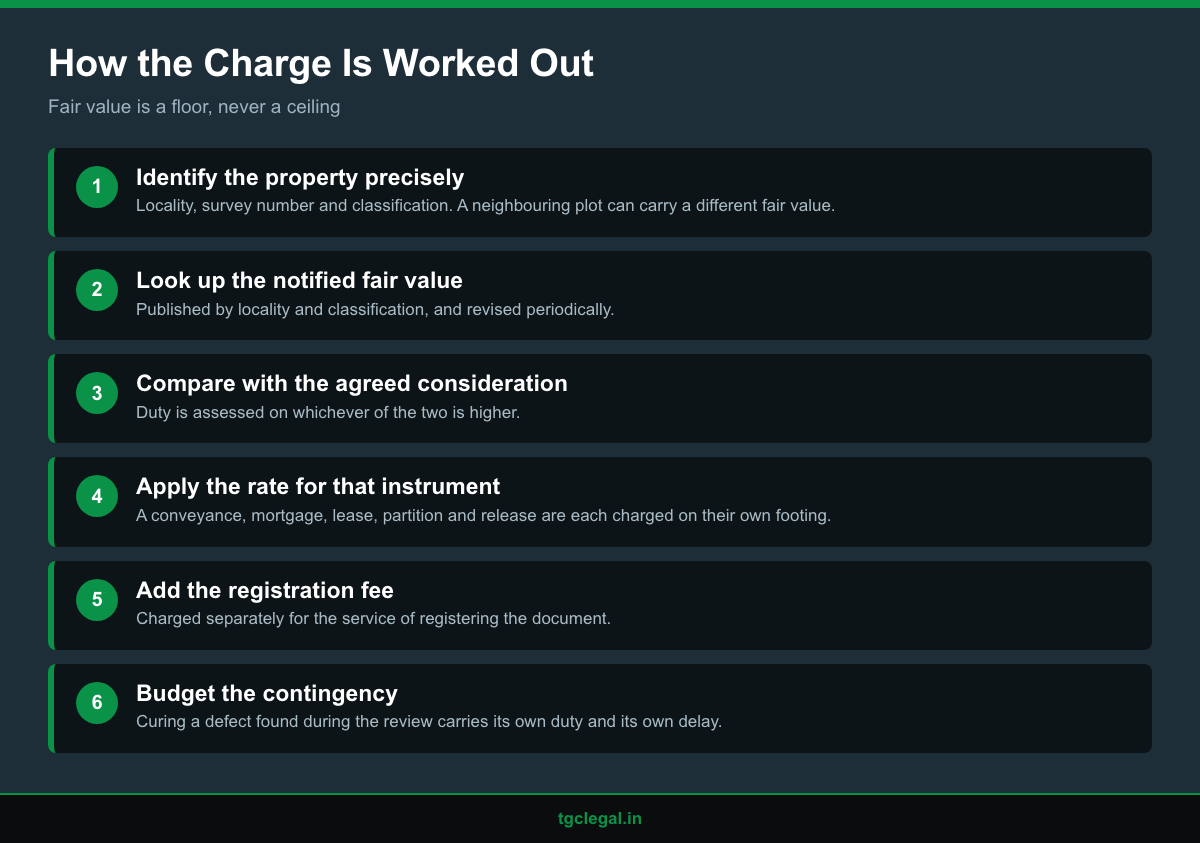
For an ordinary sale of immovable property in Kerala the position is eight per cent duty and a two per cent registration fee. A buyer paying fifty lakh rupees for a plot should therefore budget about five lakh rupees for the registry, before legal costs and incidental charges.
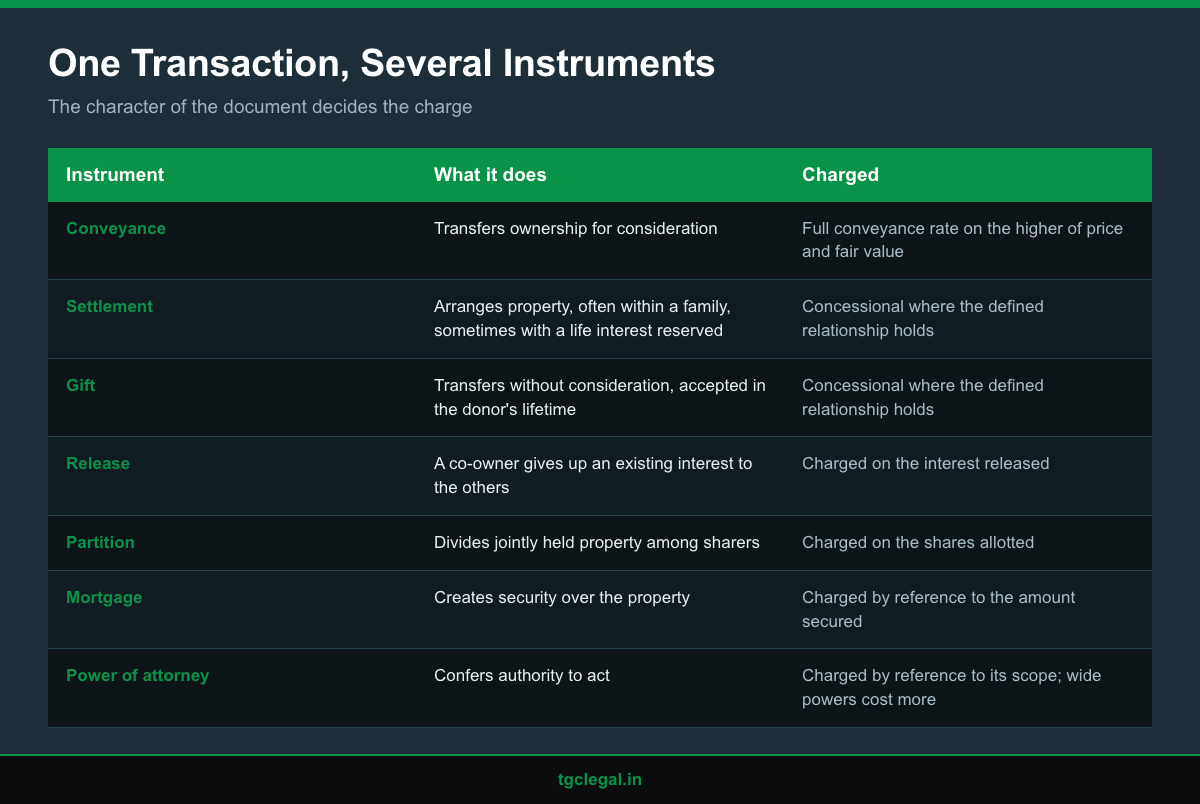
Rates and the instruments they attach to are revised, and different instruments attract different treatment. A mortgage, a lease, a partition, a release and a power of attorney are each charged on their own footing, and the difference between them is frequently the difference between a modest charge and a substantial one. Getting the character of the instrument right is therefore part of the drafting, not an afterthought at the counter.
Fair Value: The Base Nobody Negotiates
Kerala operates a fair value system. The government notifies a fair value for land by locality, by classification and by category of access, and the registering officer charges duty on the higher of the consideration stated in the instrument and the fair value applicable to the property.
The consequence is straightforward and still surprises people every week. A buyer who agrees a price below the notified fair value does not pay duty on the price. They pay duty on the fair value, and they have created a document in which the recited consideration does not match the value on which duty was assessed.
The opposite case is more common than it sounds. Where the market price is well above fair value, duty is charged on the price, because the higher figure governs. Fair value is a floor, not a ceiling, and it does not cap the buyer's exposure.
Fair value tables are revised periodically and are published by locality. A buyer should check the applicable figure for the specific survey number and classification before agreeing a price, because a classification difference between adjoining plots can move the base materially. The state registration department portal is the reference point for the current tables.
How an Undervaluation Notice Arises
Where the registering officer has reason to believe that the value set out in an instrument is below the true market value, the instrument can be referred to the Collector for determination of value. The document is registered, the buyer takes possession, and the reference proceeds separately.
That timing is what makes the process awkward. The notice arrives months later, addressed to a buyer who has already paid the price, paid the duty, moved in and stopped thinking about the transaction. There is a hearing, valuation evidence is considered, and if the Collector determines a higher value the buyer is liable for the differential duty, usually with interest and sometimes with a penalty.
Triggers are reasonably predictable. A consideration materially below the fair value for the locality. A property described in a way that attracts a lower classification than its actual use. A conveyance of built property recorded as bare land. A sale between related parties at a figure that does not resemble any market. A series of transactions in the same locality at inconsistent values.
Defending a reference is a valuation exercise rather than a legal argument. The material that helps is contemporaneous: the agreement for sale, the payment trail, photographs and a description of the actual condition of the property on the date of the deed, comparable transactions in the same locality, and any factor that genuinely depresses value such as access, litigation or a use restriction. A matter on a company's dispute over what it owed at the sub registry illustrates how those references are run.
The point worth internalising is that the process cannot be avoided by silence. A buyer who ignores the notice is assessed anyway.
Where Concessional Treatment Applies
Not every instrument is charged at conveyance rates. Kerala provides concessional treatment for certain family transactions, notably settlement and gift between defined relatives, and for some other categories of instrument.
The concession is conditional on the relationship, and the relationship must appear on the face of the instrument and be capable of proof. A settlement described as being in favour of a relative who does not fall within the defined class attracts ordinary rates, and the deficiency surfaces at assessment rather than at drafting.
There is a second condition that is easy to miss. A concessional instrument is often subject to a clawback if the property is dealt with in a particular way within a stated period, or if the recited relationship turns out not to hold. Buyers acquiring from someone who received the property under a concessional settlement should therefore check the terms on which that earlier instrument was charged.
Our separate note on what a family gift costs when it is made between relatives in Kerala covers the mechanics of deed registration that these instruments sit within.
Insufficient Stamping in the Chain
The most expensive stamp problem in a purchase is usually not the buyer's own instrument. It is an earlier one.
Where a deed somewhere in the thirty-year chain was insufficiently stamped, the deficiency does not lapse. It travels with the document, and it becomes live the moment the document has to be produced in evidence, which is precisely when the buyer is trying to prove title. The deficiency and the penalty then have to be paid before the document can be admitted.
This is why a title review reads the chain for stamping as well as for substance. An instrument charged as a release when it operated as a conveyance, a partition that distributed unequal shares without accounting for the difference, or a settlement charged concessionally where the relationship did not qualify, are all defects that were invisible at the time and are recoverable against whoever needs the document later.
Where such a defect is found before completion, it is a negotiating point: the cure is an application to have the instrument adjudicated and the deficiency paid, and it should happen at the seller's cost with part of the price retained until it is done.
Budgeting the Whole Cost
A realistic budget for an ordinary Kerala purchase contains more than duty and fee. There is the cost of obtaining the encumbrance certificate for the full period and the certified copies of the earlier deeds. There is the cost of the title review itself. There is the mutation application afterwards and the land tax that follows it. Where the property is built, there is building tax and the local body's own charges.
Then there is the contingency that most buyers do not carry: the cost of curing a defect found during the review. A rectification deed carries its own duty. A correction to a revenue entry that has been wrong for a generation takes time and follow-up. A missing consent from an heir may need to be purchased.
Setting aside a modest contingency against those items is the difference between a defect being fixed before completion and being carried into ownership because the money had already gone. Buyers who plan for stamp duty and registration fees alone are budgeting for the counter, not for the purchase.
Conclusion
The charges themselves are simple arithmetic once the base is settled, and the base is set by the fair value notification rather than by the parties. Everything that goes wrong in this area comes from one of three places: an instrument charged in the wrong character, a consideration that does not match the value the state will assess, or a deficiency inherited from an earlier deed in the chain.
All three are visible before completion to anyone who looks. The title verification practice page sets out how that review is normally scoped.
Frequently Asked Questions
What do stamp duty and registration fees come to on a sale in Kerala?

Is duty charged on the price or on the government value?
Can we declare a lower price to reduce the charge?
What happens after an undervaluation reference is made?
What evidence helps in defending a valuation reference?
Do family transfers attract the same rates?
Does an old under-stamped deed in the chain affect us?
Is the registration fee refundable if the transaction falls through?
Do different instruments attract different duty?
What should be budgeted beyond duty and fees?