Post
Seat vs Venue: Choosing an Arbitration Forum in India
 General
Few drafting errors cost as much as confusing the seat of an arbitration with its venue. The two words look interchangeable and are not. An international arbitration lawyer will treat the seat as the single most consequential choice in the clause, because it decides which country's courts control the arbitration. This article explains what each term does, how clauses go wrong in India, UAE and USA contracts, and how to settle all three choices before signing.
Key Takeaways
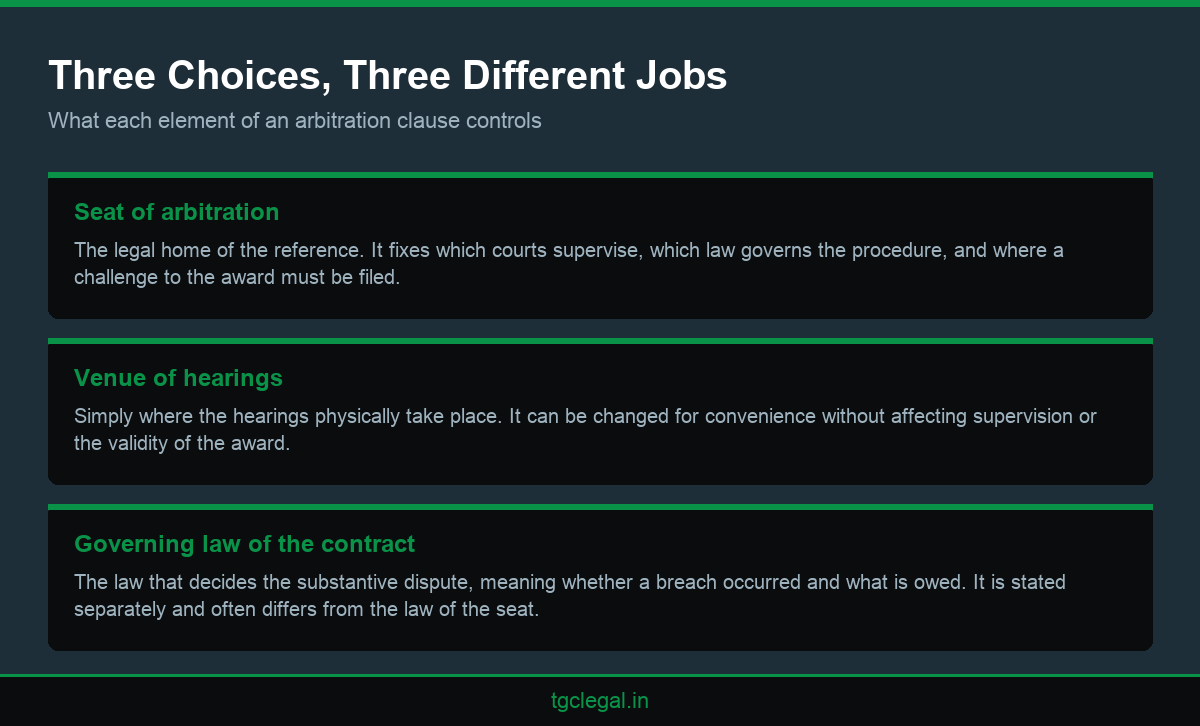
- The seat decides which courts supervise the arbitration and where a challenge to the award must be filed. It is a legal designation, not a geographic convenience.
- The venue is only where hearings happen. Moving hearings to another city or holding them online does not change the seat.
- The governing law of the contract is a third and separate choice. A contract can be governed by Indian law and seated abroad, and each choice does different work.
What the Seat Actually Decides
The seat is the legal home of an arbitration. Designating a seat attaches the reference to the arbitration law of that place and to the supervisory jurisdiction of its courts. That single choice determines a series of practical outcomes that parties rarely consider at the drafting stage.
Those outcomes include which court hears an application to appoint an arbitrator when the parties deadlock, which court can grant interim relief before a tribunal exists, which court decides a challenge to the award, and which national law fills any procedural gaps the parties left open. A reference seated in India is supervised by Indian courts under Part I of the Arbitration and Conciliation Act. A reference seated in Singapore is not, regardless of where the parties are based.
It also decides the nationality of the award for enforcement purposes. An award made in a reference seated abroad is a foreign award in India and is enforced through the recognition route rather than as a domestic decree. Our note on how jurisdiction affects clause enforceability covers the consequences that follow from this classification.
One further consequence deserves attention. The seat can determine whether a party is able to obtain interim protection at all in the crucial early period. Where an Indian company contracts with a foreign supplier and the seat is abroad, an urgent application to preserve assets may have to be made in a foreign court, in a foreign language, through foreign counsel, at foreign rates. Businesses that would realistically be the claimant in any dispute should weigh that reality heavily when they agree the seat.
Why the Venue Is Not the Same Thing
The venue is where hearings physically take place. It is an administrative convenience. Parties seated in India routinely hold hearings in whichever city suits counsel, witnesses and the tribunal, and increasingly hold them online. None of that alters the seat.
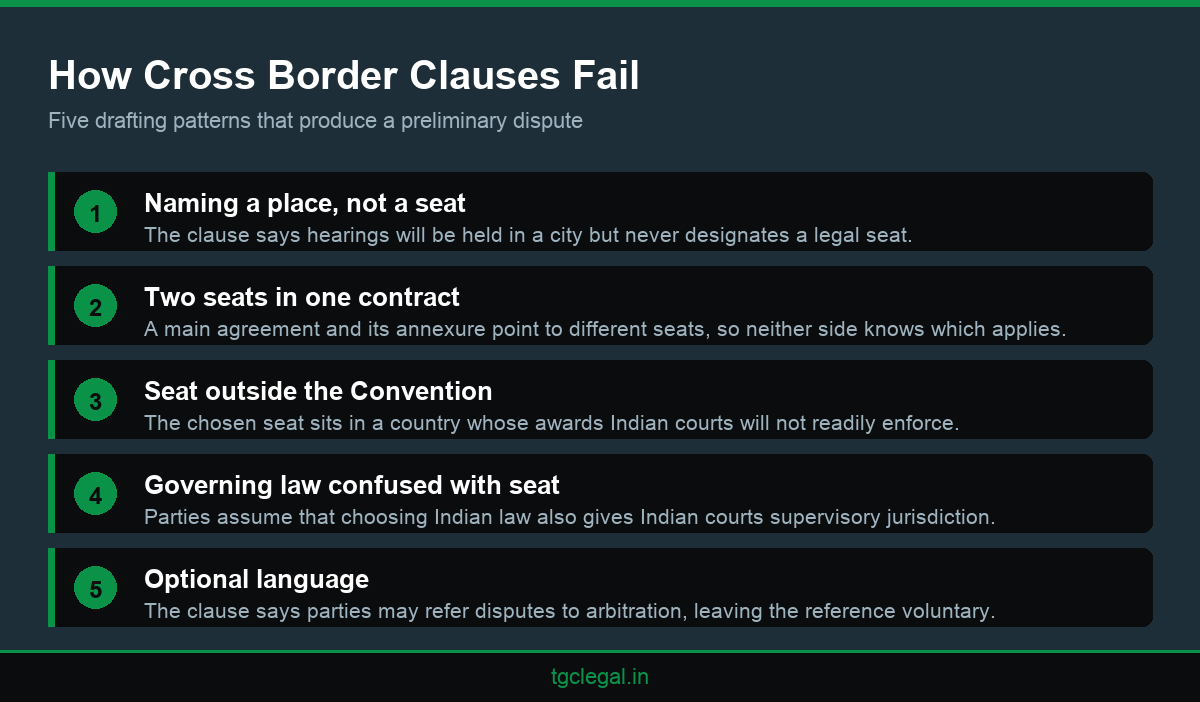
Confusion arises because contracts frequently say only that arbitration shall be held in a named city. Courts must then decide whether that wording designates a seat or merely a venue. The answer turns on the rest of the clause: whether a supervisory jurisdiction is named elsewhere, whether institutional rules are chosen, and whether any other indication of intention exists. That enquiry costs the parties months before anyone reaches the substance of the dispute.
The fix is a single sentence. State that the seat of arbitration shall be a named city, and separately state that hearings may be held at any convenient location or by video conference without affecting the seat. That wording removes the argument entirely and costs nothing at the drafting stage.
Governing Law Is a Third, Separate Choice
A commercial contract can involve three different legal systems at once. The governing law decides the substantive dispute: whether the supplier breached, what the clause means, what damages follow. The law of the seat governs the procedure of the arbitration. A third law, the law governing the arbitration agreement itself, decides whether the clause is valid, although in practice parties rarely specify it separately.
Parties commonly assume that choosing Indian governing law gives Indian courts supervisory control. It does not. A contract governed by Indian law but seated in Dubai is supervised by the courts of the seat, and an Indian party needing urgent relief may find its local court unwilling to intervene. The mistake usually surfaces at the worst moment, when something urgent is required.
For businesses in Kerala trading with the Gulf and North America, the sensible practice is to state all three choices expressly in the clause rather than leaving two of them to inference. Our note on how a technology lawyer safeguards a business worldwide looks at the same question from a cross border contracting perspective.
How Clauses Go Wrong in India, UAE and USA Contracts
The most damaging error is choosing a seat without checking enforcement. India enforces foreign awards made in territories notified as reciprocating under the New York Convention framework. Seating an arbitration outside that framework can leave a party holding an award that is difficult to execute against Indian assets, which defeats the purpose of arbitrating at all.
A second pattern appears in layered transactions. A master agreement names one seat, an annexure or a local implementation agreement names another, and a purchase order incorporates standard terms naming a third. When a dispute crosses those documents, the parties argue about which clause governs before they argue about anything else. Drafting the family of documents together avoids it.
A third pattern is optional wording. A clause saying parties may refer disputes to arbitration creates no obligation, so a respondent can simply decline and insist on court. Arbitration clauses need mandatory language. Our note on key clauses in a corporate arbitration agreement sets out the components that make a clause operable, and our case study on a Kerala logistics acquisition in Europe shows a cross border structure in practice.
Settling the Three Choices Before You Sign
The choices should follow the commercial reality of the deal rather than a template. Where the assets that would satisfy an award sit in India, an Indian seat usually makes enforcement simplest. Where the counterparty and its assets sit abroad, a neutral seat within the Convention framework may serve better even though it costs more to run.
Practical considerations matter too. A seat whose courts handle arbitration applications promptly is worth more than a seat with an attractive reputation and a congested docket. Language, travel and the availability of arbitrators with relevant sector experience all affect the real cost of the reference.
Above all, the clause should be drafted for the dispute you would actually have, not for the deal you hope to sign. Ask which party is more likely to be the claimant, where the money would need to be recovered, and how urgent interim relief would be. Those three answers usually settle the seat. See our page on commercial suits and dispute resolution for how we approach these references.
A short drafting checklist covers most situations. Name the seat in its own sentence. State that hearings may be held elsewhere or remotely without changing the seat. State the governing law of the contract separately. Choose either institutional rules or a clearly described ad hoc procedure. Specify the number of arbitrators and the appointment mechanism. Fix the language. Six lines drafted properly at signature will save a preliminary skirmish that routinely consumes six months and a substantial share of the disputed amount.
Conclusion
Seat, venue and governing law are three separate decisions that a single sentence in a contract often blurs. The seat controls supervision and challenge, the venue controls nothing beyond convenience, and the governing law decides the merits. Stating all three expressly removes an entire category of preliminary dispute and costs nothing at the drafting stage. To see how these choices play out in cross border matters, explore our commercial dispute case studies.
Frequently Asked Questions
What is the difference between the seat and the venue of an arbitration?

Can hearings be held somewhere other than the seat?
Does choosing Indian governing law mean Indian courts supervise the arbitration?
Which seat should an Indian business choose?
What happens if the contract names no seat at all?
Can a contract have two different seats?
Is an award from any country enforceable in India?
Do institutional rules fix the seat automatically?
Should the arbitration agreement have its own governing law?
Where do these choices sit in a wider contract review?