Post
Stamp Duty on a Gift Deed Between Family Members in Kerala
 General
Transferring property within a family looks like the simplest transaction there is. There is no price to negotiate, no buyer to satisfy and usually no dispute. It is also the transaction where the wrong instrument is chosen most often, and the cost of that choice does not appear until years later.
This note covers the stamp duty on gift deed transfers within a family at a Kerala sub registry, who falls inside the concessional class, how a gift differs from a settlement and from a release, and the conditions that can take the concession away after the deed is registered.
Key Takeaways
- A gift is a transfer without consideration, and it is only complete when it is accepted by the donee during the donor's lifetime.
- Kerala charges gifts and settlements between defined relatives at concessional rates, well below the ordinary conveyance rate.
- The relationship must appear on the face of the instrument and be capable of proof. It is not enough that the parties know they are related.
- A settlement deed, a release deed and a gift deed do different things. Choosing by cost rather than by effect is how families end up litigating.
- Registration is compulsory for a gift of immovable property. An unregistered gift transfers nothing.
What a Gift Actually Is
A gift is the transfer of property made voluntarily and without consideration, by a donor to a donee, and accepted by or on behalf of the donee during the donor's lifetime and while the donor is still capable of giving. Each element of that sentence carries weight.
Voluntarily means the donor must be acting freely. Gifts within families are challenged on undue influence more often than any other instrument, particularly where an elderly donor transfers to one of several children, and the challenge is easier where the donor was dependent on the donee.
Without consideration means exactly that. Where a deed described as a gift in fact records some obligation on the donee, such as maintaining the donor or paying off a debt, it is not a pure gift and it may be charged and construed differently. Families frequently intend such a condition and leave it out of the document, which produces the worst of both outcomes: no enforceable obligation, and a possible argument that the deed was not what it said it was.
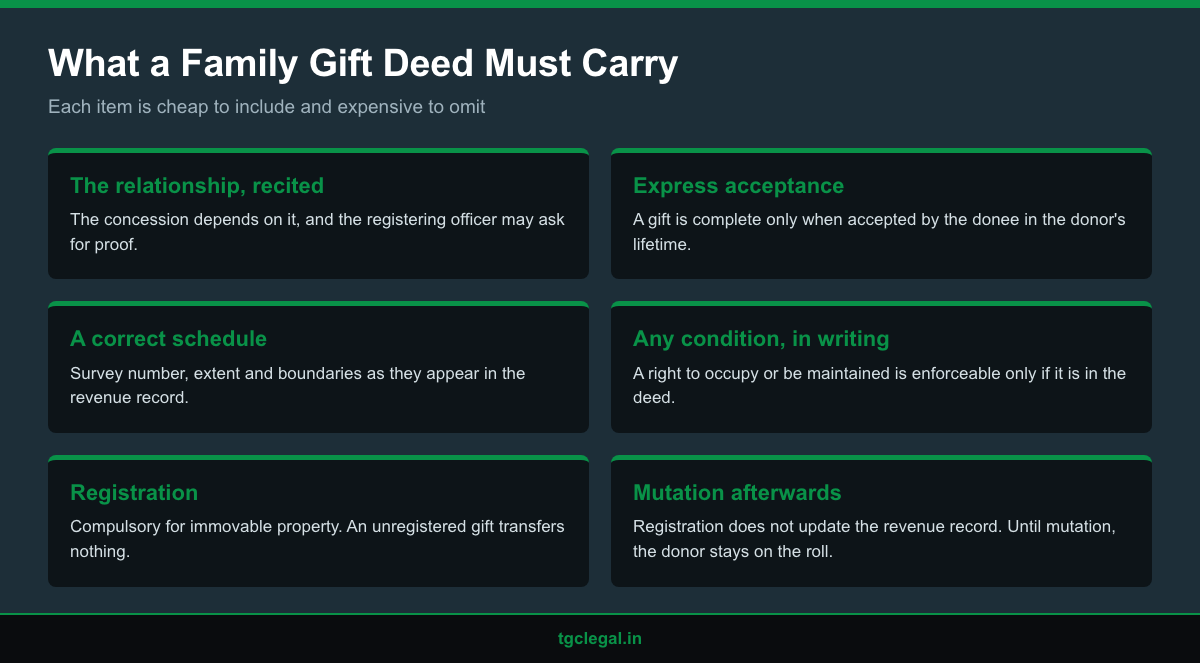
Accepted during the donor's lifetime means a gift that is executed but never delivered or accepted fails. Acceptance is usually evidenced by the donee joining in the deed, taking possession, or acting as owner.
For immovable property, registration is compulsory. An unregistered gift of land or a building does not transfer anything, however clear the family's understanding may be. Our note on how a deed secures ownership in Kerala covers the registration side.
The Concessional Rate, and Who Qualifies
The ordinary rate for a conveyance of immovable property in Kerala is eight per cent, with a two per cent registration fee, and the stamp duty on gift deed transfers is where families find the largest saving available to them. Gifts and settlements executed in favour of a defined class of relatives are charged at concessional rates that are a small fraction of that figure, and the difference on a property of any value is substantial.
The class is defined and is narrower than most families assume. It is built around close relations of the donor: spouse, children, parents, grandchildren and siblings, with the precise scope set by the notification in force. A transfer to a nephew, a daughter-in-law or a cousin may fall outside it depending on how the relationship is framed, and the assumption that any relative qualifies is the most common reason a concessional instrument is later assessed at ordinary rates.
Two drafting consequences follow. First, the relationship must be recited on the face of the deed and must be provable, because the registering officer is entitled to require evidence. Second, where the intended donee is outside the class, it is sometimes possible to achieve the same family outcome through a sequence of transfers each of which is within the class, though that requires care and creates its own duty at each step.
Rates and the defined class are revised from time to time. The state registration department portal carries the current position and should be checked before the deed is drafted rather than after.
Gift, Settlement or Release: Three Different Instruments
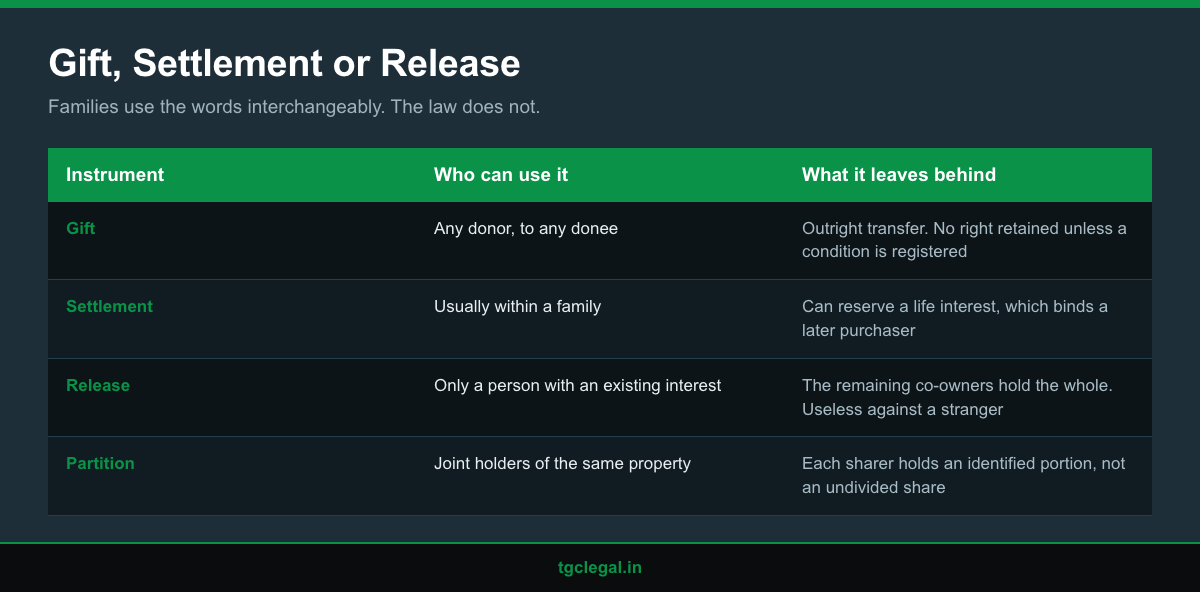
Families use these words interchangeably. The law does not.
A gift transfers ownership outright and immediately, without consideration, to someone who need not have any existing interest in the property.
A settlement is a disposition, usually within a family, that arranges property for the benefit of one or more persons, and it commonly carries conditions. The classic form reserves a life interest to the settlor, so the property passes but the settlor retains the right to live in it and take its income for life. That reservation is enforceable and it binds a later purchaser, which is why buyers must read settlements in the chain rather than skim them.
A release operates where the releasor already has an interest, typically as a co-owner or a sharer in a family property, and gives it up in favour of the other co-owners. It cannot be used to transfer to a stranger, because there is nothing to release.
Choosing the wrong one has consequences that outlast the saving. A release executed where a gift was intended may transfer nothing if the releasor had no existing interest. A gift used where a life interest was intended leaves the donor with no right to remain in the property. And an instrument charged in one character but operating in another attracts the difference in duty whenever it is produced in evidence. Our note on the errors in a revenue entry that follow a family transfer shows how those defects surface much later.
Conditions, Clawbacks and Revocation
A concessional instrument is not simply cheaper. It can carry conditions, and a family that treats the concession as a discount rather than as a bargain may lose it.
The usual condition relates to what happens to the property afterwards. Where a property received at concessional rates is dealt with in a particular way within a stated period, or where the recited relationship turns out not to hold, the differential duty can be recovered. A buyer acquiring from someone who received the property under a concessional settlement should therefore ask on what basis that earlier instrument was charged.
Revocation is the other area families get wrong. A completed gift cannot be revoked at will. It can be revoked only on grounds the law recognises, such as an agreement between the parties at the time of the gift that it would be revocable on a specified event which was not merely the donor's own pleasure, or on the ordinary grounds that would allow any transfer to be set aside, such as fraud or undue influence.
That matters because the commonest family scenario is a parent who transfers to a child and later regrets it. Without a condition built into the deed at the outset, there is usually no route back. Where the parent's real intention is to secure care and occupation for life, a settlement reserving a life interest, or a gift subject to an express and registered condition, does that job. A bare gift does not.
Where an elderly donor is transferring to one of several children, it is also worth documenting capacity and independence at the time, because the transfer is the one most likely to be challenged by the others after the donor's death.
The Tax Side Families Forget
Duty at the sub registry is not the only cost attached to a family transfer, and the others are easier to overlook because nobody collects them at the counter.
Income tax treats a gift of immovable property received without consideration as income in the hands of the recipient where its value exceeds the statutory threshold, unless the transfer falls within an exempt category. Transfers from a defined relative are exempt, which is why the same relationship question that governs the concessional duty also governs the tax position. Where the donee is outside the exempt class, a family transfer that cost very little at the registry can produce a tax liability that dwarfs the saving.
Capital gains follow their own logic. A gift is not a transfer that triggers gain in the donor's hands, but the donee inherits the donor's cost of acquisition and the donor's period of holding. That means the gain is not avoided, only deferred to whenever the donee sells, and the calculation reaches back to what the donor originally paid. Families who transfer property to a younger generation shortly before a sale sometimes discover that the structure achieved nothing.
Where the donor is resident abroad or the donee is, an additional layer of exchange control and reporting applies to acquisition and to any later repatriation of sale proceeds. That should be checked before the deed is drafted, not after the property is sold.
None of this argues against a family transfer. It argues for deciding the instrument, the timing and the recipient with the whole cost in view rather than the counter charge alone.
What the Registry Will Want to See
A family transfer is registered the same way any other deed is. The instrument is presented at the sub registrar's office having jurisdiction over the property, within the statutory period from execution, and the executants attend and admit execution.
The document should carry a correct and complete schedule identifying the property by survey number, extent and boundaries as they appear in the revenue record, a clear recital of the relationship relied on for the concession, an express statement of acceptance by the donee, and the correct description of the instrument's character.
The supporting papers are the parent deed by which the donor acquired the property, the current encumbrance certificate, the thandaper extract and land tax receipt showing the donor as the holder, and identity documents for both sides. Where the donor is abroad, the power of attorney used must be in acceptable form and must be subsisting, a point our note on the risks inside a power granted by an owner overseas develops.
Afterwards, the donee applies for mutation so the revenue record reflects the change, and pays land tax in their own name. A family transfer that is registered but never mutated leaves the donor on the roll and the donee holding a deed that is only half the picture.
Conclusion
The concession for family transfers in Kerala is real and worth having, but it rewards precision. Establish that the intended donee is inside the defined class, recite the relationship, choose the instrument by what it needs to do rather than by what it costs, put any intended condition into the deed, and complete the mutation afterwards.
Where the family's real intention includes care, occupation or a right to income, say so in the document. Almost every family dispute over a transfer of this kind begins with an understanding that everybody had and nobody wrote down.
Frequently Asked Questions
What does a gift between family members cost in Kerala?

Who counts as a relative for the concession?
Does a gift of land have to be registered?
Can a parent take back a property gifted to a child?
How do we transfer but keep the right to live in the property?
What is the difference between a gift and a release?
Can the concession be lost after registration?
What if the donor is living abroad?
Is mutation needed after a family transfer?
Can a gift within a family be challenged by other heirs?