Post
What a Property Legal Opinion Covers and How to Read One
 General
Buyers commission a title opinion, read the last paragraph, and file it. That last paragraph is the least informative part of the document. The value sits in the middle: what was examined, what was not produced, what could not be verified, and what has to happen before the balance of the price is released.
This note explains how such an opinion is put together, how to read the qualifications that carry the real risk allocation, and what to agree about scope before it is commissioned rather than after.
Key Takeaways
- An opinion is a report on documents examined, not a guarantee of ownership. India has no conclusive title system.
- The scope decides the product. An opinion on papers the seller chose to supply is a different exercise from one that includes registry, revenue and litigation searches.
- The qualifications section is where the risk sits. Read it first.
- A useful opinion ends in conditions, not conclusions: what the seller must do before completion, and what should be held back until they do.
- The opinion fixes the position in time, which matters if a defect surfaces later and the buyer needs a remedy.
What the Exercise Actually Is
A legal opinion on property is a written report by a lawyer setting out the result of an examination of the title to a specific property, for a specific purpose, on a specific date. Every one of those qualifiers matters.
Because Indian law does not operate a conclusive title system, no opinion can state that the seller owns the property as a matter of certainty. What it can do is trace how the property came to the seller, identify the instruments in that chain, test each for validity, stamping and registration, reconcile the registry record with the revenue record, and report what it found.
The purpose matters because a lender's opinion and a buyer's opinion answer different questions. A lender wants to know whether the property is good security and whether a charge can be created and enforced. A buyer wants to know whether they will own what they are paying for and whether they can use it as intended. Commissioning a lender-style opinion and reading it as a buyer's report is a common and expensive confusion.
The date matters because an opinion speaks as at the date of the searches. A certificate obtained six weeks before completion does not cover the six weeks. Where there is a gap, a fresh search on the day is the standard precaution.
What Is Examined
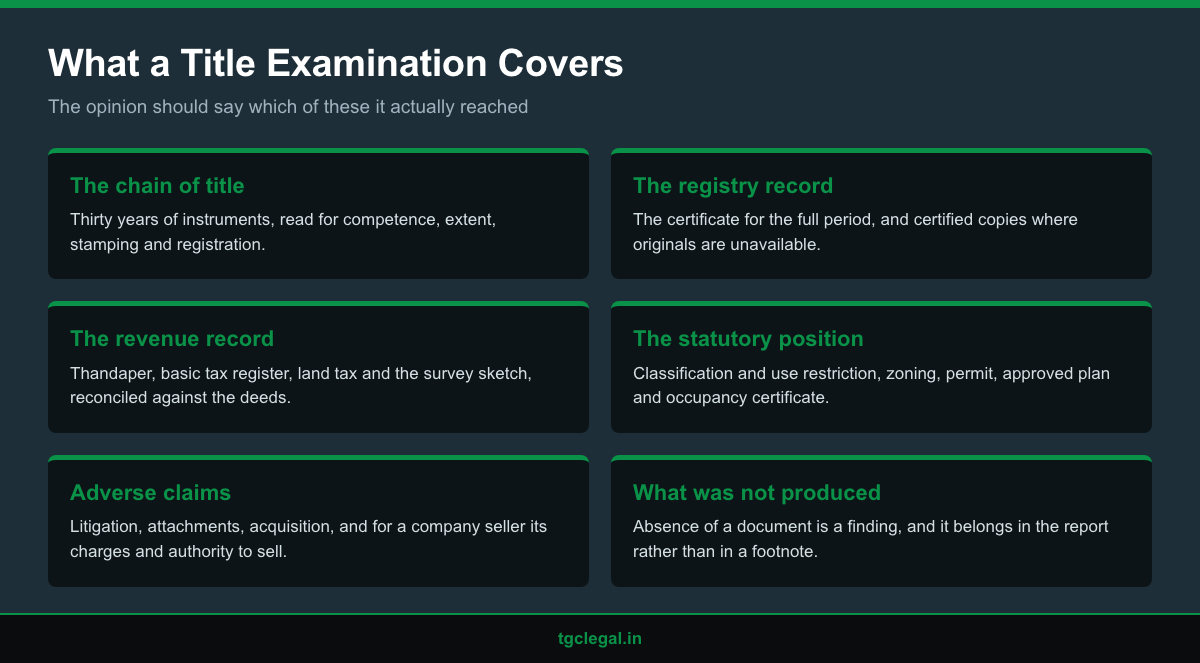
A full examination covers five categories of material, and the opinion should say which of them it reached.
Where any of these were not obtained, the opinion should say so expressly rather than pass over it. Absence of a document is itself a finding, and our note on preventing a hidden charge from surviving a purchase shows what a missing discharge costs later.
- The chain of title: the parent deed and the preceding instruments over thirty years, read for competence of the transferor, extent of the interest transferred, stamping and registration.
- The registry record: the encumbrance certificate for the full period, and certified copies of the deeds where originals are unavailable.
- The revenue record: the thandaper extract, the basic tax register entry, the current land tax receipt and the survey sketch, reconciled against the description in the deeds.
- Statutory position: land classification and any use restriction, planning and zoning, building permit, approved plan and occupancy certificate for built property, and project registration where the regulator's threshold applies.
- Adverse claims: pending litigation, attachments, acquisition proceedings, and, where the seller is a company, its register of charges and its authority to sell.
The Qualifications Are the Document
Every opinion carries a set of assumptions and limitations, and buyers routinely skip them because they read as boilerplate. They are not boilerplate. They are the precise statement of what risk the buyer is keeping.
The standard qualifications are worth understanding individually. That documents produced are genuine and are what they purport to be, which means forgery is outside the opinion. That signatures and identities are as stated. That the searches conducted returned complete records, which is an assumption about the registry rather than a finding. That no facts exist which were not disclosed and could not be discovered from the documents examined. That the opinion is confined to the law as at the date given.
Then come the property-specific qualifications, and these are the ones to read closely. An earlier deed available only as a certified copy. A gap in the chain covered by a recital rather than a document. A revenue extract describing a different extent. A power of attorney whose original could not be inspected. A tenant in occupation whose terms were not produced.
A buyer's response to each qualification should be a decision, not a shrug: accept it, price it, or make its resolution a condition of completion. Our note on how errors in the revenue entry affect an owner's rights shows what one such qualification costs to clear.
Conditions, Not Conclusions
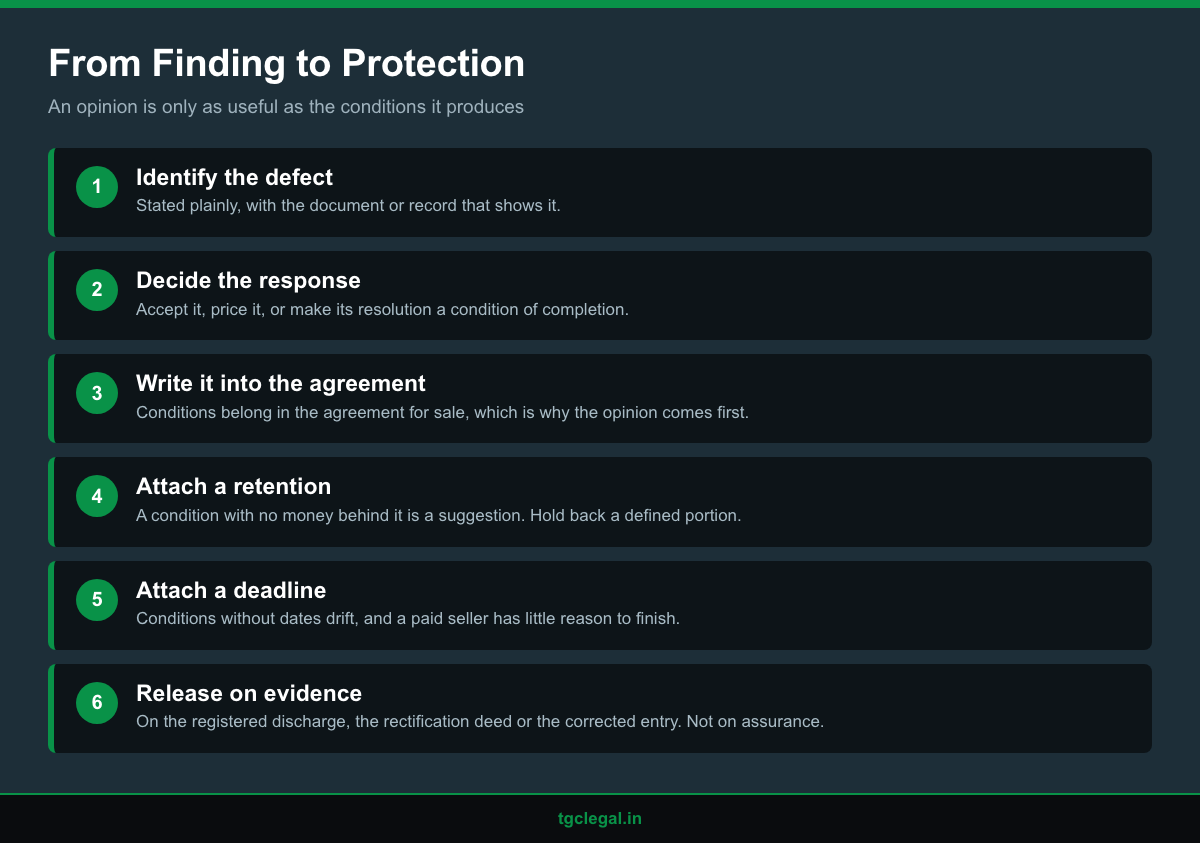
The most useful opinions end with a list of things that must happen before the balance of the price is paid. That list is what converts a report into protection.
Typical conditions include: production of the original of a specified deed; registration of a discharge for a mortgage that appears undischarged; a rectification deed correcting the extent or the boundary description; obtaining the consent or release of an heir identified in the chain; regularisation of a deviation from the approved plan; payment of arrears of land tax or local body dues; and mutation of an earlier transfer that was never carried into the revenue record.
Each condition should be tied to money. A condition with no retention behind it is a suggestion. The customary structure is that a defined portion of the price is held back until the specified condition is satisfied, and released on evidence rather than on assurance.
The other half of the structure is time. Conditions without deadlines drift, and a seller who has been paid most of the price has limited incentive to complete a rectification. A date, and a consequence for missing it, belongs in the agreement for sale rather than in the opinion, which is why the opinion should be delivered before that agreement is signed rather than after.
A matter on clearing a defective title and securing the documentation in Kerala shows what happens when the rectification is left until after completion.
Where an Opinion Is Wrong, and What Follows
Opinions are occasionally wrong, and buyers ask what that is worth. The answer depends almost entirely on the qualifications, which is the practical reason to read them at the outset rather than after a problem appears.
A defect that a reasonable examination would have found, and that the opinion neither reported nor qualified, is a different matter from a defect the opinion expressly flagged as unverifiable. In the first case the buyer relied on a statement that was made without the care the exercise required. In the second the buyer was told about the gap and chose to complete anyway.
That distinction is why a well-drafted opinion is as valuable to the person giving it as to the person receiving it. Precision about what was and was not examined protects both sides, and vagueness protects neither.
The buyer's own position also depends on what was passed on. Where an opinion is commissioned by a lender and the buyer simply reads it, the buyer is not the addressee, and reliance is a question rather than an assumption. Commissioning the opinion in the buyer's own name removes that argument entirely.
None of this is a substitute for a remedy against the seller, which is where a buyer's claim normally sits. The agreement for sale is what carries that remedy, and the opinion's function is to identify what the agreement needs to say.
Agreeing the Scope Before It Is Written
Most disappointment with a title opinion traces back to a scope that was never discussed. Four questions settle it.
Which documents will be obtained independently, and which will be accepted from the seller? An opinion built only on the seller's bundle inherits whatever the seller chose not to include.
What period will the encumbrance certificate cover, and will more than one sub registrar's office be searched? Where the chain shows a jurisdictional change, both offices must be covered or the search has a hole in it, a point developed in our note on the checks a buyer runs before registering land in Kochi.
Will there be a physical inspection and local enquiry? Occupation, boundary encroachment and deviations from the approved plan are visible on the ground and invisible on paper.
Will litigation and, for a corporate seller, the register of charges be searched? These are separate exercises and are often excluded by default.
Settling those four points in writing at the outset costs nothing and determines what the buyer is actually buying. The title verification practice page sets out how the review is normally scoped.
Conclusion
A legal opinion on property is not a verdict. It is a structured account of what was examined, what was found, what could not be verified and what should happen next. Read in that spirit it is the most useful document in a purchase file.
Read as a clearance, it becomes a comfort object. The buyers who get value from one are the buyers who read the qualifications first, turn each into a decision, and hold money back until the conditions have been met.
Frequently Asked Questions
Does a title opinion guarantee that the seller owns the property?

How far back should the chain be examined?
What is the difference between a lender's opinion and a buyer's opinion?
Which part of the opinion should be read first?
What should an opinion end with?
How current does the search need to be?
Can an opinion be given where an original deed is missing?
Is a physical inspection part of the exercise?
Who should commission the opinion?
What if a defect emerges after completion?