Post
Commercial Lease Termination: Exit Clauses, Notice and Lock-In Enforcement
 Property Litigation Law Services
Leases are negotiated by people planning to move in. They are enforced by people trying to move out, and the two groups care about entirely different clauses. Rent, area and escalation dominate the first conversation; notice, lock-in, reinstatement and the deposit dominate the second.
This note works through how a commercial tenancy actually ends, what breaking a lock-in costs, why termination notices fail, and the exit mechanics that belong in the lease and usually are not.
Key Takeaways
- A lease ends by efflux of time, by notice where the lease or the general law allows it, by surrender, or by forfeiture.
- A lock-in is enforceable as a contract. The usual consequence of breaking it is liability for rent for the balance, not an order to stay.
- Notices fail on the ground stated, the period given, the addressee and the mode of service more often than on substance.
- Where rent control applies, contractual termination does not by itself produce possession. A statutory ground and an order are still needed.
- Exit mechanics, handover condition, reinstatement, deposit and outstanding charges, are what the last month of a tenancy is actually about.
The Four Ways a Lease Ends
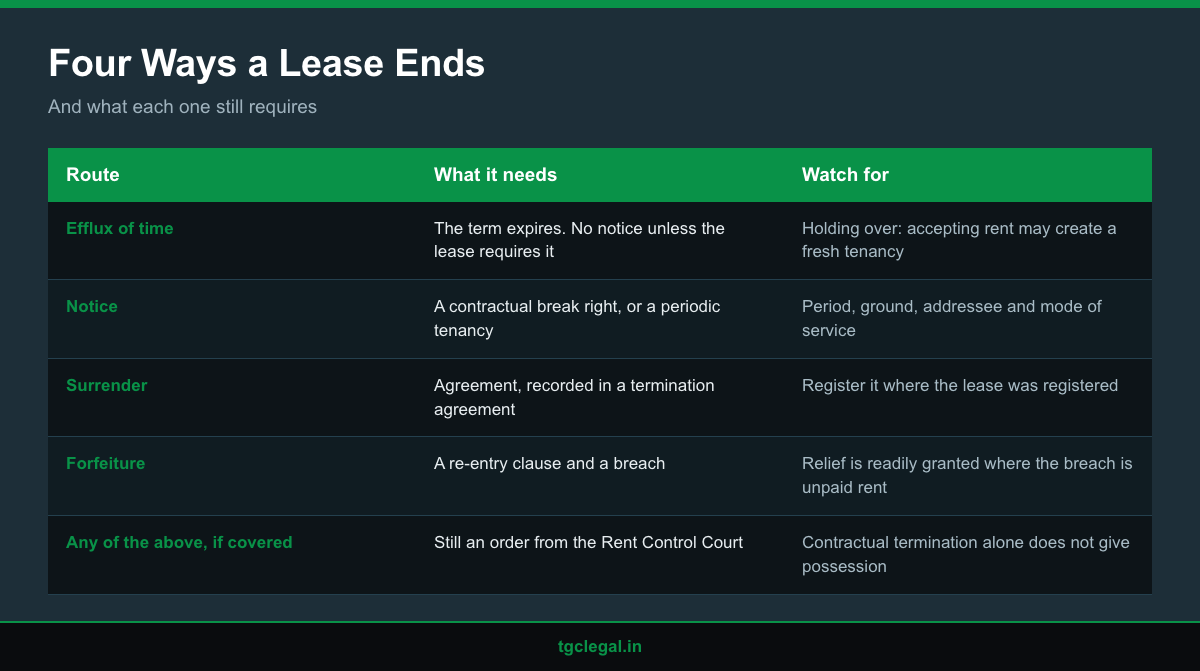
Efflux of time is the simplest. A lease for a fixed term expires on the last day, and no notice is required unless the lease says otherwise. What complicates it is holding over: where the tenant remains and the landlord accepts rent, the law may treat a new tenancy as created on the terms of the old one so far as applicable, and the parties are back in a periodic arrangement neither of them documented.
Notice is the second route, and it applies both where the lease confers a contractual break right and where the tenancy is periodic. Under the general law the notice period for a lease for agricultural or manufacturing purposes differs from that for other purposes, and the difference is not a formality.
Surrender is agreement. Both sides consent to end the lease, and the arrangement is recorded in a commercial lease termination agreement dealing with the date, the condition of handover, the deposit and outstanding charges. Where the lease was registered, the surrender should be registered too.
Forfeiture is the landlord's remedy where the lease provides for re-entry on breach. It is the least reliable of the four, because relief against forfeiture is readily granted where the breach is non-payment of rent and the tenant pays what is due.
Layered on all four, where the premises fall within the rent control legislation, is the statutory position: the contractual termination determines the contract, and possession still requires an order on a statutory ground.
Lock-In: What It Binds and What It Costs
A lock-in is a period during which neither party may terminate. It exists because both sides incur cost at the start: the landlord in giving a rent-free fit-out period and in taking the unit off the market, the tenant in fitting out.
It is enforceable as a contract. The usual consequence of a tenant leaving during a lock-in is liability for rent for the balance of the period, subject to the ordinary principles governing damages, including the landlord's obligation to act reasonably in mitigating loss by reletting. A landlord who leaves a unit empty for the balance of a three-year lock-in and then claims the whole amount will be met with that argument.
Two drafting points matter more than the length. First, the lock-in should be mutual. A lock-in binding only the tenant allocates all of the market risk to one side, and a tenant asked to accept one should ask what the landlord is giving in exchange. Second, the consequence of breach should be stated: whether the balance is payable, whether the deposit is forfeited, and whether the two overlap. A lease that is silent produces a negotiation at exactly the moment the parties have stopped cooperating.
A lock-in also interacts with the deposit. Where the deposit equals six months' rent and the remaining lock-in is four months, the commercial answer is usually obvious and should be written down rather than argued.
Where premises become unusable through no fault of either party, the position depends on the lease. Indian courts have not been receptive to arguments that a tenant is relieved of rent by disruption alone, so a tenant that needs relief in such circumstances should negotiate for it expressly.
Why Notices Fail
More termination disputes are lost on the notice than on the merits, and the failures are consistent.
The wrong period. A contractual break right requiring six months' notice is not satisfied by five months and a willingness to pay the difference, unless the lease says so.
The wrong ground. A notice that terminates for one breach cannot later be supported on a different one. Where several grounds exist, they should all be stated.
The wrong addressee. A notice to a company that goes to a branch manager rather than the registered office, or a notice to a partnership addressed to one partner, is a service problem waiting to happen.
The wrong mode. The lease usually specifies how notices are to be given and to what address. A notice sent by email where the lease requires registered post is a notice that may not have been given at all. The cheapest protection is to serve by every method the lease permits, simultaneously, and to keep the proof.
Finally, timing. A notice served on the wrong date, or one that expires mid-period where the arrangement is periodic, may be ineffective altogether. Our note on the contract mistakes businesses make most often covers the same discipline across commercial agreements.
The Exit Mechanics Nobody Drafts
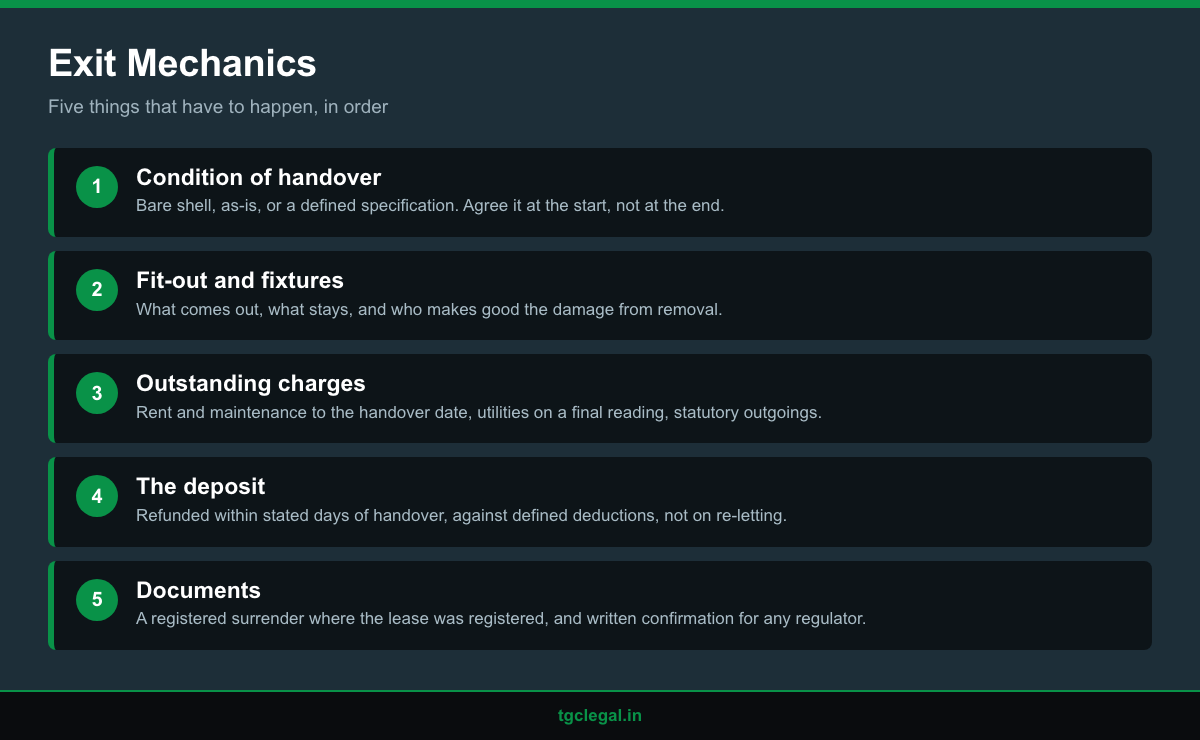
Assume the parties agree to end the tenancy. Five things then have to happen, and a lease that does not sequence them produces a standoff.
Condition of handover. Bare shell, as-is, or something in between. Where reinstatement is required, the specification should be defined at the outset rather than described as good and tenantable condition, which means whatever the party reading it wants it to mean.
Fit-out and fixtures. Which installations the tenant may remove, which become the landlord's, and who makes good the damage caused by removal.
Outstanding charges. Rent to the handover date, maintenance to the same date, utilities on a final meter reading, and any statutory outgoing allocated to the tenant.
The deposit. Refundable within a stated number of days of handover, against a defined set of deductions, and not conditional on the landlord finding a new tenant.
Documents. Where the lease was registered, a registered surrender. Where any licence or registration is tied to the address, a written confirmation the tenant can produce to the regulator. A matter on a premature exit from commercial premises in Kerala shows what the absence of these mechanics costs.
Where Rent Control Changes the Analysis
Everything above describes the contractual position. Where the premises are a building in an area to which the rent control legislation extends, the contract is only half the story.
A landlord who validly terminates the contractual tenancy does not thereby become entitled to possession. Possession requires an order from the Rent Control Court on one of the statutory grounds, and the tenant remains in occupation until that order is made and executed.
That is why a landlord's practical planning should start with the timeline rather than with the notice. A contested proceeding, with an appeal and a revision available, runs for years. A negotiated exit that costs the landlord some money is frequently a better commercial outcome than a proceeding that is technically stronger.
For a tenant the same fact is leverage, and it should be used carefully. A tenant who relies on delay while accruing arrears is building the landlord's strongest ground, and the arrears route is the one on which possession is most readily ordered.
The rent control practice page sets out how those proceedings are normally handled.
Negotiating the Exit
Most commercial tenancies end by agreement, and the agreement is usually reached in a fortnight once both sides accept what the alternative costs.
The landlord's position is driven by re-letting: how long the unit will sit empty, what it will let for, and what it will cost to make it lettable. A tenant offering to leave the fit-out in place, to introduce a replacement occupier, or to hand over in a specified condition on a specified date, is offering things that genuinely reduce that cost.
The tenant's position is driven by continuity: whether the business can move, when, and what it loses in the process. Where the answer is that moving is expensive and slow, the tenant should be negotiating an extension rather than an exit, and should start early enough to have that option.
The settlement is then arithmetic: balance of lock-in, less mitigation, against deposit held, adjusted for reinstatement and outstanding charges, with a date. Recording it in a signed commercial lease termination agreement, with mutual releases, is what stops the same conversation reopening three months later.
A matter on an office tenancy resolved in Kochi shows the shape a negotiated exit usually takes.
Conclusion
A tenancy ends on the clauses nobody negotiated: the notice mechanic, the lock-in consequence, the reinstatement specification and the deposit refund. Those four decide what the last month costs, and all four can be settled in half an hour at the start.
Where the premises fall within rent control, add the timeline to the analysis before anything else, because it changes what each side's contractual rights are actually worth.
Frequently Asked Questions
How does a fixed-term commercial lease end?

Is a lock-in clause enforceable?
Should a lock-in bind both sides?
What is the most common reason a termination notice fails?
Does terminating the contract entitle a landlord to possession?
Can the deposit be set off against the lock-in liability?
What does reinstatement usually require?
Should a surrender be registered?
Can a tenant stop paying rent if the premises become unusable?
What is the fastest way to end a commercial tenancy?