Post
Commercial Leasing in Kerala: Agreements, Rent Control and Eviction
 Property Litigation Law Services
Commercial premises are usually taken quickly. A business finds a unit, agrees a rent, signs a document the landlord's office has used for years, and moves in. The document is looked at again only when something has gone wrong, and by then the choices available to each side were fixed by clauses nobody negotiated.
This guide sets out how a commercial property lease agreement actually works in Kerala: the difference between a lease, a licence and a tenancy and why it decides everything else; what the rent control legislation covers and what it leaves to the general law; how a commercial lease is structured clause by clause; what registration does and what an unregistered document can still prove; and what each side can realistically do when possession, rent or a deposit is in dispute.
It is written for businesses taking space and for owners letting it, and each section links to a fuller note where one exists.
Key Takeaways
- Exclusive possession is what makes an arrangement a lease. Calling a document a licence does not make it one.
- The Kerala rent control legislation applies to buildings in notified areas and gives a tenant statutory protection that a contract cannot remove.
- A lease from year to year, for a term exceeding one year, or reserving a yearly rent, must be by registered instrument.
- An unregistered lease is not useless. It can still evidence possession and the terms on which rent was paid, but it cannot be enforced as a lease.
- Self-help eviction is unlawful. A tenant dispossessed otherwise than in due course of law has a fast statutory remedy.
Lease, Licence and Tenancy: Three Relationships
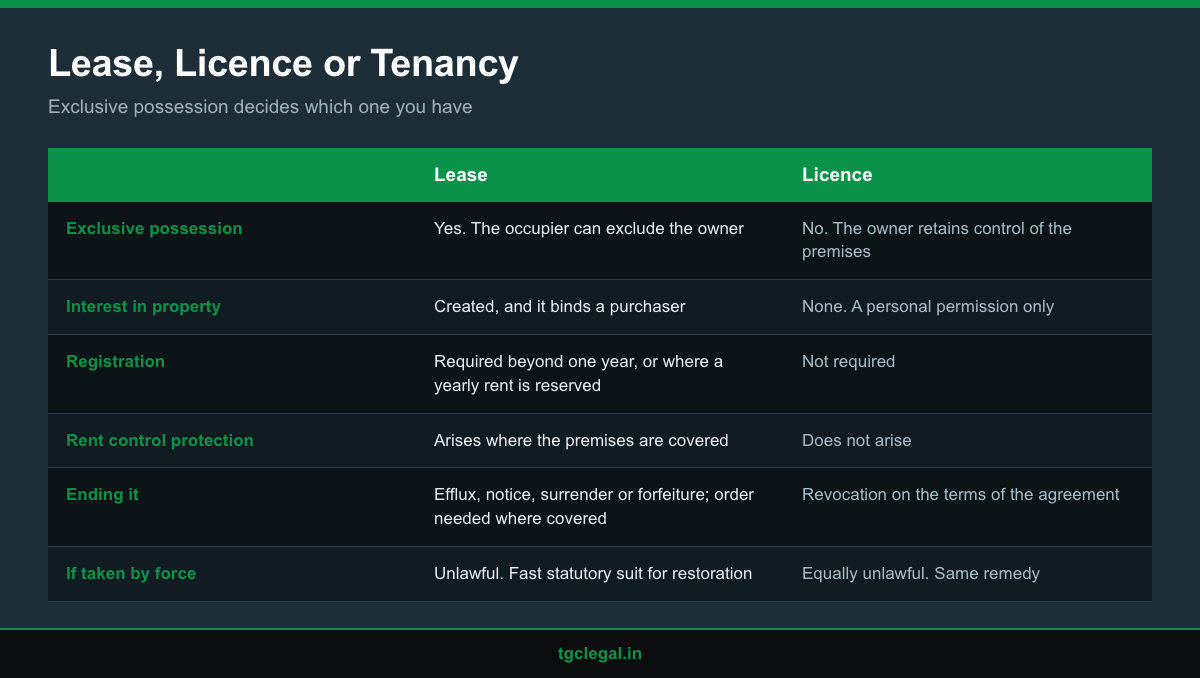
A lease transfers a right to enjoy immovable property for a term, in consideration of rent. A licence permits a person to do something on the property that would otherwise be unlawful, without transferring any interest in it. The distinction sounds technical and decides almost everything that follows.
The test is exclusive possession. Where the occupier has the right to exclude the world, including the owner, the arrangement is a lease however the document describes itself. Where the owner retains legal possession and the occupier has only permission to use, it is a licence. Courts look at the substance of the arrangement rather than its label, so a document headed leave and licence that gives a business exclusive control of a floor is a lease.
Why it matters: a lease creates an interest in the property that binds a purchaser, may require registration, and where the premises are covered by rent control brings statutory protection with it. A licence creates none of that, is revocable in accordance with its terms, and leaves the occupier with a contractual claim rather than a possessory right.
Tenancy is the word used for the relationship once a lease is in operation, and in the statutory context it carries the additional protections the legislation confers. A tenant holding over after the term has expired, whose rent continues to be accepted, does not simply become a trespasser; the relationship continues on the terms of the original arrangement so far as they are applicable.
The practical instruction for both sides is the same. Decide what the arrangement is, then use the right document. A landlord who wants flexibility should not grant exclusive possession and then rely on the heading of the page.
What the Rent Control Legislation Covers
Kerala's rent control legislation regulates the letting of buildings in areas to which it has been extended. Where it applies, it does two things that a contract cannot undo: it restricts the grounds on which a tenant may be evicted, and it channels those proceedings into a specialised forum rather than the ordinary civil court.
The scope question comes first and is answered by three checks. Is the property a building within the meaning of the Act, as opposed to bare land? Is it situated in an area to which the Act has been extended? And does any exemption apply to it? Bare land let for a business purpose falls outside and is governed by the general law of transfer of property.
Where the Act applies, eviction requires an order on one of the statutory grounds. The recurring ones are arrears of rent, the landlord's own bona fide need of the building for occupation, a bona fide need for additional accommodation, subletting or transfer without consent, use for a purpose other than that for which it was let, acts of waste or nuisance, cessation of occupation for a continuous period, and the building requiring reconstruction.
Two features of the own-need ground are worth knowing before a notice is issued. The landlord must establish that the need is genuine rather than a device, and there are statutory provisos that protect a tenant who depends mainly on the income from a business carried on in that building and who has no other suitable building available in the locality. Own-need petitions fail on those provisos regularly.
The forum is the Rent Control Court, with an appeal to the appellate authority and a revision to the High Court. That route is not a shortcut. A contested eviction runs for years, which is the single most important fact for a landlord to price before letting.
Anatomy of a Commercial Lease
A commercial property lease agreement is a long document made up of a small number of decisions. The clauses that matter are these.
Term and renewal. A fixed term with a stated expiry, and if renewal is intended, a mechanism that works: a notice period, a basis for setting the renewed rent, and what happens if the parties cannot agree. An option to renew on terms to be mutually agreed is not an option at all.
Rent and escalation. The amount, the day it is payable, and the escalation formula with its frequency and base. A percentage escalation compounding annually over a nine-year term produces a figure most tenants have not modelled, and it is worth modelling before signature rather than after.
Lock-in. A period during which neither side may terminate. It is enforceable as a contract, and the ordinary consequence of breaking it is liability for rent for the balance of the period rather than an order compelling occupation. Lock-ins should be mutual; a lock-in that binds only the tenant is a one-sided allocation of market risk.
Deposit. The amount, whether it carries interest, what it may be applied against, and the period within which it must be refunded after handover. This is the clause that generates the most disputes and receives the least attention.
Use and alterations. What the premises may be used for, whether the use may change, and what the tenant may do to the structure. Rent control legislation treats use for a different purpose as an eviction ground, so a change of business line without consent is a real risk rather than a technicality.
Repairs and outgoings. Which repairs fall to each side, who insures the structure and who insures the contents, and which statutory outgoings are the landlord's and which the tenant's. Property tax, building tax and any local body charge should be allocated expressly, because silence produces a demand that arrives addressed to the owner and is then passed on without a contractual basis.
Quiet enjoyment and access. The tenant's right to occupy without interference from the landlord, and the landlord's right of entry on notice for inspection and repair. A landlord who reserves an unrestricted right of entry has weakened the tenant's exclusive possession, which may matter later when the character of the arrangement is in issue.
Termination and consequences. What each side may do on default, what notice is required, whether there is a cure period, and what happens to fit-out, deposit and outstanding charges on exit. A lease that states termination rights but not exit mechanics simply relocates the argument to the day the tenant moves out.
Fit-Out, Common Area Charges and Reinstatement
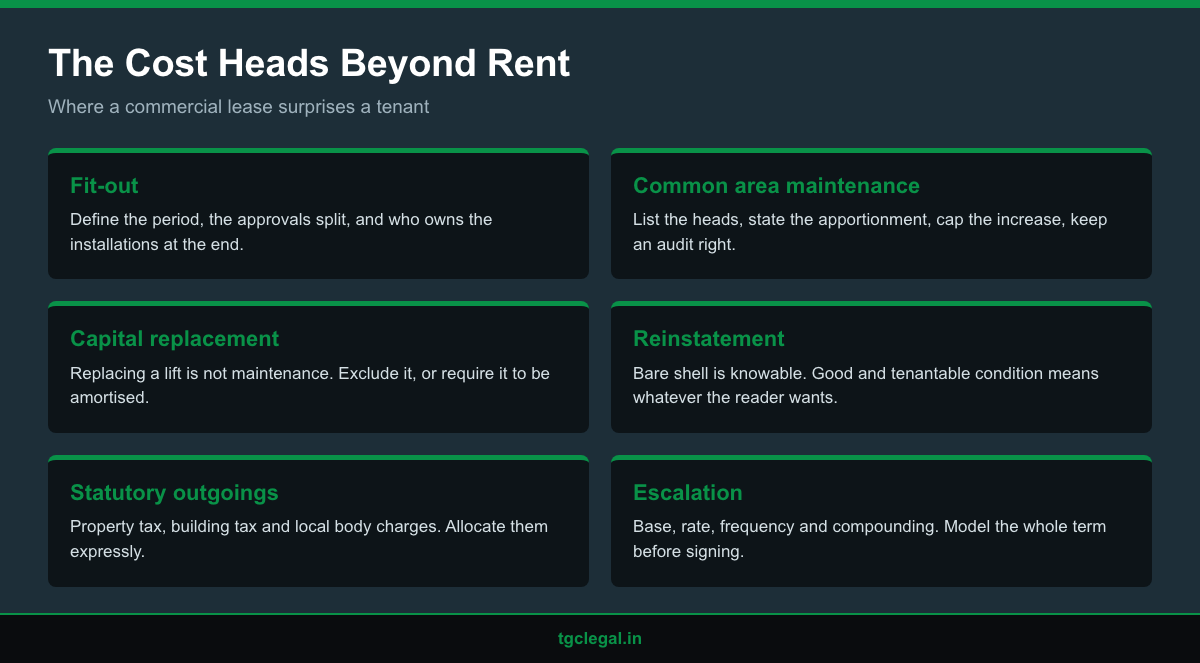
Three cost heads sit outside the rent and are where commercial leases most often surprise a tenant.
Fit-out is the tenant's work to make the space usable. The lease should state the fit-out period and whether it is rent free, who obtains statutory approvals for the work, what may be installed, and who owns the installations at the end. A tenant who spends heavily on fit-out inside a short lock-in has spent money it may not recover.
Common area maintenance is the tenant's share of the cost of running the building. The clause should state what is included, on what basis the share is calculated, whether there is a cap, and what audit rights the tenant has. An open-ended obligation to pay a share of costs the landlord determines is a blank cheque, and a cap with an annual increase limit is the ordinary compromise.
Reinstatement is the obligation to return the premises in a stated condition. Where the lease requires the tenant to restore the space to bare shell, the cost of that exit should be estimated at the outset. Where the landlord wants to keep the fit-out, the lease should say so, because the two positions are inconsistent and both appear in the same document more often than they should.
Our note on the fit-out and common area clauses in an office lease covers this from a tenant's side, and a matter on an office tenancy in Kochi shows what happens when the heads are left vague.
Assignment, Subletting and Change of Control
A lease is granted to a particular tenant, and landlords care about who occupies. Three clauses control that, and businesses that restructure, take investment or are acquired discover them at the worst moment.
Assignment is the transfer of the whole leasehold interest to someone else. Subletting is the grant of a lesser interest to an occupier who takes possession under the tenant. Both are ordinarily prohibited without the landlord's written consent, and under the rent control legislation subletting or transferring without consent is itself an eviction ground. A business that lets an associated company occupy part of its floor, without documentation and without consent, has created a subletting risk it did not intend.
Change of control is the clause that catches growing companies. Where the lease treats a change in the tenant's shareholding as a deemed assignment, an investment round or an acquisition triggers a consent requirement even though the tenant entity has not changed. A tenant expecting to raise capital should negotiate a carve-out for intra-group transfers and for changes in shareholding that do not alter the business carried on at the premises.
Landlords have a legitimate interest here, and the usual compromise is consent not to be unreasonably withheld, with a defined period for a response and a deemed consent if none is given. An absolute prohibition is a serious constraint on a growing business and should be priced as one.
The same analysis applies in reverse. A tenant taking space from an intermediate landlord should establish what that landlord's own interest is and whether it permits the subletting the tenant is being offered, because a sub-tenancy cannot outlive the interest it was carved out of.
Registration, Stamping and What an Unregistered Lease Proves
A lease of immovable property from year to year, for any term exceeding one year, or reserving a yearly rent, must be made by a registered instrument. Anything shorter may be made by an unregistered writing or, in some circumstances, orally with delivery of possession.
The commercial consequence of that rule is the eleven-month agreement, renewed repeatedly, which the market uses to stay outside the registration requirement. It works for its purpose and it costs the tenant security of term, because each renewal is a fresh negotiation in which the tenant's fit-out investment is the landlord's leverage.
Where registration was required and did not happen, the document cannot be received in evidence as a lease. It is not thereby worthless. It can be used to evidence a collateral fact such as the nature of possession or the rate at which rent was paid, and a party in possession under a written agreement who has performed their part may in some circumstances resist dispossession on the strength of that part performance. Those are defensive positions rather than a substitute for a registered lease.
Stamp duty on a lease in Kerala varies with the term and the rent reserved, and an insufficiently stamped instrument is inadmissible until the deficiency and penalty are paid. Our note on the effect of stamping defects on a lease treats that separately.
The practical advice for a business taking space of any significance is to register. The cost is a fraction of the fit-out budget and it converts a renewable permission into a term the tenant actually holds.
When the Landlord Wants Possession
The route depends on whether the premises are covered by the rent control legislation.
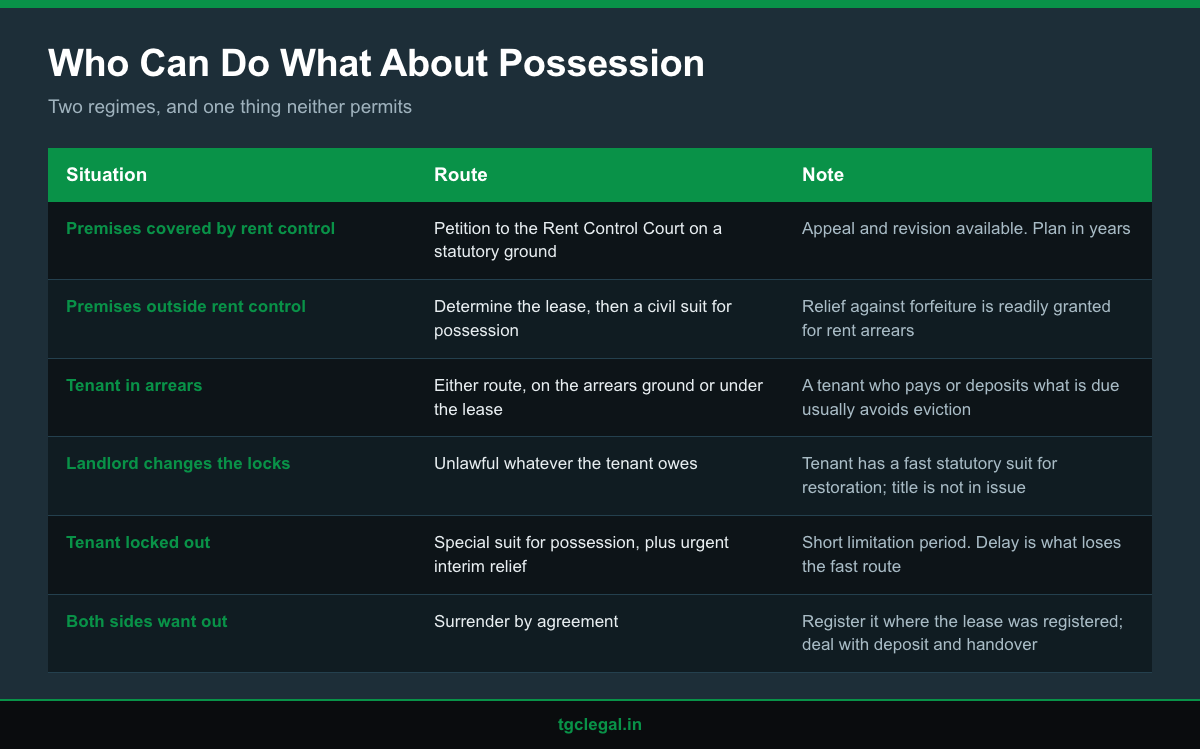
Where they are, the landlord files before the Rent Control Court on a statutory ground, and the tenant has statutory defences including, on an arrears ground, the ability to stop the eviction by depositing what is due. That relief is not unlimited, and a tenant who defaults repeatedly loses it, but a landlord who assumes non-payment produces quick possession is usually mistaken.
Where they are not, possession is recovered by a suit under the general law, following determination of the lease by efflux of time, by notice, or by forfeiture where the lease provides for it. A forfeiture for non-payment of rent is subject to relief, and a court will ordinarily allow a tenant who pays what is due to remain.
In either route the notice is where cases are lost. A notice that misstates the ground, gives the wrong period, is addressed to the wrong person or is not properly served puts the landlord back to the beginning. The statutory notice periods under the general law differ for leases of agricultural or manufacturing purposes and for other purposes, and the difference is not a detail.
One further practical point applies whichever route is used. Rent that accrues during the proceedings is recoverable, and a landlord should keep claiming and receipting it in a way that does not compromise the case, while a tenant defending an arrears ground should be depositing rather than accumulating a defence. In both directions the paper trail created during the dispute is what the forum actually reads.
Timelines should be planned for, not hoped about. A matter on ending an IT park tenancy in Ernakulam shows what a contested exit involves, and a matter on a landlord who enforced the contract terms in court shows the alternative.
When the Tenant Is Locked Out
Self-help is unlawful. A landlord who changes the locks, removes the tenant's goods, cuts the power or posts security at the door to prevent entry is not exercising a remedy; they are dispossessing an occupier otherwise than in due course of law.
The tenant's fastest route is the special statutory suit for possession available to a person dispossessed without consent and otherwise than in due course of law. It is deliberately narrow: the question is whether the plaintiff was in possession and was dispossessed, not who has better title. That narrowness is what makes it quick, and it carries a short limitation period, so delay is fatal.
Interim relief is usually the point of the exercise. An order restoring possession or restraining further interference, obtained quickly, does more for a business than damages awarded years later. Where the lease contains an arbitration clause, urgent interim protection remains available from a court notwithstanding the clause.
There is a criminal dimension as well where goods have been removed or force used, and there are consumer-facing consequences where a business is prevented from trading. The commercial reality is that a lockout usually reflects a landlord who is owed money and has lost patience. That is a reason to engage early rather than a defence.
Our note on the remedies available when an eviction claim is pressed unlawfully covers the landlord's side of the same problem.
Deposits, Escalation and the Disputes That Follow
Most commercial tenancy disputes are not about possession at all. They are about money at the end.
Security deposits are the largest recurring problem. The lease should state the amount, whether interest accrues, exactly what it may be set off against, and a period for refund tied to handover rather than to the landlord finding a new tenant. Where the lease is silent, the tenant is left suing for a debt while the landlord holds the money, and the practical answer is to align the last months' rent with the deposit position rather than to litigate.
Escalation disputes arise where the formula is ambiguous, where the base is not defined, or where the escalation was never applied for years and is then claimed in arrears. Silence over time does not necessarily waive a contractual right, but a landlord claiming six years of unapplied escalation in one demand is in a weaker position than one who invoiced it each year.
Maintenance charge disputes follow the same pattern: no cap, no audit right, no definition of what is included. The tenant's protection is drafting, not litigation.
A matter on escalation inside a Kerala mall and a matter on securing occupancy rights for a retailer both turned on clauses that were agreed without being modelled.
Co-Working, Managed Offices and Short Occupation
A growing share of commercial occupation in Kochi and Thiruvananthapuram is through co-working and managed-office arrangements, and the documents used are usually service agreements rather than leases.
That is a genuine difference rather than a label. The occupier typically has a right to use a stated number of seats or a defined cabin, with services included, and no exclusive possession of an identified part of the building. The provider retains control, the arrangement is terminable on notice, and no interest in the property passes.
The questions a business should ask are therefore commercial rather than proprietary. What notice is required on each side? What happens to the deposit? What is the position if the provider's own lease of the building ends? Is there any right to remain if the space is reallocated? Who is responsible for data and network security in a shared environment?
The last of those is frequently overlooked and matters for regulated businesses and for anyone handling client information. A matter on a co-working arrangement structured for a growing team shows the questions worth settling before signature.
Short arrangements suit uncertainty and they do not suit investment. A business planning meaningful fit-out or needing a stable address for licensing purposes should take a lease and register it.
There is one further point specific to managed space. Registrations and licences that a business holds, from a shop and establishment registration to a professional tax or GST registration, are tied to a stated address, and some regulators expect evidence of a right to occupy it. A service agreement terminable on thirty days' notice satisfies that requirement thinly, and a business that has built customer-facing presence around an address should understand how easily it can be required to leave it.
A Pre-Signature Checklist for Both Sides
Before either party signs, six questions settle most of what would otherwise become a dispute.
What is this document, in substance: lease, licence or service arrangement? Does the rent control legislation apply to these premises? Is registration required, and if it is, will it happen? What is the total cost over the term, including escalation, maintenance and reinstatement? What does each side have to do to bring the arrangement to an end, and how long does that take in practice? And where is the deposit, in the sequence of exit obligations?
For a landlord there is a seventh: what does a contested eviction from these premises actually cost in time, and is the covenant of this tenant worth that risk? Rent is only part of the return.
For a tenant there is a different seventh: what happens to the business if possession is lost at short notice? Where the answer is serious, the term, the registration and the renewal mechanism deserve more attention than the rent.
The rent control practice page sets out how these disputes are normally handled, and our note on the clauses that keep a commercial property transaction out of court makes the same argument for purchases.
Conclusion
Commercial leasing in Kerala runs on two questions that are settled before anyone signs: what kind of arrangement this is, and whether the rent control legislation applies to the premises. Everything else, the escalation formula, the maintenance cap, the lock-in, the reinstatement obligation and the deposit, is negotiation, and it is negotiation that both sides tend to skip because the space is available and the business needs to move.
The clusters under this guide take each of those decisions separately: lease against licence, termination and lock-in, fit-out and common area charges, statutory coverage, eviction, tenant remedies, escalation and deposits, managed offices, and registration. Each is written for the point in the relationship where it actually arises.
Frequently Asked Questions
What makes an arrangement a lease rather than a licence?

Does Kerala rent control apply to commercial premises?
On what grounds can a commercial tenant be evicted?
Why do own-need eviction petitions fail so often?
Does a commercial lease have to be registered?
Is an unregistered lease worthless?
Can a landlord lock out a tenant who has not paid?
Is a lock-in clause enforceable against a tenant?
How should common area maintenance be handled in the lease?
What is the most common commercial tenancy dispute?