Post
Flat Registration and RERA: What to Verify Before Registering an Apartment
 Property Litigation Law Services
By the time an apartment buyer reaches the sub registrar's office, most of the money has already moved. Payments have been made against a construction schedule for two or three years, possession may already have been offered, and the deed is presented as the last administrative step in a process that is effectively over.
That sequencing is exactly why the checks that matter have to happen earlier. This note sets out what to verify before the deed is executed, what to insist on at the point of possession, and what the buyer should still hold back until the position is clean.
Key Takeaways
- Project registration with the state regulator carries the promoter's declarations about title, encumbrances, approvals and completion date. Read it against what the sales team says.
- The occupancy certificate is the document that says the building may lawfully be occupied. Possession offered without one is a real risk, not a formality.
- Carpet area is the statutory basis of sale. Reconcile it against what was quoted before signing.
- The undivided share should be stated as a specific fraction in the deed, and the fractions across the building should account for the whole parcel.
- Common areas, the association and the maintenance corpus are handed over as a separate exercise, and payment leverage disappears once the deed is registered.
Start With the Promoter's Own Declarations
A project above the notified size must be registered with the state real estate regulator before it is marketed, and the registration file is public. For a buyer, it is the cheapest source of verified information available.
The file carries the promoter's declarations about title to the land, encumbrances on it, the approvals obtained, the sanctioned plan, the number and configuration of units, the declared completion date and the promoter's undertakings about the separate account into which a portion of collections must be deposited.
Read against the sales brochure and the sales conversation, that file does two things. It confirms whether the project is registered at all, and it surfaces discrepancies. A completion date in the file that is later than the date quoted verbally, a unit count that does not match the brochure, or an encumbrance disclosed on the file and not mentioned at the sales office, are each worth a direct question.
Registration is not a certification of title. The regulator records declarations. The buyer still examines the promoter's chain, and where the project sits on land contributed by a landowner under a development arrangement, the buyer examines that arrangement too. A matter on structuring a real estate transaction in Kochi shows how those layers are worked through.
Approvals, and Comparing the Plan With the Building
Three documents establish that the building may lawfully exist in the form it takes: the building permit, the sanctioned plan and the occupancy certificate.
The sanctioned plan is worth obtaining and comparing against the building. Deviations are common. An extra floor, a covered balcony, a converted common area, a setback that does not match the approval. Some deviations are regularisable and some are not, and either way they become the buyer's problem once the deed is executed.
The occupancy certificate is the one to insist on. It records that the completed building has been inspected and may lawfully be occupied. Possession offered before it issues is offered on the promoter's assurance that it will follow, and buyers who accept that assurance sometimes wait years. Utilities, municipal assessment and any later sale are all easier with it and awkward without it.
Where the property is near the coast or a backwater, coastal regulation clearance is a separate question with its own consequences, and it is checked rather than assumed. Our note on the legal considerations that run through a property transaction covers the wider set.

Carpet Area, and the Number the Price Was Based On
Apartments were sold on super built-up area for decades, a figure that included a share of common areas calculated on a basis the buyer could not verify. The statutory position now requires sale on carpet area, which is a defined measure of the usable floor area within the apartment.
That change matters at two points. Before signing, the agreement should state the carpet area, and the buyer should confirm that the price quoted corresponds to it rather than to a larger figure used in marketing. After completion, the delivered area should be checked against the agreed figure, because a shortfall carries a defined consequence.
The reconciliation is worth doing on paper before it is done with a tape measure. Where the brochure quotes one number, the agreement another and the deed a third, the discrepancy should be resolved before the deed is presented, not after.
Balconies, verandahs, terraces and service areas are treated in specific ways in the statutory definition. A promoter including them in the figure quoted is describing something other than carpet area, and the buyer is entitled to see the calculation.
The Undivided Share and the Common Areas
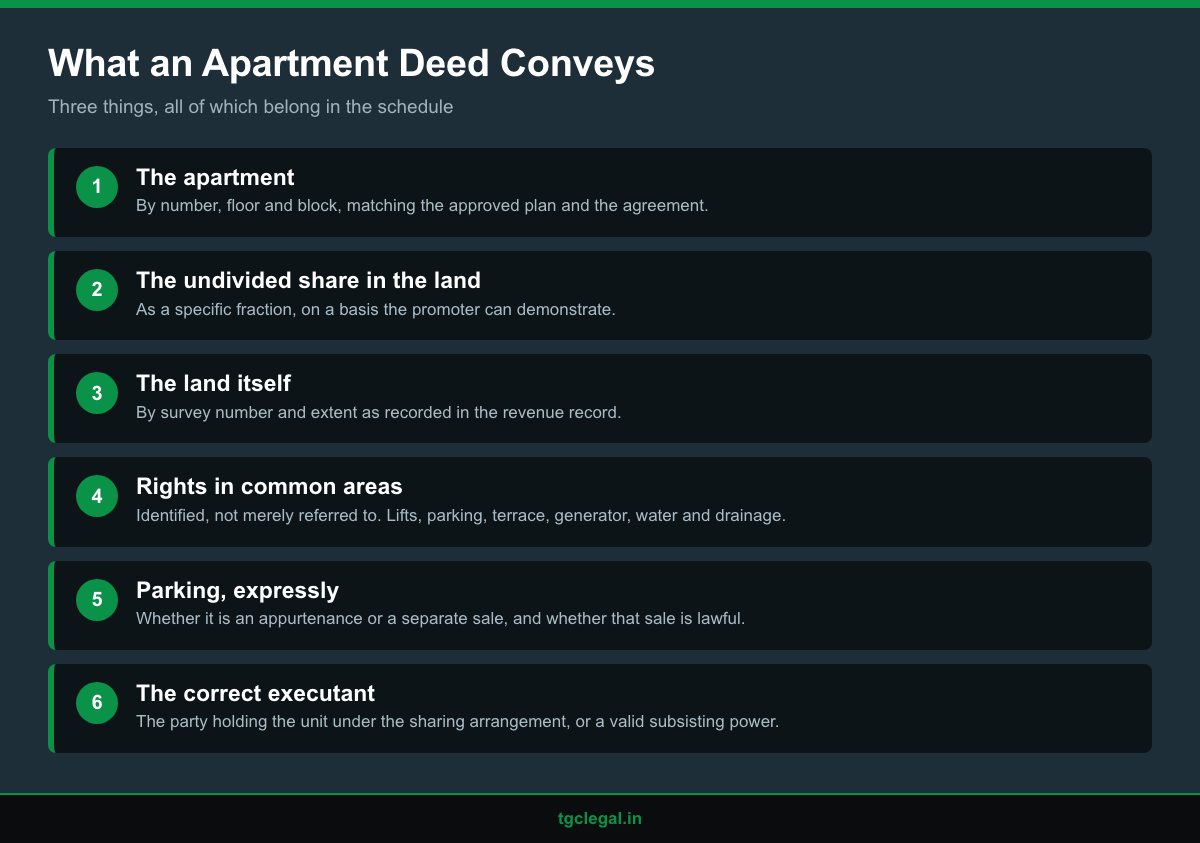
The deed conveys three things: the apartment, an undivided share in the land, and rights in the common areas and facilities. All three should appear in the document.
The undivided share should be a specific fraction, and the promoter should be able to show how it was calculated. The ordinary basis is the apartment's carpet area relative to the total. Where the share is not stated, or the fractions across the building do not account for the whole parcel, the buyer should ask what happened to the remainder.
Common areas need identifying rather than describing. A deed that refers to common areas as shown in the plan is only as good as the plan attached to it. Lifts, generators, parking, the terrace, the club facilities, the water and drainage systems and the land not built upon are the items that later become contested.
Parking deserves its own line. Where a parking slot is being sold as an appurtenance, the buyer should establish on what basis and whether it is identified. Where it is being sold separately, the buyer should establish whether it can lawfully be sold separately at all.
A matter on ownership conflict in a Kochi apartment block shows how quickly a vague description of the common areas becomes a dispute among owners.
The Day Itself
Registration of flats follows the ordinary process. The deed is presented at the sub registrar's office having jurisdiction, the executants attend and admit execution, identity is verified, and the instrument is registered.
The failures on the day are the same as on any conveyance, with two additions. The schedule must describe the apartment by its number, floor and building, the undivided share by fraction, and the land by survey number and extent as it appears in the revenue record. A schedule that describes the apartment but not the land is incomplete.
The second addition is the executant. Where the project sits on land contributed by a landowner, the person executing must be the one who holds the unit under the sharing arrangement, or must hold a valid and subsisting power of attorney from them. This is checked before the appointment, not at the counter.
Duty and the registration fee are assessed on the same footing as any conveyance, on the higher of consideration and notified fair value. Where the apartment is being registered at a figure lower than the amounts actually paid under the agreement, the mismatch is visible on the file and serves no purpose.
After Registration, and What to Hold Back
Registration is not handover. Three things follow and none of them happen automatically.
Mutation, so the revenue record shows the buyer, a step our note on how a defective revenue entry affects an owner explains in detail. Municipal assessment, so the property tax account is in the buyer's name. And the handover of the common areas and the maintenance corpus to the owners' association, which is a separate exercise with its own timeline and its own disputes.
The association is where an apartment buyer's long-term position is decided. It controls maintenance, the corpus, and decisions about the building. A promoter who retains unsold units retains a proportionate voice, and a promoter who has not handed over the corpus retains leverage. Asking how many units remain unsold, and whether the association has been formed and the corpus transferred, is worth doing before the deed rather than after.
That is the argument for holding something back. Once the deed is registered and the price is paid, the buyer's leverage is gone. A retention against the occupancy certificate, the handover of common areas and the transfer of the corpus is the only practical mechanism, and it belongs in the agreement for sale signed years earlier. Our note on the clauses that keep a purchase out of court makes the same case for commercial premises.
Conclusion
The registration of flats is the visible step, and it is the step at which nothing can be fixed. Everything that protects an apartment buyer happens earlier: reading the promoter's declarations on the regulator's file, obtaining the sanctioned plan and comparing it with the building, insisting on the occupancy certificate, reconciling carpet area, and getting the undivided share stated as a fraction.
Buyers who do those five things before the deed is drafted rarely have a difficult registration. Buyers who leave them until the appointment usually discover that the leverage they needed was spent two years earlier.
Frequently Asked Questions
What does project registration with the regulator actually tell a buyer?

Can we take possession without the occupancy certificate?
What is carpet area and why does it matter?
Should the undivided share be written into the deed?
What if the building differs from the sanctioned plan?
How should parking be dealt with in the deed?
Who should execute the deed where a landowner contributed the land?
Is duty on an apartment calculated differently?
When is the owners' association formed and the corpus handed over?
What can a buyer realistically hold back?