Post
Lease vs Leave-and-Licence: Which One Your Commercial Premises Needs
 Property Litigation Law Services
Two businesses take identical units on the same floor. One signs a document headed lease deed, the other one headed leave and licence agreement. A year later both want to leave early, and one of them has a materially better position than the other, for reasons neither of them considered when the space was taken.
The difference is not the heading on the commercial space rental agreement. It is whether the occupier has exclusive possession, and everything that follows, registration, statutory protection, the route to recover possession and the cost of getting it wrong, turns on that single question.
Key Takeaways
- Exclusive possession makes an arrangement a lease. A document called a licence that grants it is a lease.
- A lease creates an interest in the property, may require registration and can bring statutory tenancy protection with it.
- A licence creates a personal permission, is revocable on its terms and leaves the occupier with a contractual claim rather than a possessory right.
- Landlords who want flexibility must give up control of the space, not merely relabel the document.
- Occupiers investing in fit-out should want a lease, and should want it registered.
The Test the Courts Actually Apply
A lease transfers a right to enjoy immovable property for a term in consideration of rent. A licence permits a person to do something on the property that would otherwise be unlawful, and transfers no interest at all.
The distinguishing feature is exclusive possession. Where the occupier can exclude everyone, including the owner, from the space, the arrangement is a lease. Where the owner retains legal possession and the occupier has permission to use the space alongside the owner's continuing control, it is a licence.
Indian courts have consistently looked at the substance of the arrangement rather than the words the parties chose. A document headed leave and licence, granting a business the whole of a floor, with its own key, its own security and no right of entry reserved to the owner except on notice, is a lease. Nothing in the heading changes that.
Conversely, a genuine licence looks different in practice, not merely on paper. The owner retains keys and access, provides services, may relocate the occupier within the building, and controls the premises in a way that would be inconsistent with a tenant's exclusive occupation.
The intention of the parties matters, but it is the intention gathered from what they agreed to do rather than from the label they applied to it.
What a Lease Gives, and Costs
A lease creates an interest in the property. Three consequences follow.
It binds a purchaser. Where the owner sells the building, a lessee's interest continues against the new owner on the same terms, which is real security for a business that has invested in the space.
It may require registration. A lease from year to year, for a term exceeding one year, or reserving a yearly rent, must be by registered instrument, and a lease that should have been registered and was not cannot be enforced as a lease.
Where the premises fall within the rent control legislation, a tenant acquires statutory protection that the contract cannot remove. Eviction then requires an order on a statutory ground from the Rent Control Court, and the practical timeline is measured in years rather than months.
For an owner, that third consequence is the cost of granting a lease, and it should be priced before letting rather than discovered afterwards. For a business taking space, it is the principal benefit.
What a Licence Gives, and Does Not
A licence gives flexibility to the owner and speed to both sides. There is no interest in the property, ordinarily no registration requirement, no statutory tenancy protection, and revocation follows the terms of the agreement.
For the occupier that is a thinner position than it looks. A licensee who is asked to leave has a contractual claim for breach if the revocation was wrongful, and generally not a right to remain in the space. Where the business depends on the location, that difference is the whole point.
There is one qualification worth knowing. A licensee in lawful occupation cannot simply be thrown out by force. Dispossession otherwise than in due course of law gives rise to a statutory remedy regardless of the character of the occupation, and an owner who changes the locks on a licensee is exposed in the same way as one who does it to a tenant.
Licences also create a practical exposure for the owner. Where the arrangement in fact confers exclusive possession, the owner has granted a lease and will be told so at the point they try to recover possession, by which time the occupier may have statutory protection the owner believed they had contracted out of.
Choosing, and Then Documenting Consistently
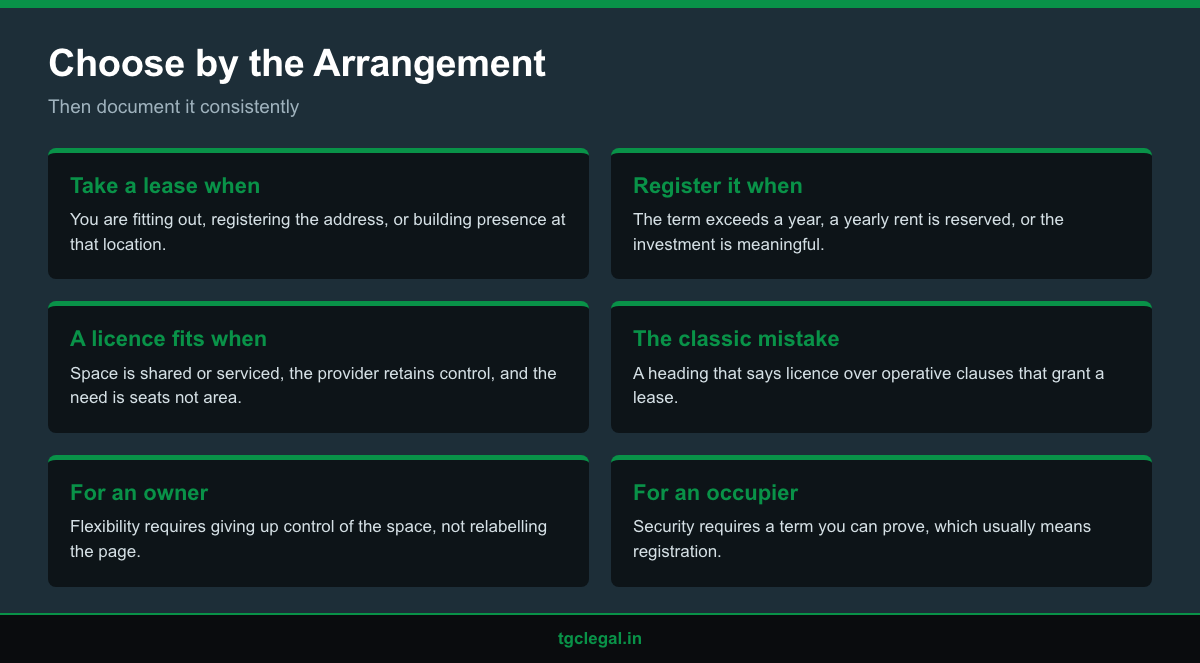
The choice should follow the commercial arrangement rather than the other way round.
Where the occupier needs a defined space to itself, is fitting out, is registering the address with regulators, or is building customer-facing presence there, a lease is the right instrument, and for anything beyond a short term it should be registered.
Where the arrangement genuinely involves shared or serviced space, where the provider retains control and services the premises, and where the occupier's requirement is a number of seats rather than an identified area, a licence or a services agreement is the honest description.
Having chosen, document it consistently. The commonest failure is a document that says licence in the heading and grants a lease in the operative clauses: exclusive use of an identified area, the occupier's own locks, a fixed term with a lock-in, and a reinstatement obligation on exit. Every one of those points towards a lease, and a court reading the document as a whole will say so.
A matter on an office tenancy dispute in Kochi shows how quickly the character of the arrangement becomes the central question once a dispute begins.
Registration, Duty and the Eleven-Month Habit
The market's standard answer to the registration requirement is the eleven-month agreement, renewed as needed. It is lawful and it is a trade.
What the owner gets is flexibility and a lower documentary cost. What the occupier gives up is security of term. Each renewal is a fresh negotiation in which the occupier's fit-out, its customer base at that address and its licences are the owner's leverage. A business that has spent on the space and cannot easily move is negotiating from a weak position every eleven months.
Stamp duty on a commercial space rental agreement in Kerala varies with the term and the rent reserved, and an insufficiently stamped instrument is inadmissible until the deficiency and any penalty are paid. Our note on the effect of stamping defects on a lease treats that separately.
For anything with real investment behind it, registration is worth the cost. It converts a renewable permission into a term the occupier actually holds, and it is a fraction of a fit-out budget.
Converting One Into the Other
Parties sometimes want to change the character of an existing arrangement, usually because the business has grown into the space or because the owner wants to regain flexibility. Both directions are possible and both need care.
Moving from a licence to a lease is the simpler direction. A new registered lease is granted for a defined term, the licence is terminated by agreement, and the parties record that possession from the commencement date is held under the lease. The point to watch is what happened before: where the occupier already had exclusive possession under the licence, the relationship may already have been a lease, and the new document should not recite a history that is inconsistent with that.
Moving from a lease to a licence is harder, and often not achievable at all where the premises are covered by rent control, because statutory protection once acquired is not surrendered by agreement. An owner attempting it should expect the earlier relationship to be treated as continuing.
A surrender of a lease is itself a transaction. Where the lease was registered, the surrender should be registered too, and the parties should deal expressly with the deposit, outstanding charges, fit-out and the condition in which the premises are handed back. Our note on the clauses that decide a commercial exit covers the mechanics.
Where an intermediate structure is involved, such as a business taking space from a tenant rather than from the owner, the analysis runs twice: what the head arrangement permits, and what the sub-arrangement purports to grant. A sub-tenancy cannot outlast the interest it was carved out of, and a matter on an IT park tenancy that broke down shows how quickly that becomes the live issue.
Six Clauses That Reveal What the Document Really Is
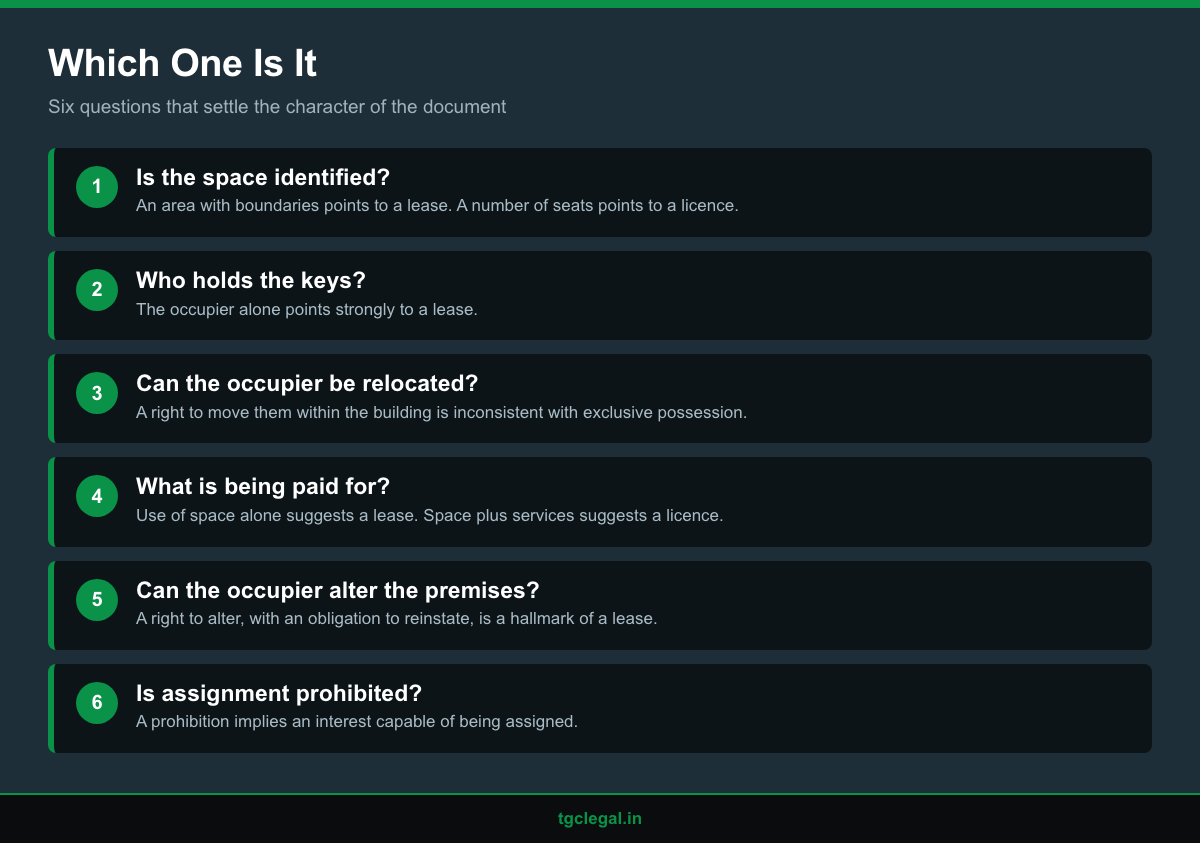
Where the character of an arrangement is unclear, these clauses usually settle it.
Read together, they describe either an occupier in control of a space or a provider in control of a service. A document that is ambiguous across all six is a document that will be argued about.
- Description of the space. An identified area with boundaries points to a lease. A stated number of seats, or a right to be allocated space, points to a licence.
- Keys and access. The occupier holding the only keys points strongly to a lease. The owner retaining access and providing security points the other way.
- Relocation. A right for the owner to move the occupier within the building is inconsistent with exclusive possession.
- Services. Where the consideration covers services provided by the owner rather than the use of space alone, the arrangement looks like a licence.
- Alterations and fit-out. A right to alter the premises and an obligation to reinstate them are hallmarks of a lease.
- Assignment and subletting. A prohibition on assignment implies there is an interest capable of being assigned, which points to a lease.
Conclusion
The question is not which document is better. It is which one describes what the parties are actually doing. An owner who wants flexibility must give up control of a defined space; an occupier who needs security must accept a term and pay to register it.
Where the document and the arrangement disagree, the arrangement wins, and that is discovered at the least convenient moment. The rent control practice page sets out how those disputes are handled.
Frequently Asked Questions
Does calling a document a licence stop it being a lease?

What is exclusive possession in practice?
Why does the distinction matter commercially?
Can a licensee be removed by changing the locks?
Which should a business taking an office choose?
Why do landlords prefer eleven-month agreements?
What happens if a lease that needed registration was not registered?
Does a lock-in clause suggest a lease?
Can an owner reserve a right to relocate the occupier?
What is the risk to an owner of getting this wrong?