Post
Reading a Registered Sale Deed: Nine Clauses Buyers Skim Past
 Property Litigation Law Services
The draft deed usually arrives late, in a format nobody can edit comfortably, a few days before an appointment that has already been booked. It is read for the names, the price and the schedule, and everything else is treated as the form of words that conveyances take.
That is a mistake with a long tail, because the deed is the document that will be produced in thirty years by somebody trying to prove what happened. These nine clauses are where the difference between a clean file and an argument is made.
Key Takeaways
- The recitals are evidence. A chain summarised loosely in the recitals is a defect a future buyer will find.
- The schedule identifies the property. A schedule that does not match the revenue record conveys something nobody can later locate.
- The covenants for title are the buyer's contractual remedy against the seller and are frequently cut down without comment.
- Consideration should match what was actually paid and should be traceable through banking channels.
- The indemnity, the possession clause and the delivery of documents clause decide what happens when something surfaces after completion.
The Recitals, and Why They Are Not Preamble
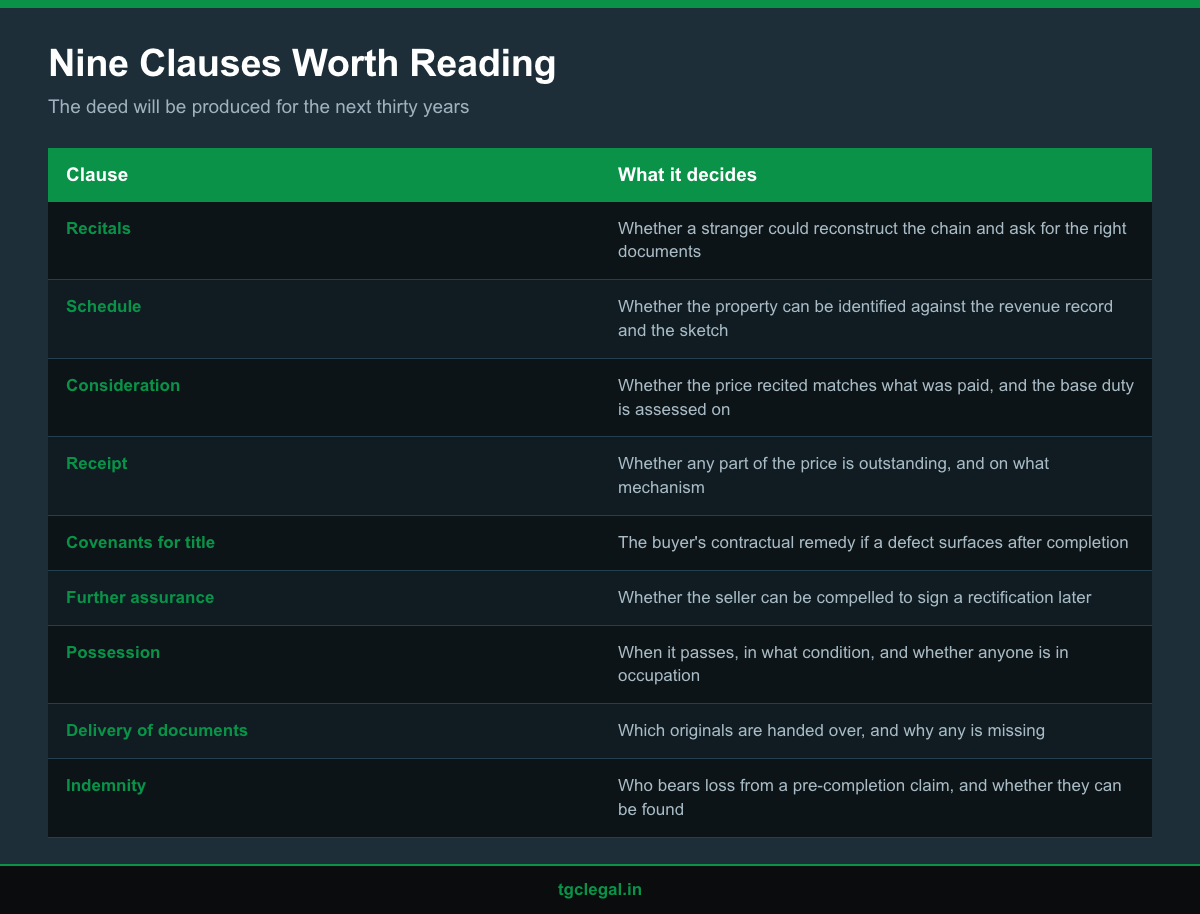
The recitals set out how the seller came to own the property. In a well-drafted registered sale deed they run through the chain in order, naming each instrument, its date, its parties and its registration particulars.
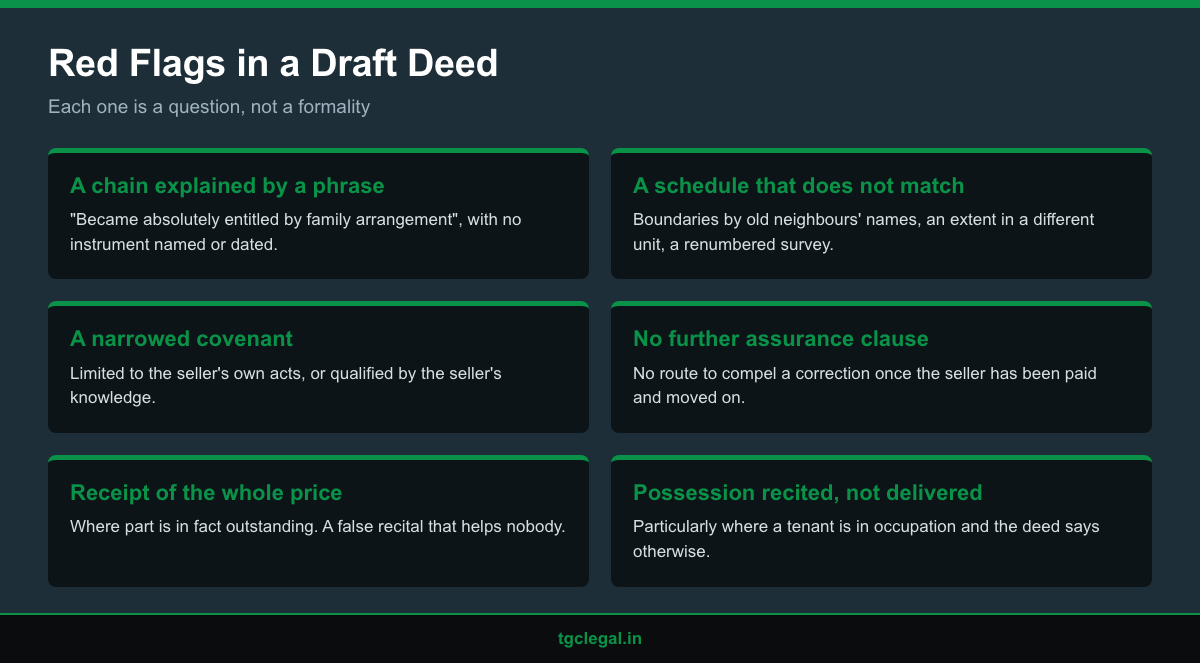
They matter for two reasons. First, they are an admission by the parties about the history, and a future buyer's reviewer will read them against the deeds themselves. Second, a gap papered over in the recitals is a gap that will be found. A recital that says the vendor became absolutely entitled by virtue of family arrangement, with no instrument named, is a flag rather than an explanation.
Where the chain includes a partition, a settlement with a reserved life interest, a release by some sharers, or a guardianship sale, each should be named and dated. Where an interest was extinguished, the recitals should say how.
The test to apply is simple. Could a stranger reading only the recitals reconstruct the chain and ask for the right documents? If not, the recitals need work, and the work is cheaper now than in the next transaction.
The Schedule, and the Description That Has To Match
The schedule identifies what is being conveyed. It should describe the property by village, survey number and subdivision, extent, and boundaries, in terms that match the revenue record and the survey sketch.
The recurring failures are consistent across Kerala files. Boundaries described by the names of neighbouring owners who changed decades ago. An extent stated in a unit that does not match the revenue entry. A survey number that was renumbered at a resurvey with no reference to the earlier number. A built property described only by a building number with no reference to the land.
Where an apartment is being conveyed, the schedule needs three parts: the unit by number, floor and block; the undivided share in the land as a specific fraction; and the land itself by survey number and extent.
Comparing the draft schedule against the revenue extract and the sketch, a week before the appointment, is the single most effective thing a buyer can do. Almost every failure at the counter is a schedule failure, as our note on the checklist a buyer works through before registering land in Kochi sets out.
Consideration, Receipt and the Payment Trail
The consideration clause states the price and the receipt clause acknowledges payment. Both should reflect what actually happened.
Where part of the price is paid after registration, the deed should say so and should record the mechanism, whether that is a retention, a post-dated instrument or a charge in the seller's favour. A deed that acknowledges receipt of the whole price where part is outstanding creates a false record that helps neither side.
Payments should be traceable through banking channels and should be recited with their particulars. Cash components produce a mismatch between the instrument and reality, and the party that suffers from that mismatch is almost always the buyer trying to prove what was paid.
The consideration also has a duty consequence. Duty is assessed on the higher of the stated consideration and the notified fair value, so understating the price does not reduce the charge and does invite a reference to the Collector on value.
Covenants for Title, and the Ones That Get Cut
A conveyance carries covenants by the seller about title: that the seller has good right to convey, that the buyer will enjoy the property without disturbance from the seller or those claiming under them, that the property is free from encumbrances, and that the seller will do whatever further acts are necessary to perfect the buyer's title.
These are the buyer's contractual remedy if something surfaces later, and they are quietly narrowed more often than buyers notice. A covenant limited to acts done by the seller personally excludes anything done by a predecessor. A covenant qualified by the words so far as the vendor is aware converts an absolute assurance into a statement about the seller's knowledge. A deed that omits the further assurance covenant leaves the buyer with no route to compel the seller to sign a rectification.
The further assurance covenant deserves particular attention, because the commonest post-completion problem is a document that needs correcting and a seller who has moved on. A covenant obliging the seller to execute such documents is what makes that correction possible without litigation.
Where the seller is genuinely unable to give a full covenant, that is a fact to price, not a clause to delete silently. Our note on remedies when a covenant is broken covers what enforcement looks like.
Possession, Documents and Indemnity
Three clauses decide what happens between execution and the buyer being fully in control.
Possession should state when it passes and in what condition. Where possession is to be given on a later date, or where a tenant is in occupation, the deed should say so and the agreement should carry the mechanism. A deed reciting that possession has been delivered where it has not is a false recital the buyer will later have to explain.
Delivery of documents should list the originals being handed over, by date and description. This is the clause most often reduced to a general phrase, and it is the one that matters when a title deed turns out to be with a lender rather than with the seller. Where an original is not available, the deed should say why.
The indemnity is the seller's promise to make good loss arising from a defect in title or from a claim relating to the period before completion. Its value depends on who the seller is and whether they can be found, which is why an indemnity is a complement to a retention rather than a substitute for one.
A matter on clearing a defective title in Kerala shows what rectification costs when these three clauses were left loose.
The Ninth Clause: What Is Not There
The last thing to read in a draft is what the draft omits.
There is often no statement about the land classification, which in Kerala is the fact most likely to determine what the buyer can do with the property. There is often nothing about approvals, so a built property is conveyed with no representation that it was built lawfully. There is often nothing about arrears of land tax, building tax or local body dues, which pass with the property in practical terms.
There is frequently no mention of pending proceedings, no statement that no title deeds have been deposited with any lender, and no confirmation that nobody else is in occupation. Each of those is a one-line representation, each is cheap to include, and each gives the buyer something to point at if the position turns out otherwise.
Sellers rarely object to representations that are true. A seller who objects to a representation is telling the buyer where to look, which makes the drafting exercise useful even when the clause does not survive negotiation.
Finally, check that the deed says how it will be corrected. A short clause providing that the parties will execute any document necessary to correct an error in description or particulars costs nothing and saves a great deal.
Conclusion
A registered sale deed is read once carefully and produced repeatedly for the next thirty years. The clauses that repay attention are not exotic: the recitals that reconstruct the chain, the schedule that matches the revenue record, a consideration that matches the payment trail, covenants that have not been quietly narrowed, and a clear position on possession, documents and indemnity.
Ten minutes with the draft, the revenue extract and the survey sketch, a week before the appointment, prevents most of what goes wrong later. The title verification practice page sets out how the review is normally scoped.
Frequently Asked Questions
Why do the recitals in a deed matter?

What should the schedule contain?
Should the deed record the actual price?
What are covenants for title?
Which covenant is most often narrowed?
What should the possession clause say?
Why does the document delivery clause matter?
Is an indemnity from the seller enough protection?
What is usually missing from a draft deed?
How should a buyer review the draft?