Post
Sale Deed Correction in Kerala: Rectification, Boundaries and Names
 Property Litigation Law Services
Sale deed correction in Kerala is usually needed long after the registration itself, when a bank, a village officer or a later buyer notices that the deed does not say what the parties meant. A misspelt name, a wrong survey number or a boundary that points to the neighbouring plot can sit unnoticed for years and then hold up a loan, a mutation or a sale.
The good news is that most of these errors can be fixed without litigation, provided the original parties are available and willing. Our note on how deed registration secures ownership in Kerala explains why the registered document carries so much weight. This note covers what happens when that document is wrong.
Key Takeaways
- A registered sale deed cannot be corrected by an affidavit, a letter or a handwritten note. It is corrected by another registered instrument, or by a court decree.
- A rectification deed executed by the same parties and registered at the sub registrar's office is the ordinary route for genuine clerical errors.
- A rectification that only corrects a mistake is treated very differently, for stamp duty, from one that changes what was actually conveyed.
- Where a party will not cooperate, the remedy is a suit for rectification under Section 26 of the Specific Relief Act 1963, which requires proof of fraud or mutual mistake.
- Correcting the deed is only half the work. The revenue records, the thandaper and any bank's security documents must be brought into line afterwards.
The Errors That Turn Up After Registration
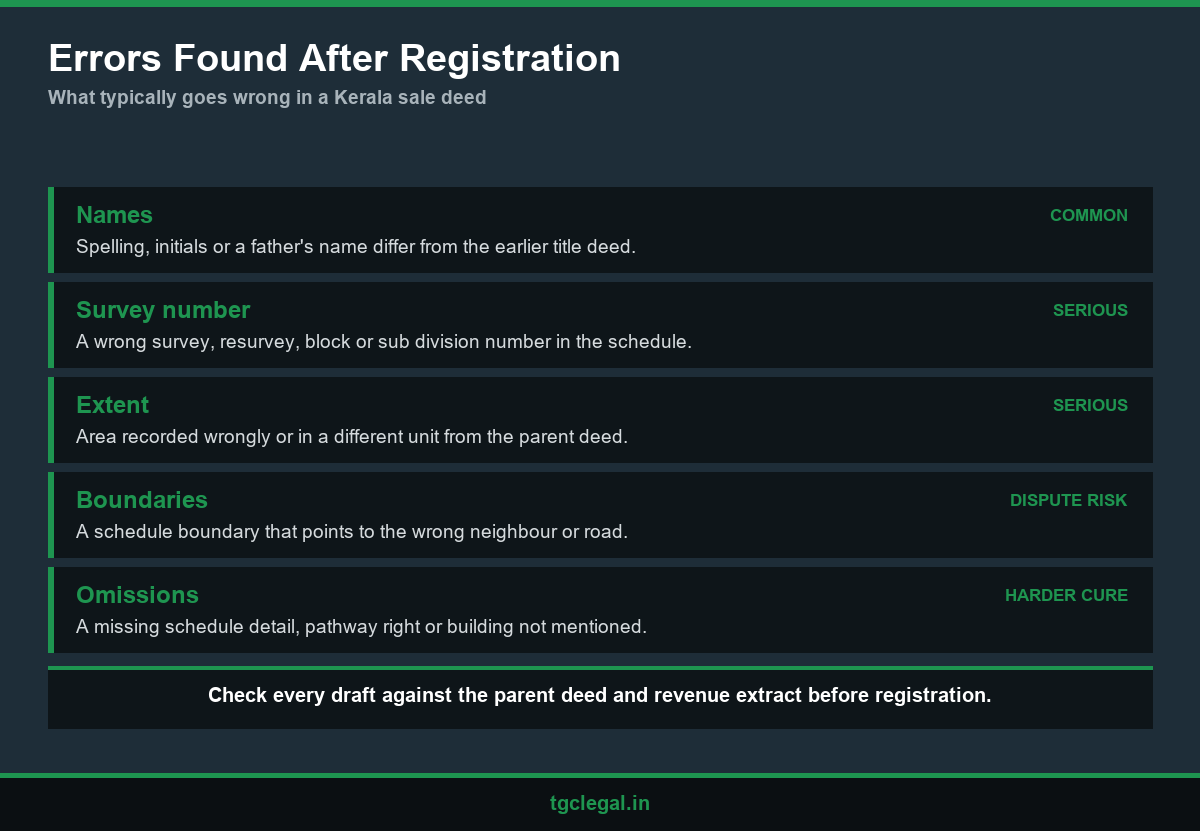
The most common error is in a name. A seller's name spelt differently from the earlier title deed, a father's name omitted, an initial transposed or a house name recorded in a different form. On its own this looks trivial, but when the next buyer's lawyer traces the chain, every inconsistency has to be explained, and a bank will not accept an explanation it cannot document.
The second category concerns the property description. A survey number or resurvey number entered wrongly, a sub division missed, a block number from the wrong village, or an extent recorded in cents where the earlier deed used ares. These errors matter more than names, because they go to what was actually conveyed.
Boundary errors form the third category. A schedule that describes the eastern boundary as a road when it is a neighbour's property, or that swaps north and south, creates a document that no longer describes the land on the ground. In a later dispute the boundaries often carry as much weight as the survey number.
The fourth category is omission: a missing schedule, a pathway right that the parties agreed but never wrote down, or a building that was conveyed with the land but not mentioned. Omissions are harder to cure, because the question becomes whether the parties ever agreed on the missing term at all.
How a Rectification Deed Works
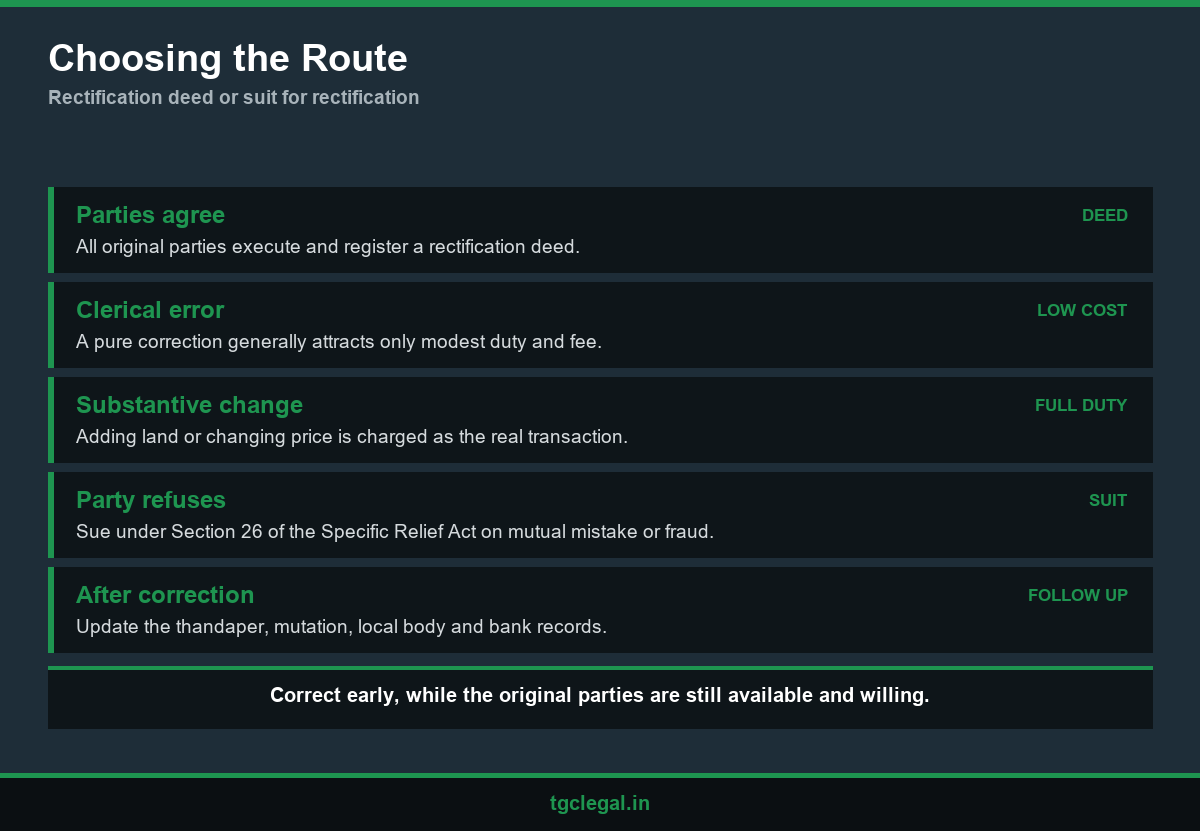
A rectification deed is a fresh instrument in which the parties to the original sale deed recite that deed, identify the error, state the correct particulars and confirm that the original deed should be read as corrected. It does not cancel the original document. It sits beside it in the chain of title and is read together with it.
The deed should be executed by all the parties who signed the original, or by their legal representatives where a party has died. It is presented for registration under the Registration Act 1908 at a sub registrar's office having jurisdiction over the property, usually the office where the original was registered. The registering officer will compare the rectification with the earlier document and may decline to register a rectification that is in substance a new transaction.
Drafting matters more than parties tend to assume. The deed should quote the incorrect entry exactly, give the correct entry exactly, and explain briefly how the error arose. Supporting documents such as the earlier title deed, the possession certificate, the resurvey records and identity documents should be checked before the draft is finalised, so that the correction does not itself introduce a new mismatch.
Where the correction affects the schedule, a fresh sketch or a survey report is often worth obtaining. A boundary correction drafted only from memory risks fixing one error and creating another.
Stamp Duty and Registration Fee on Rectification
The cost of a rectification depends on what it actually does. Where the deed merely corrects a clerical or descriptive error and transfers nothing new, the duty and fee under the Kerala Stamp Act and the registration fee table are generally modest. The Kerala registration department's portal publishes the current schedule and fair value information.
The position changes where the so called rectification adds land, changes the extent materially, alters the consideration or brings in a new party. In substance that is a further conveyance, and it is charged as the transaction it really is, with credit given for duty already paid on the original instrument. Parties sometimes discover this only at the counter.
The practical lesson is to describe the correction honestly. An attempt to pass off a fresh transfer as a clerical correction exposes the parties to a duty demand and leaves the title open to challenge. Where an extent was genuinely understated in the original deed, it is better to obtain advice on the correct instrument than to stretch a rectification to cover it.
Because duty rates and fees are revised from time to time, the figures should be confirmed with the sub registrar's office or a lawyer before execution.
When the Other Party Will Not Cooperate
A rectification deed needs the signatures of the original parties. Where the seller has died and the heirs are scattered, has moved abroad and stopped responding, or simply refuses because the property has risen in value, the consensual route is closed.
The remedy then lies under Section 26 of the Specific Relief Act 1963. Where, through fraud or a mutual mistake of the parties, a written instrument does not express their real intention, either party may sue to have it rectified. Rectification can also be claimed in the pleadings of a suit in which a right under the instrument is already in issue, by a plaintiff or by a defendant.
Two features of that remedy deserve attention. The mistake must be mutual, or the result of fraud. A buyer who simply misunderstood what he was buying cannot use rectification to rewrite the bargain. And the court must be satisfied that the real intention of the parties can be clearly proved, usually from the agreement for sale, the earlier title deeds, the payment record and the physical position on the ground.
The court will not grant rectification where it would prejudice rights acquired in good faith and for value by a third party. A suit should therefore be filed promptly, and the period of limitation should be checked on the facts of each case. In Ernakulam, such suits are heard by the civil court having jurisdiction over the property.
Revenue Records, Thandaper and the Bank
Once the deed is corrected, the corrected particulars have to travel. The village office maintains the thandaper and the basic tax register, and the mutation effected on the original sale will reflect the original error. An application with the rectification deed is normally needed to correct the revenue entry, after which the land tax receipt should show the right name, survey number and extent.
Local body records follow the same pattern. Building tax assessments and ownership certificates are often issued on the strength of the deed and the revenue entry, and they will repeat any error until it is corrected at source. Our note on how mutation errors affect property rights explains why a mismatch here can matter as much as an error in the deed.
Where the property is mortgaged, the lender holds the original deed and its own security documents describe the property. A rectification should be notified to the bank, the corrected deed deposited with the original, and the bank's records and any registered memorandum updated. An unexplained mismatch between the security documents and the corrected title can delay a closure, a top up loan or a sale.
Getting the Correction Right the First Time
The cheapest correction is the one made before registration. A careful reading of the draft against the earlier title deed, the revenue extract and the survey records catches most errors before the document reaches the sub registrar, and that is the stage at which a property documentation legal review earns its fee.
Where an error is found after registration, it should be dealt with promptly, while the original parties are alive, reachable and still on good terms. A rectification negotiated in the first year after a sale is routine. The same correction attempted after a death, a family dispute or a sharp rise in value may need a suit.
Keep the whole file together: the original deed, the rectification deed, the revenue correction order and the bank's acknowledgement. A matter on clearing a defective title in Kerala shows how quickly an old, unexplained discrepancy can resurface when the property is next sold.
Conclusion
Most errors in a registered sale deed are curable. Where the parties are available and the mistake is genuine, a properly drafted rectification deed registered at the sub registrar's office puts the record right at modest cost. Where a party refuses, a suit for rectification is available, but it demands proof of a mutual mistake or fraud and should not be delayed.
The correction is complete only when the revenue records, the local body records and the bank's file all match the corrected deed. A review of the original deed and the supporting records before anything is drafted is the sensible first step, and our property documentation practice page sets out how that review is normally scoped.
Frequently Asked Questions
Can a mistake in a registered sale deed be corrected by affidavit?

Who must sign a rectification deed in Kerala?
How much stamp duty is payable on a rectification deed?
What if the seller refuses to sign a rectification deed?
Does correcting the deed automatically correct the thandaper?
Can a rectification deed be used to add land left out of the sale?