Post
5 Things Corporate Lawyers Review Before a Commercial Agreement Is Signed
 Business Corporate Law
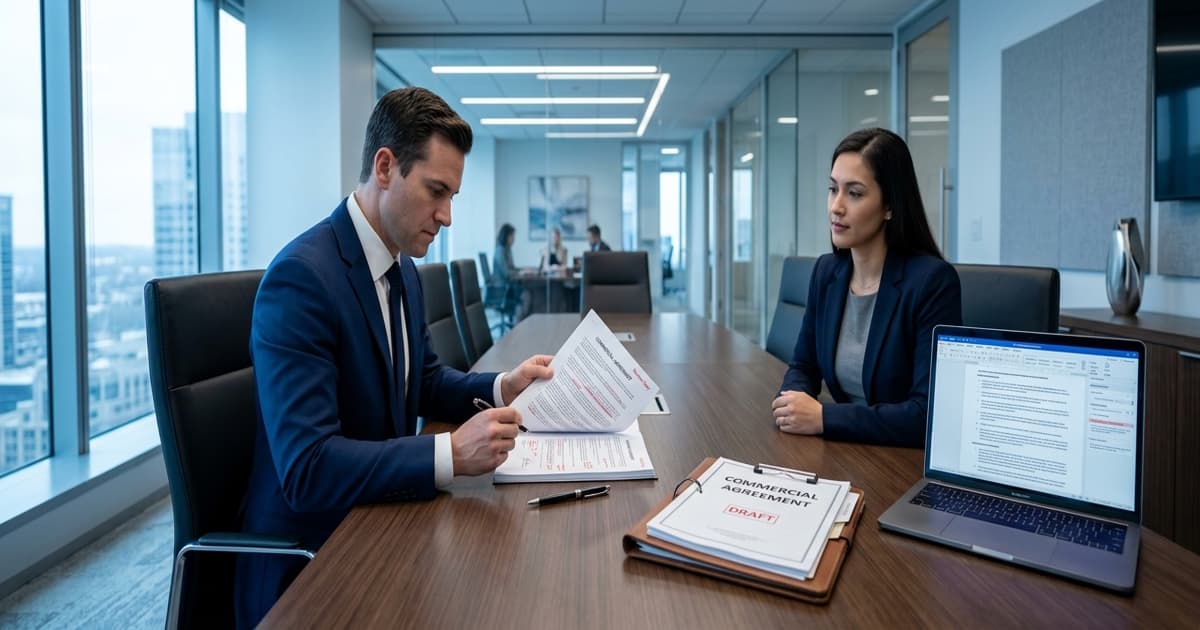
 Corporate lawyers are often the last line of defence before a business commits to a binding obligation. Whether the document in question is a commercial property lease agreement, a commercial property purchase and sale agreement, or a mutual non disclosure agreement, the review process follows a disciplined framework. In India, the enforceability of commercial contracts is governed by the Indian Contract Act, 1872, making careful drafting, risk allocation, and legal review essential before parties assume binding obligations. Understanding what a corporate lawyer examines before a signature is placed helps decision-makers engage more productively in the contracting process. For a deeper look at how software-related agreements are handled, see this post on the role of software development agreements in India.
Key Takeaways
A corporate lawyer reviews party identification, scope, payment terms, termination clauses, and dispute resolution before any commercial agreement is finalised.
Commercial agreements, including commercial rental agreements, lease rent agreements, and business confidentiality agreements, each carry distinct legal risks that require targeted review.
Understanding clauses in commercial lease termination agreements and the legal risks of commercial rental agreements can prevent costly disputes and liability exposure.
What Does a Corporate Lawyer Check in a Commercial Agreement?
The review conducted by a corporate lawyer is not a routine read-through. It is a structured analysis that examines how the contract performs under stress, ambiguity, and breach scenarios. Each clause is evaluated not just for what it says, but for what it omits and how it interacts with other provisions. The five areas covered below represent the core of this review process.
1. Accurate Identification of Parties and Authority to Contract
Why Party Identification Matters in a Commercial Agreement
The first thing a corporate lawyer verifies is whether the parties to the agreement are correctly and completely identified. This includes confirming the legal name of each entity, the jurisdiction of incorporation, and whether the signatory has the authority to bind the organisation. In practice, agreements signed by individuals who lack board authorisation or power of attorney can be challenged or declared unenforceable. This is especially critical in commercial property purchase and sale agreements where the stakes are significant, and title transfer depends on contractual validity. Any mismatch between the named party and the registered legal entity can create gaps that become costly to resolve after the fact.
2. Scope of Obligations and Performance Standards
Defining Deliverables to Prevent Commercial Rental Agreement Legal Risks
A corporate lawyer examines whether the scope of each party's obligations is precisely defined. Vague language around deliverables, timelines, or service levels is a primary source of commercial rental agreement legal risks and disputes in vendor contracts alike. In a commercial rental agreement or a lease rent agreement, this means scrutinising the permitted use clause, maintenance obligations, fit-out responsibilities, and subletting rights. In a service or supply agreement, it means verifying that milestones, acceptance criteria, and penalties for non-performance are explicitly stated. Ambiguity at this stage typically benefits neither party and routinely leads to litigation or arbitration.
Linking Scope to Payment Terms in Commercial Agreements
Payment terms are reviewed alongside scope because the two are interdependent. A commercial solicitor will assess whether payment is milestone-based or time-based, what triggers each payment, and what happens when a deliverable is disputed. Late payment interest clauses, currency of payment in cross-border agreements, and set-off rights are also examined. Where a commercial property lease agreement is involved, rent escalation clauses, security deposits, and the conditions for their return receive close attention. These details, when left unclear, become the basis for disputes that could have been resolved at the drafting stage.
3. Termination Clauses and Exit Mechanisms
Understanding Commercial Lease Termination Agreement Clauses
Termination provisions are among the most contested sections of any commercial contract. A corporate lawyer will assess whether termination rights are mutual or one-sided, what notice periods apply, and whether termination for convenience is permitted alongside termination for cause. In commercial property lease agreements, commercial lease termination agreement clauses must also address reinstatement obligations, dilapidation liability, and the conditions under which a tenant may exit without penalty. Poorly drafted termination provisions can leave one party locked into an obligation that no longer serves the business, or expose them to damages claims they did not anticipate. A careful review at this stage protects against both scenarios.
Force Majeure and Its Interaction with Termination Rights
Force majeure clauses are reviewed alongside termination provisions because they define what happens when performance becomes impossible due to events outside a party's control. A corporate lawyer will check whether the clause is broadly or narrowly drafted, whether it triggers suspension or termination, and whether notice requirements are specified. In post-pandemic contracting, businesses are far more attentive to how force majeure interacts with payment obligations and business tenancy agreement dispute prevention strategies. A clause that does not account for partial performance or prolonged disruption can produce unexpected results in practice.
4. Confidentiality, IP, and Data Protection Provisions
Reviewing Business Confidentiality Agreements Within Commercial Contracts
Many commercial agreements contain embedded confidentiality obligations, even when a standalone business confidentiality agreement or mutual non disclosure agreement exists. A corporate lawyer will review whether confidentiality obligations are consistent across all documents, whether the definition of confidential information is appropriately broad, and whether exclusions are reasonable. The duration of confidentiality obligations post-termination is another key consideration. In technology and data-driven sectors, these provisions must also align with data protection requirements under Indian law. For reference on how data protection obligations interact with commercial agreements, the Ministry of Electronics and Information Technology provides updated guidance on applicable frameworks. Further reading on this topic is available in the blog on data protection agreements and compliance with Indian and global laws.
Intellectual Property Ownership in Commercial Agreements
Where a commercial agreement involves the creation, transfer, or licensing of intellectual property, a corporate lawyer will examine who owns the output and whether that ownership is clearly documented. This is particularly relevant in agreements involving software development, creative services, or joint ventures. The review covers whether IP created during the contract term vests immediately in the commissioning party or remains with the creator until payment is received. Without clarity on this point, disputes over ownership can arise long after the commercial relationship has ended.
5. Dispute Resolution and Governing Law
Why Corporate Lawyers Prioritise Dispute Resolution Clauses
As a matter of best practice, commercial agreements should clearly specify how disputes will be resolved and which law governs the contract. A corporate lawyer will assess whether litigation or arbitration is more appropriate, given the nature of the transaction, the parties' jurisdiction, and the likely value of any dispute. In India, arbitration clauses are frequently preferred in commercial contracts because they offer greater confidentiality and procedural flexibility. For business tenancy agreement dispute prevention, this clause is particularly important since property disputes can be protracted when the mechanism for resolution is not clearly defined. A well-drafted dispute resolution clause can significantly reduce the time and cost of resolving commercial disagreements. The distinction between arbitration and litigation in corporate disputes is explored in depth in the blog on arbitration legal services versus litigation for corporates.
Jurisdiction Clauses and Their Practical Implications
A governing law clause determines which country's or state's legal principles apply to interpret the contract. A commercial solicitor will advise on whether the chosen jurisdiction is practical for enforcement, particularly where parties are based in different states or countries. In cross-border transactions, the enforceability of judgments and arbitral awards is a significant consideration that feeds directly into how the dispute resolution clause is structured. This review is not a formality. It determines the practical cost and feasibility of enforcing the contract if things go wrong.
Why a Proper Corporate Lawyer Review of Commercial Agreements Is Critical Before Signing
Businesses that skip or compress the legal review stage frequently encounter problems that could have been avoided at the drafting phase. Obligations that were assumed to be standard turn out to be unusually burdensome. Termination rights that were believed to be mutual are found to be one-sided. Confidentiality obligations that were expected to be limited turn out to have indefinite duration. A structured review by a corporate lawyer before signature is not about adding friction to the process. It is about ensuring that each party understands exactly what they are agreeing to and that the agreement reflects that shared understanding accurately.
Conclusion
A thorough pre-signing review by a corporate lawyer addresses five interconnected areas: party identification, scope and performance, termination rights, confidentiality and IP, and dispute resolution. Whether the agreement is a commercial property lease agreement, a mutual non disclosure agreement, or a complex commercial property purchase and sale agreement, each of these areas carries risk if reviewed inadequately. The cost of a proper legal review is invariably lower than the cost of resolving a dispute that arises from a poorly understood contract. Businesses that treat this review as a standard step in their contracting process are better positioned to manage commercial relationships with clarity and confidence. For a deeper look, see this post on how a corporate technology lawyer can protect your business interests at every stage of the contracting process.
Frequently Asked Questions
What does a corporate lawyer look for in a commercial rental agreement?

How are commercial lease termination agreement clauses typically structured?
What is the difference between a business confidentiality agreement and a mutual non disclosure agreement?
Why is governing law important in a commercial property purchase and sale agreement?
What role does a commercial solicitor play in reviewing a lease rent agreement?
How does a corporate lawyer approach dispute resolution clauses in commercial agreements?
What are the key legal risks in a commercial rental agreement that businesses should know?
How does a corporate lawyer handle IP ownership in commercial agreements?
What should businesses know about business tenancy agreement dispute prevention?
When should a business engage a corporate lawyer before signing a commercial agreement?