Post
POSH Conciliation vs Inquiry: An Employer Decision Guide
 Business Corporate Law
The choice between POSH conciliation vs inquiry is often treated by employers as a question of speed, when it is really a question of who is entitled to make it. Under the Sexual Harassment of Women at Workplace (Prevention, Prohibition and Redressal) Act 2013, that choice belongs to the aggrieved woman, and the Internal Committee's task is to respect it and record it properly.
Most challenges to Internal Committee proceedings that reach the courts begin with a procedural step taken in the wrong order, or recorded too loosely to be defended later. Our earlier note on what employers must know when a complaint arrives covers intake and acknowledgement. This note picks up at the next decision point and follows it through to the employer's action on the report.
Key Takeaways
- Conciliation under Section 10 of the 2013 Act is available only at the request of the aggrieved woman, and only before an inquiry begins.
- No monetary settlement can be the basis of conciliation. A settlement that turns on payment is outside the Act.
- A conciliated settlement must be recorded, sent to the employer and copied to both parties, and a breach of its terms reopens the route to inquiry.
- Inquiry under Section 11 is the right path wherever the complainant prefers it, the allegations are serious, or the facts are disputed. It must be completed within ninety days.
- Most successful challenges to Internal Committee proceedings turn on procedure: notice, hearing, composition, confidentiality and reasons.
What the Act Actually Permits
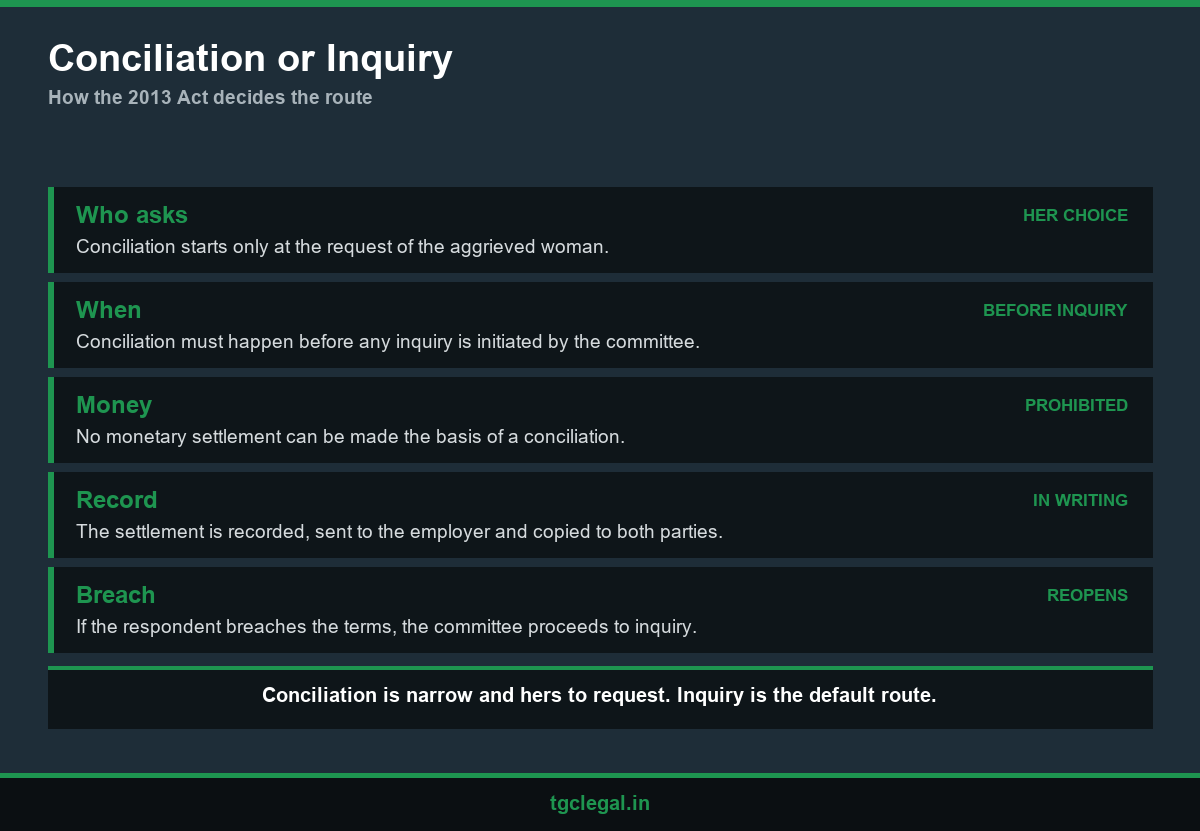
Section 10 of the 2013 Act on workplace sexual harassment allows the Internal Committee, before initiating an inquiry, to take steps to settle the matter between the aggrieved woman and the respondent through conciliation. Three conditions sit inside that sentence and each of them matters. The step is taken before inquiry, not part way through it. It is taken at the request of the aggrieved woman, not at the suggestion of the employer or the respondent. And no monetary settlement can be made the basis of the conciliation.
The first condition is about sequence. Once the committee has begun an inquiry, conciliation is no longer the statutory route, and a settlement reached in the middle of an inquiry sits uneasily with the scheme of the Act. Where a complainant changes her mind after an inquiry has started, the committee should record what has happened carefully and take advice on how to close or continue the proceeding.
The second condition is about ownership. An Internal Committee member who suggests conciliation to a complainant, however kindly, risks the later allegation that she was pressed into it. The safer practice is to explain both routes neutrally at the first meeting, in writing, and to act only on a written request from her.
The third condition is about substance. Conciliation is meant to resolve conduct, through an apology, an undertaking, a change in reporting lines or a similar measure. It is not a mechanism for buying a complaint out, and an agreement framed around a payment is vulnerable on that ground alone.
Recording the Settlement and What Happens on Breach
Where conciliation succeeds, the Act requires the Internal Committee to record the settlement and forward it to the employer, who acts on it. Copies go to the aggrieved woman and the respondent. Once a settlement has been recorded in this way, the committee does not conduct a further inquiry on the same complaint.
The record is where most conciliations fail, years later. A note that says the parties have resolved their differences is almost useless. A properly drawn settlement states the request for conciliation and its date, the specific terms agreed, who is responsible for each term, the timeline for compliance, and the consequence of breach. It is signed by both parties and by the committee members present.
The Act also provides for breach. Where the aggrieved woman informs the committee that a term of the settlement has not been complied with by the respondent, the committee proceeds to make an inquiry, or forwards the complaint to the police where the circumstances call for it. That is a further reason to write the terms precisely. A vague undertaking cannot be shown to have been breached.
Employers should calendar each obligation in the settlement and confirm compliance in writing. The employer's role does not end when the committee closes the file.
When Inquiry Is the Right Path
Inquiry is the default route, and it is the only route where the aggrieved woman does not request conciliation. It is also the better route in several situations even where conciliation is technically open.
- The allegations involve physical contact, threats, or a pattern of conduct across more than one complainant.
- The respondent is senior to the complainant, so that any settlement may be seen as made under pressure.
- The facts are disputed and a finding is needed for the organisation to act.
- An earlier settlement with the same respondent has been breached.
Where the respondent is an employee, Section 11 directs the committee to proceed in accordance with the applicable service rules, and where there are none, in the manner prescribed by the rules framed under the Act. The process must observe the principles of natural justice: notice of the complaint, an opportunity to reply, a hearing, the chance to present evidence and, in appropriate cases, to respond to witnesses.
The committee also has the powers of a civil court on summoning and enforcing attendance, examination on oath and the production of documents. Those powers should be used with care, and every exercise of them should be minuted. Our guide on how a complaint is filed and acknowledged explains the earlier stages that the inquiry builds on.
Timelines, Interim Relief and Confidentiality
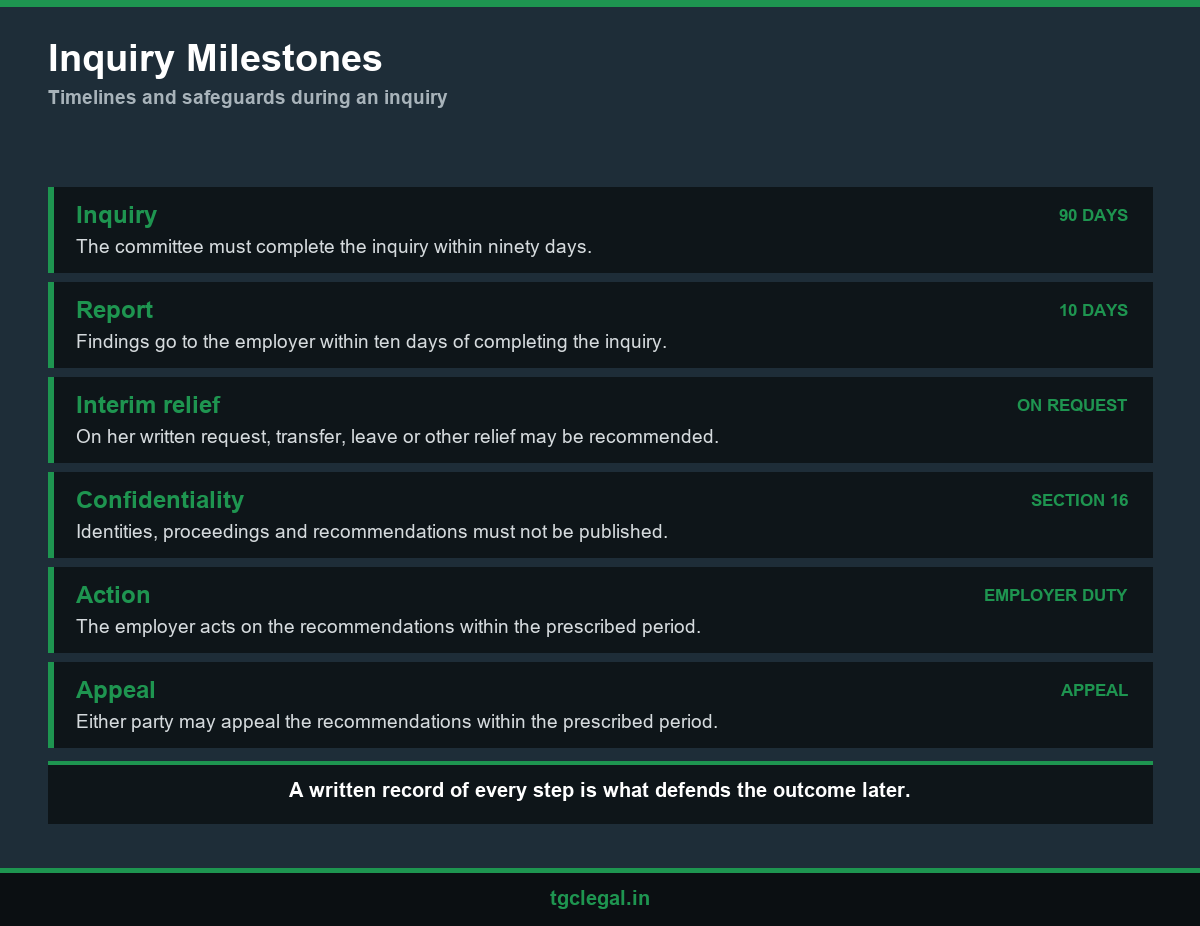
The Act requires the inquiry to be completed within ninety days. Within ten days of completing it, the committee must provide its report of findings to the employer and make it available to the concerned parties. Where the allegation is proved, the employer must act on the recommendations within the period the Act and rules prescribe, and the recommendations can include action under the service rules and a deduction from the respondent's wages for compensation, determined on the factors the Act lists.
During the inquiry, Section 12 allows the aggrieved woman to make a written request for interim relief. On that request the committee may recommend that either party be transferred, that she be granted leave, or that other prescribed relief be given, such as restraining the respondent from reporting on her work. The employer must implement the recommendation and report back. The leave is in addition to her ordinary entitlement.
Interim relief requests are often handled informally, and that is a mistake. The request, the recommendation and the employer's implementation should each be in writing, with dates. A complainant who later says she was left working under the respondent for weeks will be answered only by that record.
Confidentiality runs through all of this. Section 16 prohibits publication of the contents of the complaint, the identities of the parties and witnesses, the proceedings and the recommendations, subject to limited information on the justice secured. A matter involving an inquiry timeline at a Kerala IT company shows how a structured calendar, kept from the first day, makes these obligations manageable.
The Employer's Role in Acting on Recommendations
The Internal Committee recommends and the employer decides how to implement, but the employer cannot ignore a recommendation simply because it is inconvenient. Where the committee has found the allegation proved, the employer is expected to act within the prescribed period and to record what it has done.
That action should follow the organisation's disciplinary framework. A termination or demotion that skips the employer's own procedural steps can be challenged separately, even where the committee's finding is sound. The disciplinary authority should consider the report, record reasons and communicate its decision.
Where the allegation is not proved, the committee may recommend that no action is required. A finding that a complaint was false or malicious is a separate matter and requires a separate inquiry into intent. Mere inability to prove a complaint is not enough to treat it as false, and an employer that acts against a complainant on that basis exposes itself to serious risk.
Either party may appeal against the recommendations within the period prescribed. Employers should wait for that period to run before treating the matter as closed, and should keep the file intact while it does.
Common Mistakes That Get Proceedings Challenged
Most successful challenges do not dispute the facts. They identify a flaw in the process that makes the outcome unsafe. The following recur.
The committee is improperly constituted: no external member, a presiding officer who is not a senior woman employee, or a quorum that does not meet the organisation's own rules. Each of these can unsettle every proceeding the committee has handled.
The respondent is not given the complaint and supporting documents, or is given too little time to reply. A finding on evidence the respondent never saw is the most common ground of attack.
The report records conclusions without reasons. A report that summarises statements and then announces a finding, without explaining why one account was preferred, invites the court to set it aside.
Conciliation is recorded after the inquiry has begun, or at the employer's suggestion, or with a payment attached. Any one of these takes the settlement outside Section 10.
Confidentiality is breached by an internal email, a town hall announcement or a manager's conversation. Apart from the penalty the Act provides, the breach becomes part of the complainant's case.
Conclusion
The question of whether to conciliate or inquire is answered first by the aggrieved woman and then by the facts. Conciliation is a narrow route, available only at her request, before inquiry and without money. Inquiry is the broad route, with fixed timelines, natural justice and a reasoned report.
Employers who keep a written record of each decision, each timeline and each interim measure rarely face a successful challenge. Where a complaint has already arrived, or a recommendation is waiting for action, a review of the file before the next step is the prudent course, and our workplace harassment cases practice page explains how that review is normally scoped.
Frequently Asked Questions
Can an employer suggest conciliation to the complainant?

Can a POSH complaint be settled by paying compensation?
What happens if the respondent breaches a conciliated settlement?
How long does an Internal Committee inquiry take?
What interim relief can a complainant receive during an inquiry?
Why are Internal Committee findings most often set aside?