Post
Consumer Arbitration Clauses: Are They Enforceable?
 General Indian Law
Businesses often assume that an arbitration clause in their standard terms will keep customer disputes out of the consumer commissions. In India that assumption is usually wrong. A consumer arbitration lawyer will normally advise that the clause survives between commercial parties but does very little against a genuine consumer. This article explains why, what the Consumer Protection Act does to such clauses, and how to draft customer facing terms that do not mislead.
Key Takeaways
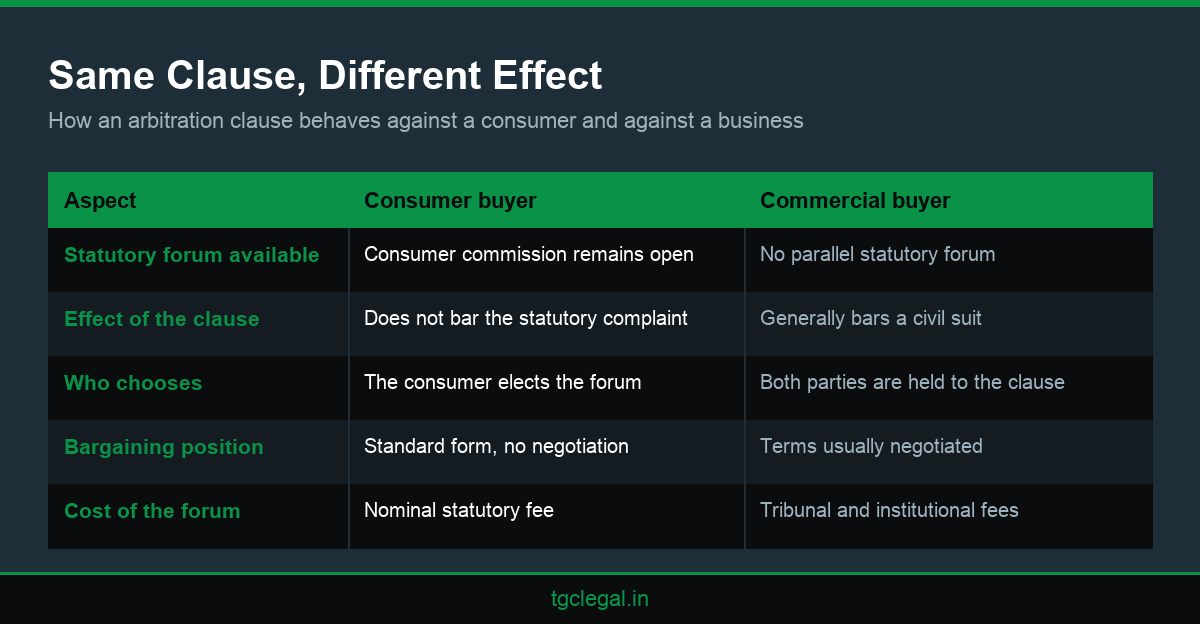
- An arbitration clause does not remove a consumer's right to approach a consumer commission. The statutory remedy sits alongside the contract rather than beneath it.
- The same clause behaves very differently against a commercial buyer, where it will generally be enforced and will bar a parallel civil suit.
- Drafting one universal clause for consumers and businesses creates a term that is unenforceable against one group and potentially misleading to the other.
Why a Consumer Contract Is Treated Differently
Arbitration rests on agreement between parties who chose their terms. That premise holds when two businesses negotiate a supply contract. It holds far less well when a customer clicks accept on a fifteen page document to buy an appliance or subscribe to a service. The consumer did not negotiate anything. They accepted a form drafted entirely by the seller.
Indian consumer law responds to that imbalance by giving the consumer a statutory remedy that does not depend on the contract. The remedy exists because Parliament created it, not because the seller agreed to it, so a term in the seller's own document cannot take it away. This is why courts and commissions have repeatedly held that an arbitration clause does not oust the jurisdiction of a consumer forum.
The practical effect is that the consumer chooses. A buyer who prefers arbitration can pursue it. A buyer who prefers the commission can file there, and the seller cannot compel a reference. Businesses that budget for arbitration and then find themselves before a district commission have usually misread this point at the drafting stage.
It is worth being clear about what this does not mean. The arbitration clause is not void, and it is not a drafting error in itself. It continues to operate wherever the counterparty is not a consumer, and it remains available if a consumer chooses to use it. What it cannot do is close the statutory door. Businesses sometimes overcorrect after learning this and strip arbitration out of every customer document, losing a mechanism that still has value in the commercial half of their contracts.
What the Consumer Protection Act Actually Provides
The Consumer Protection Act, 2019 builds a three tier structure of district, state and national commissions, with jurisdiction allocated by the value of the goods or services paid for. It defines a consumer as a person who buys goods or hires services for consideration, and expressly excludes a person who obtains them for resale or for any commercial purpose.
That exclusion is the hinge on which most disputes about the clause turn. A business buying machinery to run its factory is generally not a consumer, because the purchase serves a commercial purpose. A self employed person buying equipment to earn a livelihood may still be a consumer, because the Act carves that situation back in. Whether the buyer falls inside or outside decides whether the arbitration clause has any real effect.
The Act also introduces mediation as a route the commission itself can direct, along with product liability provisions and rules against unfair contract terms. A clause that is heavily one sided may attract attention on that separate ground even where arbitration is not the issue. The Department of Consumer Affairs publishes the framework and the current pecuniary limits.
When a Business to Business Arbitration Clause Still Works
None of this weakens arbitration between commercial parties. Where both sides are businesses, the clause does exactly what it is meant to do. It removes the dispute from the civil courts, and a court presented with a suit on the same subject will normally refer the parties to arbitration.
This matters for companies that sell through distributors and dealers. The contract with the distributor is a commercial contract and the arbitration clause in it is effective. The contract with the end customer is a consumer contract and the same clause is not. Businesses that recognise the split and paper the two relationships separately end up with terms that actually work. Our case study on a consumer arbitration matter in Kerala retail shows how that boundary is argued in practice.
Service businesses face the same question in a different form. A software company selling seats to a corporate customer is in a commercial relationship. The same company selling a subscription to an individual is not. Our note on when a SaaS licence needs legal vetting covers the contracting side of that distinction.
Drafting Customer Facing Terms That Do Not Mislead
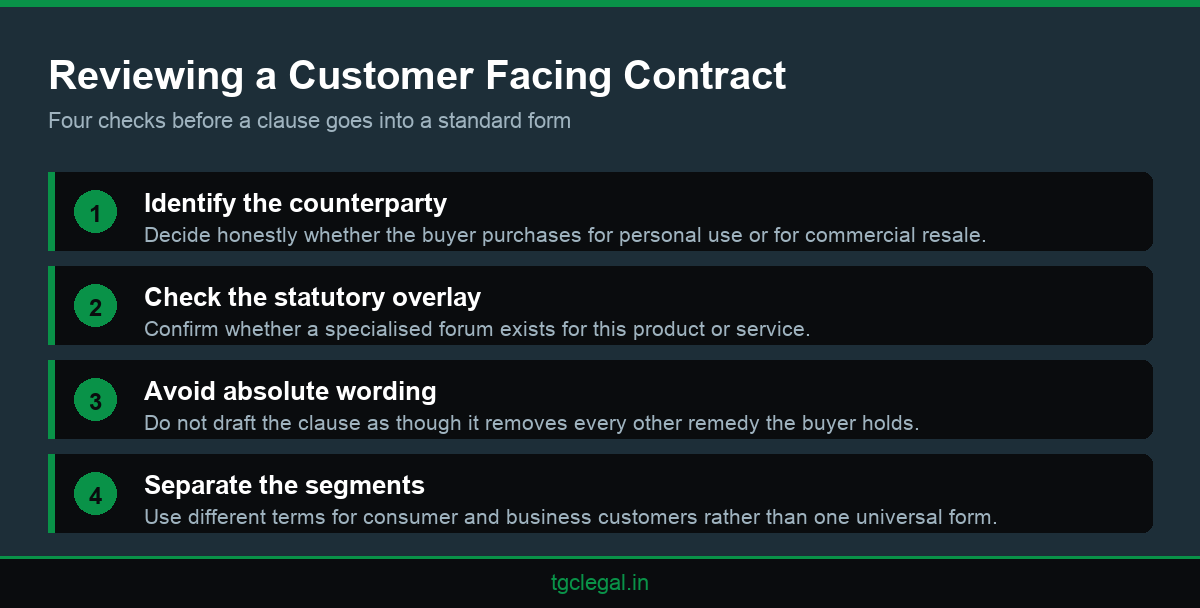
The most common drafting error is an absolute clause. Wording that says all disputes shall be referred to arbitration and no other forum shall have jurisdiction is unenforceable against a consumer, and it tells the customer something about their rights that is not true. Regulators treat overreaching standard terms unfavourably, and a clause that discourages a customer from exercising a statutory right is exactly the kind of term that attracts scrutiny.
A more defensible approach is to carve out consumer rights expressly. A clause can provide for arbitration while stating that nothing in it affects any right the customer holds under consumer protection law. That version is honest, is enforceable to the extent the law allows, and removes the risk that the whole clause is read as an attempt to contract out of statute.
Segmenting the documents is better still. Businesses that maintain one contract for commercial customers and a separate, plainer set of terms for consumers avoid the problem entirely. It costs more at the drafting stage and saves considerably later. Our note on five things reviewed before a commercial agreement is signed sets out the wider review discipline.
What Businesses Should Do Instead
If arbitration will not keep consumer disputes private, the practical answer is to reduce the number that escalate. Most consumer complaints reaching a commission passed through an internal complaints process that failed. A documented process with defined response times, a named owner and authority to settle small claims resolves the majority before they become formal.
Businesses should also understand the route a complaint takes. Many consumers begin with the national consumer helpline before filing anywhere, which gives a seller a window to resolve the matter directly. Treating that contact as an opportunity rather than a nuisance is the cheapest form of dispute management available.
Finally, advertising and product description deserve attention, because a large share of consumer claims begin with a gap between what was promised and what was delivered. Our case study on a false advertising complaint in Kochi illustrates how a marketing decision becomes a legal exposure.
Record keeping closes the loop. Where a complaint does reach a commission, the seller is asked to show what was promised, what was delivered and what was done about the complaint. A business that can produce the product description as published, the invoice, the service history and a dated log of its responses is in a very different position from one relying on recollection. The commission process is summary in nature, which rewards the party that arrives with documents and penalises the party that asks for time to find them.
Conclusion
An arbitration clause is a useful instrument in a commercial contract and a weak one in a consumer contract. Indian law gives consumers a statutory forum that private drafting cannot close, and a clause written as though it can is both unenforceable and misleading. Businesses selling to both segments should separate their terms, carve out consumer rights honestly, and invest in the internal process that stops complaints escalating. To see how commercial disputes are structured, explore our dispute resolution case studies.
Frequently Asked Questions
Can an arbitration clause stop a customer filing before a consumer commission?

Does the clause work if the buyer is a company?
Is a self employed buyer a consumer?
What is an unfair contract term?
Should we remove the arbitration clause from consumer terms entirely?
Can a consumer and a business agree to arbitrate after a dispute arises?
Which commission hears a complaint?
Does a mediation clause help more than an arbitration clause?
What about disputes with our distributors?
Can a consumer complaint and an arbitration run at the same time?