Post
Limitation of Liability Clauses in Indian Business Contracts
 General
In most commercial negotiations, the limitation of liability clause is the provision that receives the least attention at the start and the most attention once something goes wrong. It decides how much one party can recover from the other, which kinds of loss are excluded altogether, and which risks sit outside the cap entirely. Under Indian law these clauses are generally enforceable between commercial parties, but their effect depends on how they interact with the Indian Contract Act 1872, with indemnities elsewhere in the document, and with the insurance each side actually holds. A cap that looks reasonable in isolation can produce a very different result when read against the rest of the contract.
This article explains how caps and exclusions operate, where the usual carve outs come from, and what small and medium businesses should check whether they are the supplier or the customer. It reflects the approach a contract lawyer in Kochi would typically take during a commercial contract review, and it builds on our note on what corporate lawyers review before a commercial agreement is signed.
Key Takeaways
- Section 73 of the Indian Contract Act already excludes remote and indirect loss, so contractual exclusions should be drafted with that baseline in mind.
- Under section 74, a sum named in the contract operates as an upper limit, and the court awards reasonable compensation within it.
- Carve outs for fraud, wilful misconduct, confidentiality, IP and data breach should be deliberate choices, not boilerplate.
- An indemnity that sits outside the cap can effectively remove the cap for the risks that matter most.
- A cap is only as useful as the money behind it, so insurance and balance sheet strength should be checked alongside the wording.
How Indian Law Treats Damages and Caps
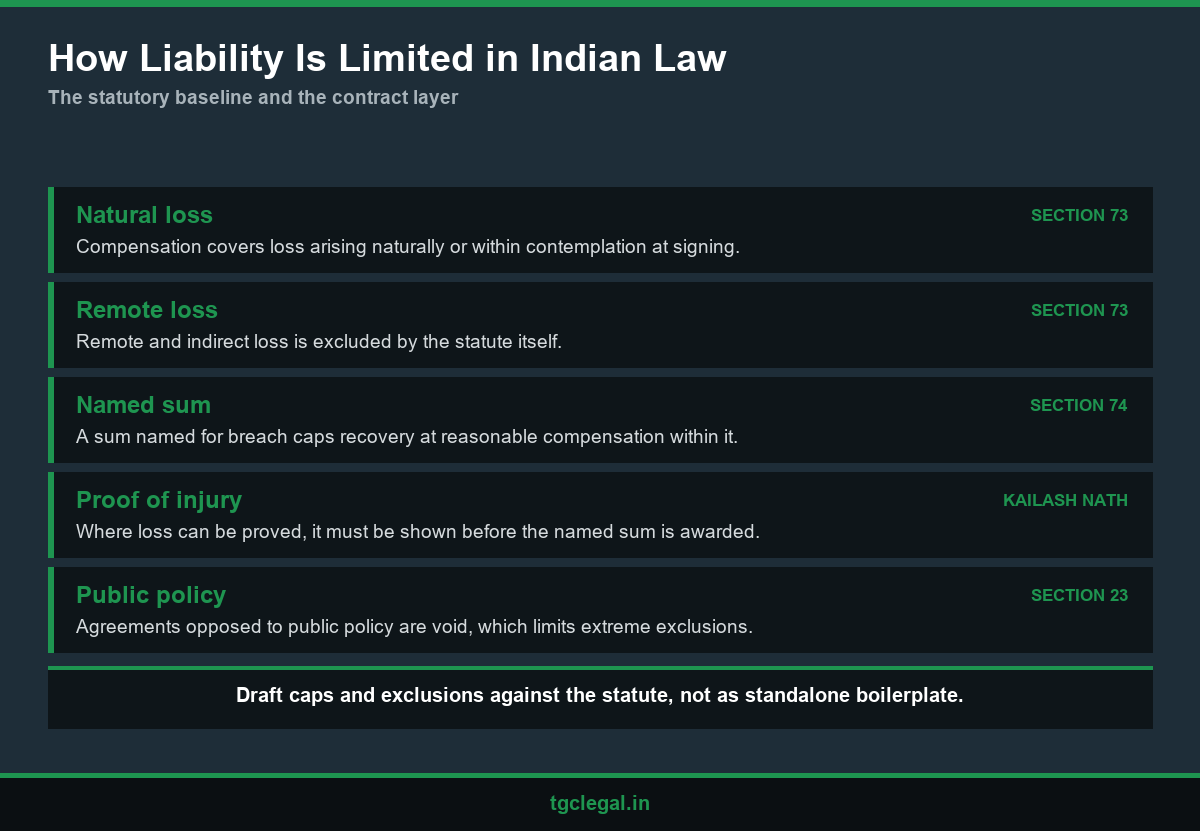
The starting point is section 73 of the Indian Contract Act. A party who suffers a breach is entitled to compensation for loss or damage which naturally arose in the usual course of things from the breach, or which the parties knew, when they made the contract, to be likely to result from it. The same section states that compensation is not given for any remote and indirect loss or damage sustained by reason of the breach.
Section 74 deals with contracts that name a sum payable on breach, or that contain a stipulation by way of penalty. In either case, the injured party is entitled to reasonable compensation not exceeding the amount so named. Indian law does not draw the sharp distinction between liquidated damages and penalties found in English law. The named sum acts as a ceiling, and the court decides what is reasonable within it.
The Supreme Court in Kailash Nath Associates v Delhi Development Authority (2015) clarified that section 74 does not dispense with the need for legal injury. Where loss is capable of proof, it must be shown, and the named sum is not awarded automatically. For drafting purposes, this means a cap or a liquidated sum limits recovery, but it does not guarantee it.
Indian courts have generally respected limitation clauses negotiated between commercial parties, subject to the overriding rule in section 23 that agreements opposed to public policy are void. A well drafted cap will therefore usually be applied as written, so the wording must be right before signature.
Excluding Consequential and Indirect Loss
Most contracts contain a clause excluding "indirect or consequential loss", often followed by a list such as loss of profit, loss of revenue, loss of goodwill and loss of data. The difficulty is that these labels do not map neatly onto section 73. Loss of profit, for example, may be a direct and natural consequence of a breach, and treating it as excluded can surprise a customer whose entire claim is about lost revenue.
The safer approach is to say exactly what is excluded rather than relying on the word "consequential". If the parties intend to exclude loss of profit whether direct or indirect, the clause should say so. If the customer wants to preserve recovery for the cost of procuring replacement services, wasted expenditure or regulatory fines, those heads should be expressly carved back in.
Data is a frequent point of friction. A supplier hosting or processing customer data will often seek to exclude loss of data entirely. A customer should consider whether restoration costs, notification costs and the cost of responding to a regulator ought to remain recoverable, particularly where the supplier controls the systems involved.
Exclusions should also be read against the definition of the services and the warranty clause. An exclusion drafted for a software licence may operate very differently when the same template is used for a managed service.
Carve Outs for Fraud, Misconduct, Confidentiality, IP and Data
Carve outs identify liabilities that are either uncapped or subject to a different limit. The most common are fraud, wilful misconduct or gross negligence, breach of confidentiality, infringement of third party intellectual property, and breach of data protection obligations. Death or personal injury caused by negligence is also usually carved out.
Fraud is the clearest case. A clause that purports to exclude liability for a party's own fraud is unlikely to be upheld, and drafting an express carve out removes any argument. Wilful misconduct and gross negligence are less settled concepts in Indian law, so if they are used, a short definition helps avoid a dispute about what they mean.
Confidentiality and IP carve outs reflect the fact that the harm from a leak or an infringement can far exceed the contract value. For a technology business, the IP indemnity is often the single most important protection in the agreement. Data breach carve outs have gained weight since the Digital Personal Data Protection Act 2023, under which a Data Fiduciary remains responsible for processing carried out on its behalf by a Data Processor. Our note on DPDP compliance and penalties explains that exposure.
Each carve out should be tested against the commercial reality. A supplier that accepts unlimited liability for every data incident may be accepting a risk it cannot insure. A customer that accepts a low cap on confidentiality breaches may have no meaningful remedy. The answer is often a middle ground, which is where super caps come in.
Super Caps and Caps Tied to Fees Paid
A general cap is commonly expressed as a multiple of fees, such as the fees paid or payable in the twelve months before the claim. This ties liability to the value of the relationship, which suppliers find fair. Customers should check how the formula works early in the contract, when little has been paid, and whether "paid" or "payable" is used, since the difference can be significant.
A super cap is a higher, separate limit for specific risks, typically data breach, confidentiality or IP. It allows the supplier to avoid unlimited exposure while giving the customer a recovery that reflects the true scale of those risks. Super caps can be a fixed amount, a higher multiple of fees, or linked to the limit of a particular insurance policy.
Good liability cap drafting also addresses whether the cap applies per claim, per year or in aggregate across the term. An aggregate cap that is exhausted by a single early claim leaves the customer unprotected for the rest of the contract. Equally, a per claim cap with no aggregate can leave a supplier facing repeated claims from one underlying failure.
It should also be clear whether amounts paid under the super cap erode the general cap, and whether service credits count towards either limit. These mechanics are easy to overlook and difficult to argue about later.
How Caps Interact With Indemnities and Insurance
The relationship between indemnity and liability provisions is where many contracts produce unintended results. Sections 124 and 125 of the Indian Contract Act deal with contracts of indemnity and the rights of the indemnity holder. Commercial indemnities are usually drafted far more broadly than the statutory definition, and the question is whether they fall inside or outside the cap.
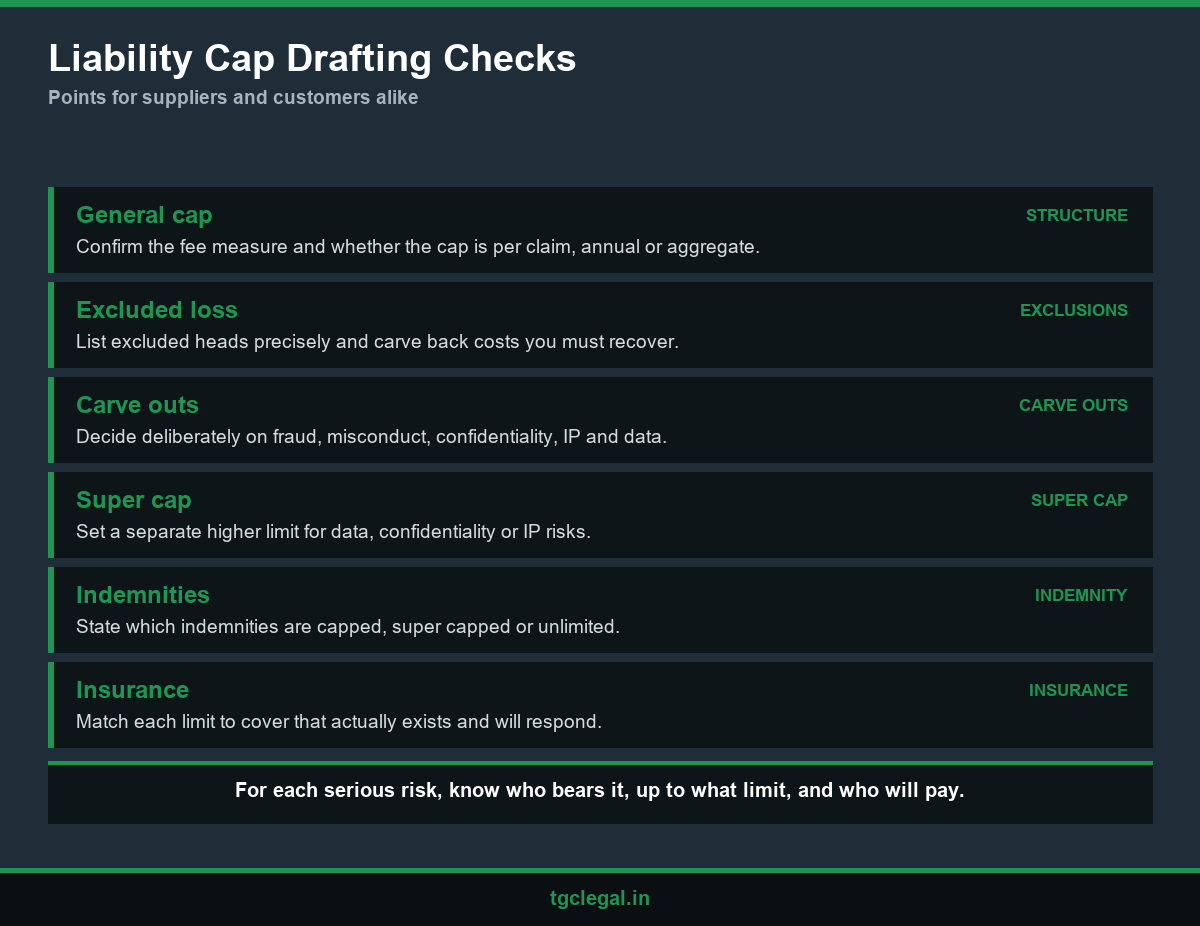
If the indemnity sits outside the cap, a party can frame an ordinary breach claim as an indemnity claim and avoid the limit altogether. If it sits inside, the indemnity may add little beyond the general right to damages. The drafting should state clearly which indemnities are capped, which are subject to a super cap, and which are unlimited.
Insurance should follow the same map. A supplier offering a super cap for data incidents should confirm that its cyber policy actually responds to that risk and carries a matching limit. A customer may reasonably ask for evidence of cover and a commitment to maintain it for the term and a period afterwards. Our master services agreement guide discusses how these clauses sit within a framework contract.
The test is simple: for each serious risk, identify who bears it, up to what limit, and what money will actually be available to pay. If those three answers do not line up, the clause needs further work.
Drafting Checks for SMEs on Both Sides of a Deal
Smaller businesses often receive templates from larger counterparties and sign them with limited negotiation. Even where leverage is limited, a few targeted points can change the outcome. The checks below apply whether you are supplying or buying.
- Read the cap, exclusions, carve outs and indemnities together, not as separate clauses.
- Confirm whether the cap is per claim, annual or aggregate, and how fees are measured.
- Check that excluded heads of loss do not remove the claim you are most likely to bring.
- Align any super cap with insurance that actually exists.
- Make sure the clause works for both parties, not only one.
Suppliers should resist unlimited liability for broadly worded indemnities and check that the cap protects them against claims framed in different ways. Customers should look for carve outs that preserve recovery where the supplier controls the risk, such as data handling and IP.
For a practical illustration, see a matter involving liability terms in Ernakulam IT contracts.
Conclusion
Limitation clauses decide the real financial outcome of most contract disputes, yet they are often accepted as standard wording. Under Indian law, sections 73 and 74 set the baseline, and the drafting on exclusions, carve outs, super caps and indemnities determines how far the parties depart from it.
Because each transaction allocates risk differently, the right position depends on the services, the data involved and the insurance in place. A review of your draft or existing agreements will show whether the clause does what you expect, and you can learn more on our commercial contracts practice page.
Frequently Asked Questions
Are limitation of liability clauses enforceable in India?

What does section 73 of the Indian Contract Act cover?
How does section 74 affect liquidated damages?
What is a super cap in a commercial contract?
Should indemnities sit inside or outside the liability cap?
What should an SME check before accepting a liability cap?