Post
Multi-Tier Dispute Clauses: Drafting Traps in Negotiation, Mediation and Arbitration Ladders
 General
Almost every commercial contract drafted in the last decade contains a ladder. The parties will first attempt to resolve the matter amicably. Failing that, senior representatives will meet. Failing that, the matter goes to mediation. Only then does it go to arbitration. It reads as prudent, it costs nothing to insert, and it is usually copied from the last contract.
It is also the clause most likely to be argued about at the exact moment nobody wants to argue about drafting. A ladder written without time limits, without a defined trigger to move between rungs and without a carve-out for urgent relief does not save cost. It creates a preliminary dispute about whether the arbitration has properly begun, and it can quietly consume the limitation period while the parties are still exchanging letters. Our wider guide to resolving commercial disputes in India covers the route as a whole; this note is about the rungs before it.
Key Takeaways
- Indian courts have generally declined to treat pre-arbitral steps as an absolute bar to arbitration, but the clause's own wording still decides how much time and argument a party loses.
- The Limitation Act applies to arbitration. Time spent in negotiation is only excluded where there is a clear breaking point, so an open-ended ladder is a limitation risk.
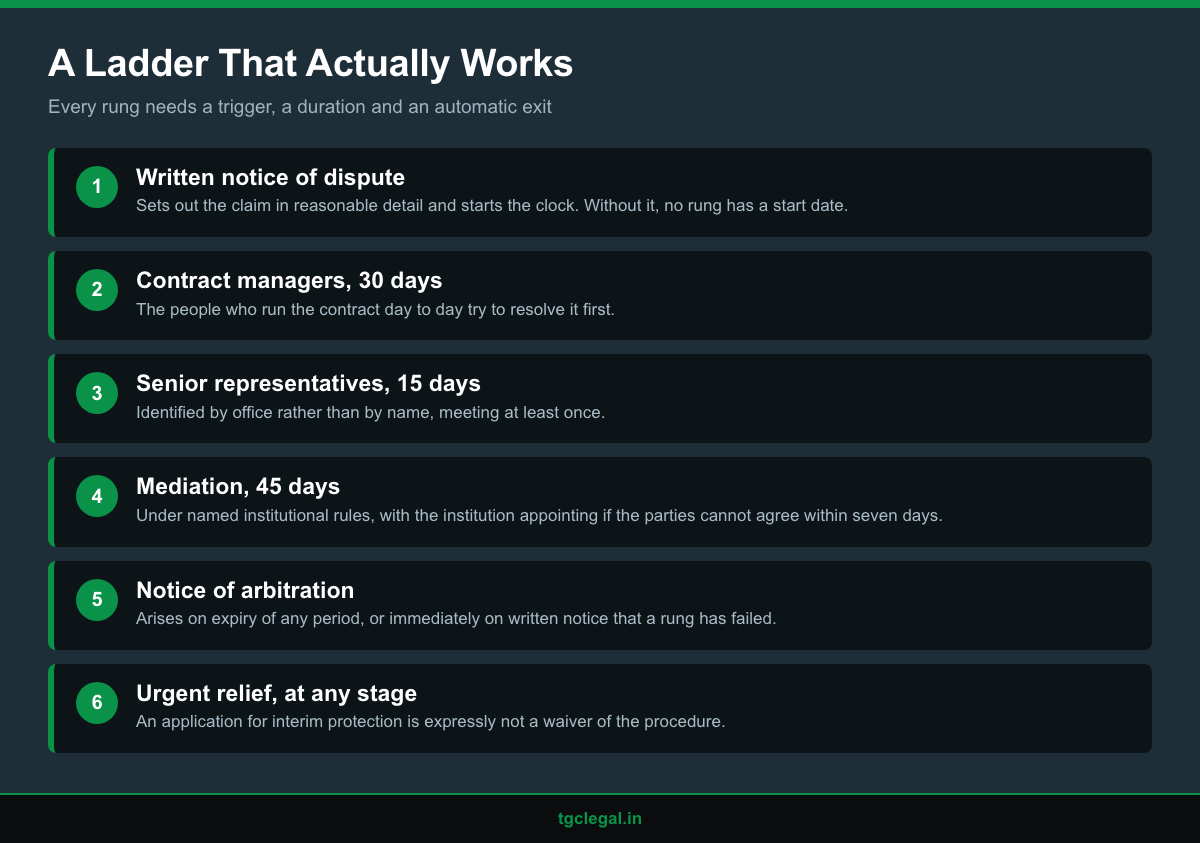
- A tier with no deadline is not a tier. Every rung needs a start trigger, a duration and an automatic exit.
- Urgent interim protection under Section 9 remains available whatever the ladder says, and the clause should say so expressly.
- Naming a mediation institution and its rules removes the argument about what mediation was even supposed to look like.
What the Ladder Is Actually Trying to Buy
The commercial case for escalation is sound. Most disputes between parties in a continuing relationship are worth settling, and the cost of a full reference is disproportionate to a great many of them. A structured pause forces the people who can settle to meet before positions harden, and it gives each side a reason to price its own case honestly.
The Mediation Act, which now provides a statutory framework for institutional mediation in India and makes a mediated settlement agreement enforceable in the same manner as a decree, has strengthened that case considerably. A settlement reached at the mediation rung is no longer an informal understanding that has to be sued upon if it is broken.
What the ladder cannot do is substitute for a working relationship. Where one party has already decided not to pay, a compulsory meeting is a formality that delays the inevitable, and courts have said as much. The drafting question is therefore not whether to have tiers, but how to build tiers that add value when the relationship is salvageable and get out of the way when it is not.
Are the Earlier Rungs Actually Binding in India?
This is the question every party asks once a dispute starts, and the honest answer is that it depends on how the clause is written and how quickly the answer is needed. The general direction of Indian authority has been to treat pre-arbitral steps as procedural rather than as an absolute jurisdictional bar, particularly where insisting on them would be an empty formality because relations have plainly broken down.
That is a comfort, not a licence. Two consequences follow. First, an opposing party will still take the point, and taking it costs a hearing and several months even when it fails. Second, a clause that uses unambiguous conditional language, that fixes a defined period for each step, and that makes completion of the step a stated pre-condition to the notice of arbitration, is materially harder to bypass than one that says the parties shall endeavour to resolve the matter amicably.
The related mechanism worth distinguishing is pre-institution mediation under the Commercial Courts Act, which applies to commercial suits that do not contemplate urgent interim relief and has been held mandatory. That regime governs suits, not arbitrations, and it is a frequent source of confusion when a contract contains both an arbitration clause and a court jurisdiction clause that nobody deleted.
A corporate arbitration attorney reviewing a ladder before a dispute exists is really asking one thing: if we needed to be in front of a tribunal in eight weeks, what in this clause stops us? The answer is usually a rung with no end date.
The Limitation Problem Nobody Prices In
Section 43 of the Arbitration and Conciliation Act applies the Limitation Act to arbitrations as it applies to court proceedings. That single line is the reason an open-ended ladder is dangerous. A claim that would have been in time when the breach occurred can be out of time by the point the parties finish negotiating.
The Supreme Court has held that the period spent in bona fide negotiation may be excluded, but only where the record shows a clear point at which negotiations broke down. Correspondence that trails off, or a series of without-prejudice meetings with no closing letter, does not produce that breaking point. The party relying on the exclusion is the one that has to prove it.
There is a second clock. An application to have an arbitrator appointed where the other side will not cooperate is itself governed by a limitation period, and it does not wait for the ladder. A party that spends fourteen months in escalation and then discovers its appointment application is stale has lost the claim without a tribunal ever reading it.
The drafting fix is unglamorous and effective. Cap each rung. Require a written notice to start it and a written notice to end it. State that failure to respond within the period is deemed a failure of that rung. Those three sentences convert a limitation argument into a documentary record.
Six Traps That Recur
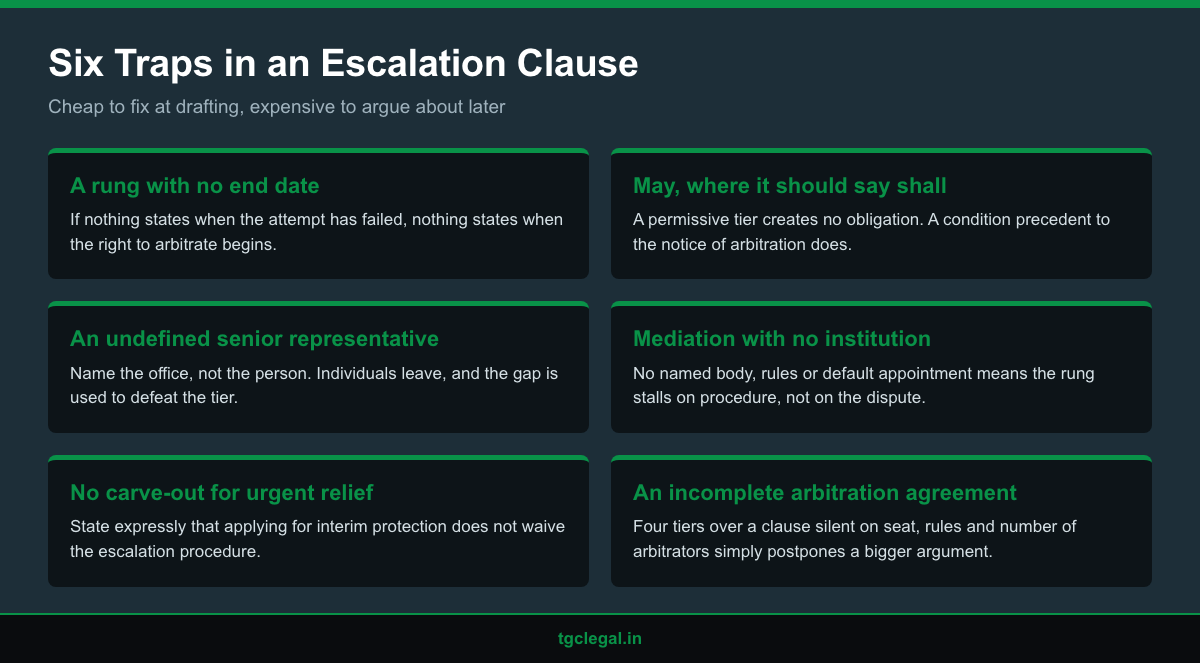
The same defects turn up across sectors, and each one is cheap to fix at drafting and expensive to argue about later.
None of these are exotic. They are what happens when a dispute resolution clause is treated as boilerplate rather than as the part of the contract that operates precisely when everything else has stopped working, and a corporate arbitration attorney asked to enforce one will spend the first fortnight on the clause rather than on the claim. Our note on the clauses that carry the risk in a commercial agreement makes the same point about the contract as a whole.
- No time limit on a rung. The clause says the parties shall attempt to resolve the matter amicably and stops there. There is no date on which that attempt has failed, so there is no date on which the right to arbitrate arises.
- Permissive language pretending to be mandatory. A tier expressed as something the parties may do creates no obligation at all, while a tier expressed as a condition precedent to the notice of arbitration creates a real one. Contracts routinely mix the two in consecutive sentences.
- An undefined senior representative. Where the clause requires a meeting between senior executives without saying who they are, the tier can be defeated by sending someone junior or by the named individual having left the company.
- Mediation with no institution and no rules. Without a named body, agreed rules and a default appointment mechanism, the mediation rung stalls on procedure, fees and venue before anyone discusses the dispute.
- No carve-out for urgent relief. A party facing dissipation of assets should not have to argue that applying to court was permitted, and the absence of an express carve-out is exactly the gap the other side will use.
- A ladder bolted onto an incomplete arbitration agreement. Where the clause fixes four tiers but leaves the seat, the rules and the number of arbitrators unstated, the escalation merely postpones a second and larger argument.
Urgent Relief Without Breaking the Ladder
The most common practical failure of an escalation clause is that a party needs protection now and believes the clause forbids it from going anywhere. It does not. Section 9 allows a court to grant interim measures before, during or after arbitral proceedings, and a well-advised party does not sit on a real risk of dissipation because a negotiation window has three weeks left to run.
That said, the clause should say so. A single sentence confirming that either party may apply to a competent court or to an emergency arbitrator for urgent interim relief at any stage, without that application constituting a waiver of the escalation procedure, removes the argument entirely. Where the parties want speed, an emergency arbitrator route under institutional rules is worth naming; our note on how urgent protection works before and after a tribunal exists sets out the difference between the court and tribunal routes.
The reverse point matters too. Applying for urgent relief should not be treated by the other side as abandonment of the ladder. Saying that expressly protects the party that acts responsibly.
A matter where urgent relief was secured while a contract dispute was still live shows why the timing usually cannot wait for a scheduled meeting.
What a Workable Ladder Looks Like
A clause that earns its place is short. A written notice of dispute setting out the claim in reasonable detail starts the process. Thirty days for the contract managers to resolve it. If unresolved, fifteen days for nominated senior representatives, identified by office rather than by name, to meet at least once. If still unresolved, forty-five days for mediation under named institutional rules, with the institution appointing the mediator if the parties cannot agree within seven days. On expiry, or on written notice from either party that a rung has failed, the right to refer to arbitration arises immediately.
Add the seat, the rules, the number of arbitrators and the language, because a ladder attached to an incomplete arbitration agreement simply relocates the argument. Our note on the clauses that make a company's arbitration agreement work covers that half of the drafting, and the two should be read together.
Add the carve-out for urgent relief. Add a confidentiality provision covering what is said at the earlier rungs, so that a candid settlement discussion cannot be quoted back at a hearing. Add a line stating that time spent in the procedure is not intended to extend any limitation period, so that neither party is lulled into treating the ladder as a stay.
Finally, keep the total realistic. Ninety days across all rungs is a genuine attempt at settlement. A ladder that runs to seven months is not a settlement mechanism, it is a delay mechanism, and it will be used as one by whichever party is holding the money.
Conclusion
A multi-tier clause is worth having when it is drafted as a timetable and worth avoiding when it is drafted as an aspiration. The test to apply to any draft is whether a reader could tell, from the clause alone, on exactly which date a party becomes entitled to issue a notice of arbitration. If that date cannot be worked out, the clause has not created a settlement process, it has created a preliminary dispute.
Where an existing contract already carries a vague ladder, it can usually be tightened at the next amendment without reopening anything commercial. Further reading on the route sits on the commercial disputes practice page, and the official text of central legislation carries the statutory provisions referred to above.
Frequently Asked Questions
Can the other side refuse arbitration because we skipped the negotiation step?

Does time spent in negotiation extend the limitation period?
How long should each tier be?
Can we go to court for an injunction while the ladder is still running?
Is mediation under the Mediation Act different from an informal settlement meeting?
Is pre-institution mediation under the Commercial Courts Act relevant to us?
What is the single most common defect you see?
Should the senior representatives be named in the contract?
Does the ladder need to name a mediation institution?
Can an existing vague clause be fixed without renegotiating the contract?