Post
Section 9 and Section 17: Interim Relief in Arbitration
 General
Most commercial disputes have a moment where waiting for the award is not an option. Funds are about to move, a guarantee is about to be encashed, or source code is about to change hands. An interim arbitration lawyer has two routes in that moment: an application to a court under Section 9, or an application to the tribunal under Section 17. This article explains which to use, when, and what has to be proved.
Key Takeaways
- Section 9 allows a court to grant protection before the arbitration begins. Section 17 gives the tribunal equivalent power once it exists.
- Once a tribunal is constituted, courts generally step back and send parties to the tribunal unless tribunal relief would be ineffective.
- An interim order made by a tribunal under Section 17 is enforceable as an order of the court, so it is not merely a direction the other side can ignore.
Two Routes to the Same Protection
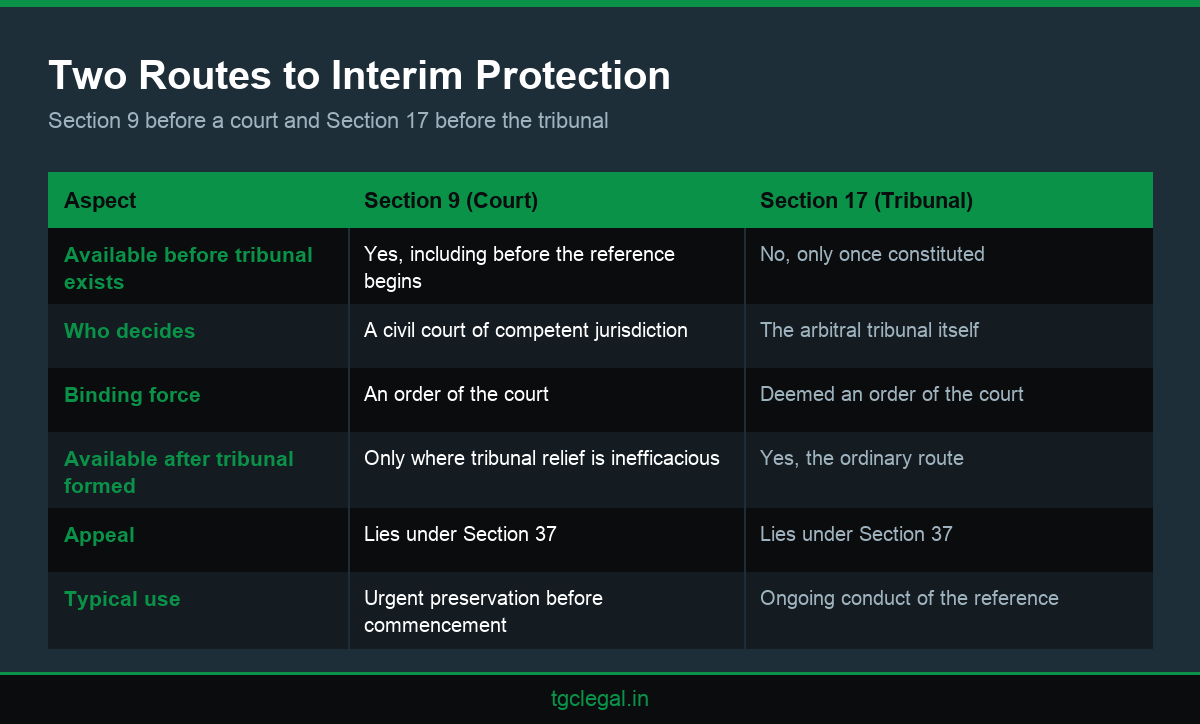
The Arbitration and Conciliation Act provides for urgent protection twice over. Section 9 empowers a court to grant interim measures before the arbitration commences, during it, or after the award but before enforcement. Section 17 empowers the tribunal to grant substantially the same measures once it has been constituted.
The categories of relief overlap almost completely. Both can secure the amount in dispute, order preservation or interim custody of goods, restrain disposal of assets, appoint a receiver, permit inspection of property and grant injunctions. The difference lies in who decides and when the route is available, not in what can be ordered.
Amendments to the Act deliberately narrowed the court's role once a tribunal exists. A court will not entertain a Section 9 application after constitution unless it finds that the remedy under Section 17 would not be efficacious. That threshold is real, and an application filed in the wrong forum usually loses the very time it was meant to save. Our note on emergency arbitrators and regular tribunals addresses the related question of which kind of tribunal can act fastest.
When Only a Court Can Help
The clearest case for a court application is where no tribunal exists and none can be constituted quickly. Appointing arbitrators takes time even when both sides cooperate, and cooperation is unlikely where one party is dissipating assets. Where the harm will occur within days, Section 9 is the only realistic route.
Courts are also the right forum where relief is needed against someone who is not a party to the arbitration agreement. A tribunal derives its authority from the agreement and cannot bind a stranger to it. Where an order must reach a bank, a registry or a third party holding disputed goods, the court's jurisdiction is what makes the order effective.
The third situation is after the award. Between the making of an award and its enforcement there is a window in which a losing party may put assets beyond reach. Section 9 remains available in that period, and using it can be the difference between an award that is collected and one that is merely correct.
Timing an application well is as important as choosing the forum. Courts are alert to applicants who sit on knowledge of a risk for months and then arrive claiming extreme urgency, because delay tends to undermine the assertion that harm is imminent. Equally, an application made before the facts are properly documented invites refusal and hands the other side an early advantage. The practical balance is to prepare the material as soon as a dispute becomes likely so that the application can be filed the moment the risk crystallises. Our note on what documents to provide before a lawsuit sets out the groundwork this requires.
What Changes Once the Tribunal Exists
After constitution, the tribunal becomes the ordinary forum for interim protection. It knows the record, it can hear an application quickly without competing for space in a court list, and it can revisit its own order as the reference develops.
The reform that made this workable was the change to the status of a tribunal's order. An interim measure under Section 17 is deemed to be an order of the court and is enforceable in the same manner. Before that change, a tribunal could make an order it had no means to enforce, which encouraged parties to go to court regardless.
Practically, this means a party should not treat a Section 17 order as advisory. Non compliance exposes the defaulting party to contempt proceedings in the same way as breach of a court order. Our case study on interim relief in a contract dispute shows how the sequencing works when the underlying dispute is already before a tribunal.
What Applicants Must Actually Prove
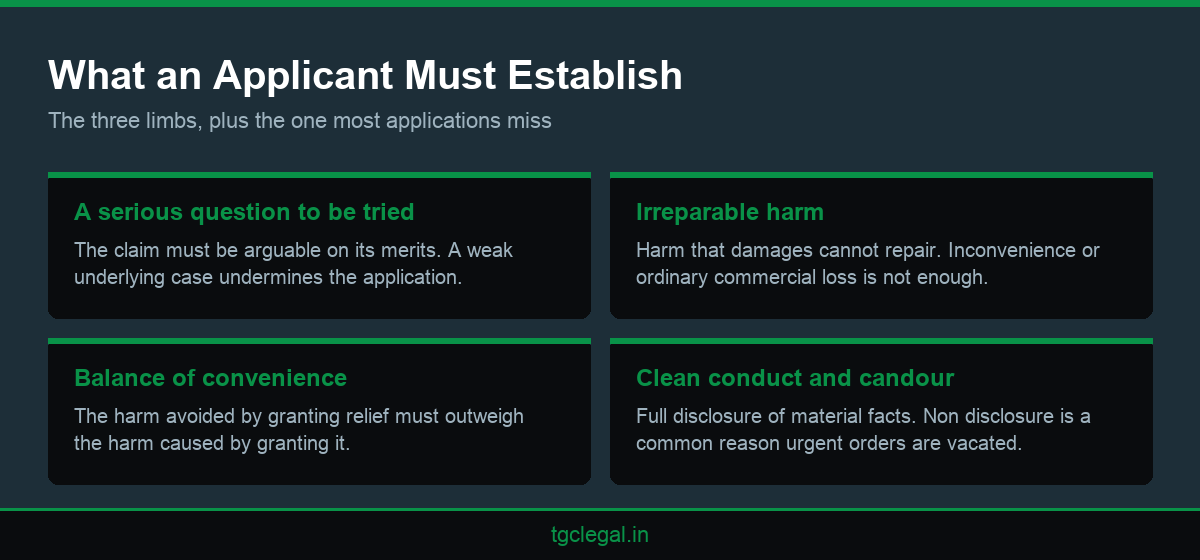
Whichever forum is chosen, the test follows established principles for injunctive relief. The applicant must show a serious question to be tried, meaning the underlying claim is arguable. It must show that the harm feared cannot be adequately compensated in damages. And it must show that the balance of convenience favours granting the order.
The second limb defeats most applications. Commercial parties often describe consequences that are severe but entirely financial, and a loss that money can repair is by definition not irreparable. Applications succeed where the subject matter is unique, where the respondent's solvency is genuinely doubtful, or where the harm is reputational or operational in a way damages cannot address.
A fourth requirement is often overlooked. Urgent applications are frequently heard with limited notice, which imposes a duty of full and frank disclosure. An applicant who omits material facts risks having the order vacated on that ground alone, regardless of the merits, and starts the substantive reference having lost credibility with the tribunal.
Courts and tribunals also commonly attach conditions to relief rather than granting or refusing it outright. An applicant may be required to give an undertaking in damages, so that if the claim ultimately fails the respondent can be compensated for loss caused by the order. Security may be demanded, or the order may be limited in time and made returnable on a fixed date. A party seeking urgent protection should therefore consider not only whether relief is likely but what it will be asked to put up in exchange, because an undertaking given lightly can become a substantial liability if the reference goes the other way.
Enforcing an Interim Order
An order is only as good as the mechanism behind it. A court order under Section 9 is enforced through the ordinary contempt and execution machinery. A tribunal order under Section 17 is enforced as though the court had made it, which puts the two on a similar footing.
Either order may be appealed under Section 37, which provides a route for a party who considers the relief wrongly granted or wrongly refused. That appeal does not automatically suspend the order, so a party subject to an interim measure should assume it must comply while the appeal is pending unless a stay is separately obtained.
Progress can be tracked through the eCourts services portal where the matter is before a court. The wider point is that interim relief is a tool for preserving the position until the tribunal decides, not a shortcut to winning. Applications framed as an early attempt to obtain the substantive remedy are usually refused. See our page on commercial suits and dispute resolution.
Conclusion
Section 9 and Section 17 provide the same protection through different doors. Before a tribunal exists, or where an order must bind someone outside the arbitration agreement, the court is the route. Once the tribunal is seized of the matter, it becomes the ordinary forum and its orders carry the force of a court order. Choosing correctly at the outset preserves the time that urgent relief is meant to protect. To read how these applications work in practice, explore our dispute resolution case studies.
Frequently Asked Questions
What is the difference between Section 9 and Section 17?

Can we approach a court after the tribunal is constituted?
Is a tribunal's interim order actually enforceable?
What kind of relief can be granted?
What does irreparable harm mean?
Can we obtain relief before the arbitration has started?
Can an interim order bind a party outside the contract?
Is there an appeal against an interim order?
What happens if we do not disclose everything?
Should the arbitration clause say anything about interim relief?