Post
What an Encumbrance Certificate Does Not Reveal About a Property
 General
The encumbrance certificate is the document buyers ask for first and understand least. A nil certificate is read as a clean bill of health, an advance is paid on the strength of it, and the claims that were never registered anywhere arrive afterwards.
Our earlier note explains why the certificate is obtained and what it establishes. This is the second half of the subject: what falls outside it, why, and what a buyer should run alongside it.
Key Takeaways
- The certificate reports registered transactions recorded at one sub registrar's office for a stated period. That is its whole scope.
- Equitable mortgages by deposit of title deeds, unregistered leases, family claims and pending litigation without a registered notice do not appear.
- A nil certificate for a short period proves very little. Kerala practice takes the full thirty years.
- Jurisdictional reorganisation means a transaction may sit at a different office than the one searched.
- The certificate is one input among six. The others are physical, documentary and human.
What the Certificate Is
The encumbrance search a buyer commissions produces an extract, and it is worth being precise about what that extract is. A sub registrar's office maintains indexes of the documents registered there, and on application it issues a statement of the transactions recorded against a described property for a stated period. Where transactions are found they are listed with their particulars. Where none are found for that period, a nil certificate issues.
Two features follow from that definition and explain almost every misunderstanding. The certificate is limited to what was registered, and it is limited to the office searched.
It is also only as good as the description used to search. A property described by a survey number that was renumbered at a resurvey, or by boundaries that have changed, may return a nil result simply because the search did not reach the right entries. That is why the application should carry the full description as it appears in the revenue record, including any earlier survey numbers.
An encumbrance search can now be initiated through the state registration department's own services, which has made the mechanics quicker without changing the scope of what is reported.
The Claims That Never Reach the Registry
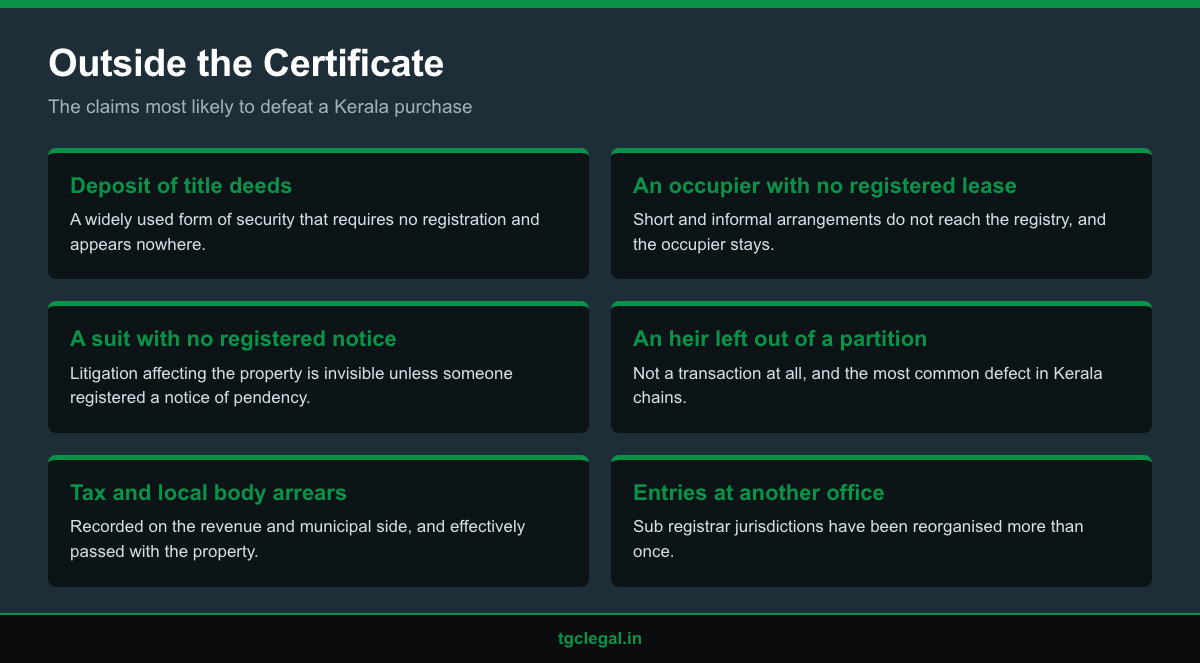
The most significant omission is the equitable mortgage. A charge created by deposit of title deeds with a lender does not require registration in the same way a formal mortgage deed does, and a great deal of property-backed lending in India is secured this way. Nothing about it appears on the certificate. The property is charged, the buyer cannot see it, and the lender's claim survives the sale.
Unregistered leases are the second. A lease for a term under twelve months does not require registration, and in practice many longer arrangements are also left unregistered. A buyer who takes a nil certificate as evidence of vacant possession may find a tenant in occupation with an arguable right to remain.
Pending litigation is the third. A suit affecting the property does not appear unless a notice of pendency has been registered, which is a step a litigant may or may not have taken. A decree that has not yet been executed is similarly invisible.
Family claims are the fourth and the most common in Kerala. A partition that omitted an heir, a minor's share dealt with without permission, an oral family arrangement never reduced to writing, a share held by someone who has been abroad for twenty years. None of these are registered transactions, and all of them are claims against the property.
Finally there are statutory and revenue claims: arrears of land tax and building tax, local body dues, and demands under land use or acquisition proceedings. These live in the revenue and municipal records, not at the sub registry.
Period, Jurisdiction and the Nil Certificate Trap
Buyers frequently obtain a certificate for thirteen years because that is what a bank asked for, and then treat it as covering the property's history. It does not. A charge created fifteen years ago and never discharged is outside the period searched and will not be listed.
The working standard for a purchase is the full thirty years, matching the period over which the chain of title is traced. Anything shorter leaves a window in which a transaction can hide, and the cost difference between a thirteen-year and a thirty-year certificate is trivial against the risk.
Jurisdiction is the second trap. Sub registrar office boundaries have been reorganised over the decades, and a property that sits in one office's jurisdiction today may have been registered at another in the past. Where a chain shows a change of office, the search should cover both. A nil result from the wrong office is worse than no result, because it produces false confidence.
The third trap is the description. Where the certificate describes a property in terms that do not exactly match the deed and the revenue extract, the buyer should treat it as unsearched until the discrepancy is explained. A matter on clearing a defective title in Kerala turned on precisely that kind of mismatch.
The Six Checks That Sit Alongside It
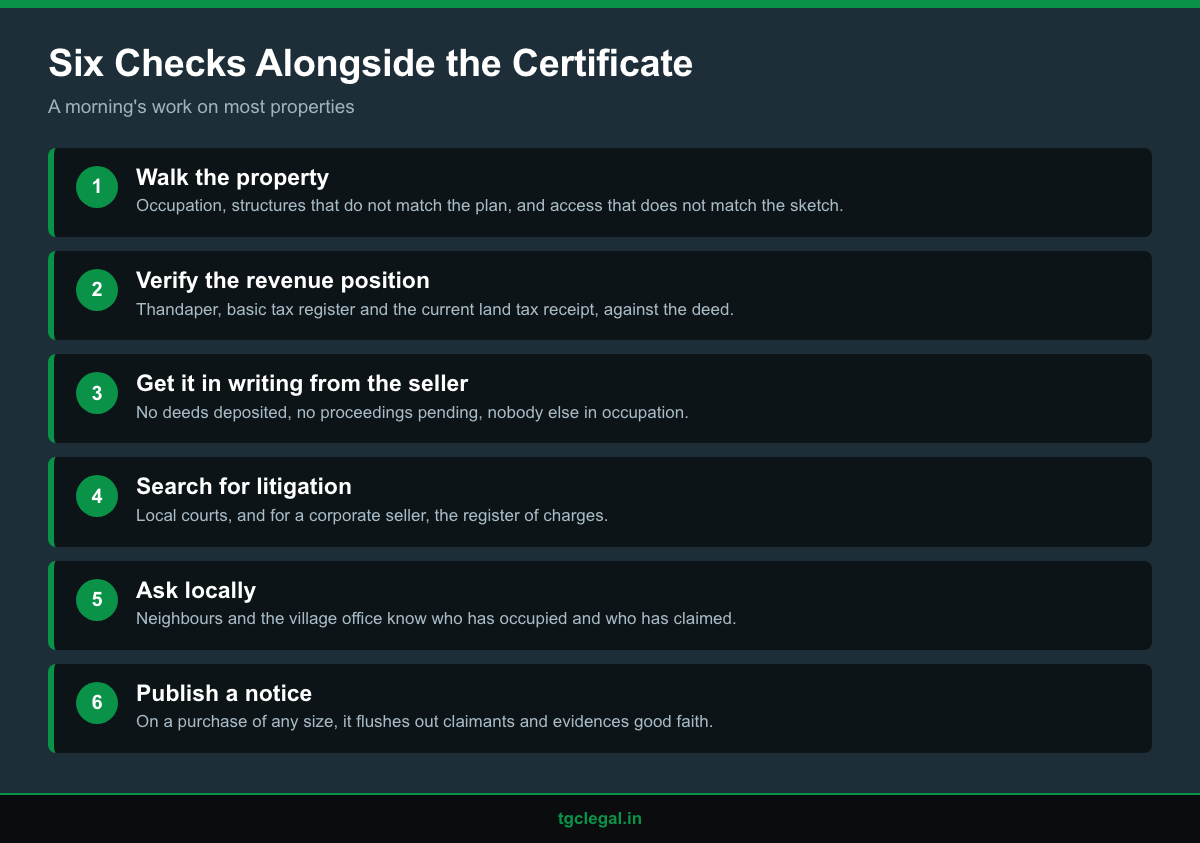
A certificate is one input. Five other lines of enquiry cover most of what it cannot.
Taken together these are a morning's work on most properties and they are the difference between a search and a diligence exercise.
- Physical inspection. Walk the property. Look for occupation, for structures that do not match the plan, for access that does not match the sketch, and for anything being stored or cultivated by someone other than the seller.
- Revenue verification. Obtain the thandaper extract, the basic tax register entry and the current land tax receipt, and confirm they name the seller and describe the same extent as the deed.
- A written declaration from the seller. Ask, in the agreement, for an express statement that no title deeds have been deposited with any lender, that no proceedings are pending, and that no other person is in occupation. A false statement then has consequences.
- A litigation check. Search the local courts and, where the seller is a company, the register of charges. A pending suit is often discoverable even where no notice was registered.
- Local enquiry. Neighbours and the village office know who has occupied and cultivated the property and whether anyone has ever asserted a claim. This is unglamorous and it is where family claims surface.
- Public notice. On a purchase of any size, a notice inviting claims, published in a newspaper circulating in the locality, flushes out claimants and establishes that the buyer acted in good faith.
Where the Buyer's Own Records Come In
There is a category of risk that no external search reaches: what the buyer was told. Representations made during a negotiation do not survive into the deed unless somebody puts them there, and the deed usually recites nothing beyond the conveyance itself.
The agreement for sale is where those representations belong. A well-drafted agreement records what the seller has said about occupation, charges, litigation, land classification and approvals, states that the buyer is relying on it, and makes the balance of the price payable only when specified conditions have been met. Where a representation later turns out to be false, the buyer has something to point at.
The payment trail is the other record worth building deliberately. Payments made through banking channels, matched to the consideration recited in the deed and to the stages set out in the agreement, prove what was paid and when. Cash components prove nothing and create a mismatch between the instrument and reality that only ever harms the buyer.
Finally, keep the correspondence. The messages in which the seller explained a gap in the chain, the email attaching an old certificate, the note confirming that a tenant would vacate. These are what an encumbrance search cannot produce and what a dispute two years later turns on.
Reading a Certificate That Is Not Nil
Where entries do appear, they need reading rather than counting. A listed mortgage may have been discharged, and the discharge should itself be registered and listed. Where it is not, the charge is still on the record whatever the seller says.
A listed lease should be matched to the physical position. A listed partition should be matched against the family described in the chain, and the shares should add up. An attachment should be traced to the proceeding that produced it, and the buyer should establish what happened in that proceeding rather than accept that it went away.
Entries that describe a different extent from the property being sold are a signal that part of a larger holding was dealt with separately at some point, and that the seller may be conveying more than remains with them.
Where anything on the certificate cannot be explained by a document the seller produces, the sensible course is to hold the balance of the price until it is. Our note on preventing a hidden charge from surviving the purchase develops that point.
Conclusion
The certificate does exactly what it says: it reports registered transactions at one office for a stated period. Treated that way it is valuable. Treated as a clearance it is dangerous, because the claims most likely to defeat a Kerala purchase, an equitable mortgage, an omitted heir and an unregistered occupier, are precisely the ones that never reach the registry.
The remedy is not to distrust the document. It is to run the other five checks alongside it, and to hold money back until anything unexplained has been explained. The title verification practice page sets out how that review is normally scoped.
Frequently Asked Questions
Does a nil encumbrance certificate mean the property is free of claims?

What period should the certificate cover?
Can a charge exist without appearing on the certificate?
Why would a certificate return nil for a property that was clearly sold before?
Does the certificate show unpaid land tax or municipal dues?
An entry shows a mortgage. Is that fatal?
Is a public notice inviting claims worth publishing?
Can the certificate be obtained online in Kerala?
What is the single most useful check to add?
Should the buyer or the seller obtain the certificate?