Post
Office Space Rental Agreements: Fit-Out, CAM and Common-Area Clauses
 Property Litigation Law Services
Rent is the number a business negotiates and rarely the number that decides what an office costs. Fit-out, the share of building running costs, and the obligation to restore the space on exit together frequently exceed a year's rent over the life of a lease, and all three are set out in clauses that are read quickly because they sit after the commercial terms.
This note works through the three cost heads that sit outside the rent in an office space rental agreement, how each should be written, and what a tenant can realistically negotiate.
Key Takeaways
- Fit-out needs a defined period, a clear approvals split, and a statement of who owns the installations at the end.
- Common area maintenance should be defined, apportioned on a stated basis, capped, and open to audit.
- Reinstatement is a cost that lands at the worst moment. Specify the standard at the start or budget for the worst reading of it.
- Landlord's works and tenant's works should be listed, not described. A schedule prevents most fit-out disputes.
- Where the building is under construction, the lease should tie possession to a condition rather than to a date.
Fit-Out: Period, Approvals and Ownership
The fit-out period is the time between handover and the commencement of rent, during which the tenant makes the space usable. It should be stated as a number of days from a defined trigger, usually the handover of the premises in an agreed condition, rather than from a calendar date the landlord may not meet.
Approvals are the part that most often causes delay. Interior work in a commercial building may require the landlord's approval of drawings, the building management's approval of services connections, and in some cases statutory approvals for change of layout, fire safety compliance or electrical load. The lease should say who obtains what, and what happens to the fit-out period if an approval is delayed through no fault of the tenant.
Ownership at the end is the clause tenants read last and should read first. Installations that become part of the building generally belong to the landlord unless the lease provides otherwise, while trade fixtures the tenant can remove without damage generally remain the tenant's. Rather than rely on that distinction, the lease should list what the tenant may remove and what stays.
The commercial reality is that fit-out expenditure is sunk. A tenant spending significantly on the space inside a short lock-in has bought an asset it may not get the use of, which is the argument for either a longer term or a landlord contribution.
Our note on the lease terms a growing business should look for covers the wider negotiation.
Landlord's Works and Tenant's Works
Almost every fit-out dispute reduces to a disagreement about what was included in the space as handed over.
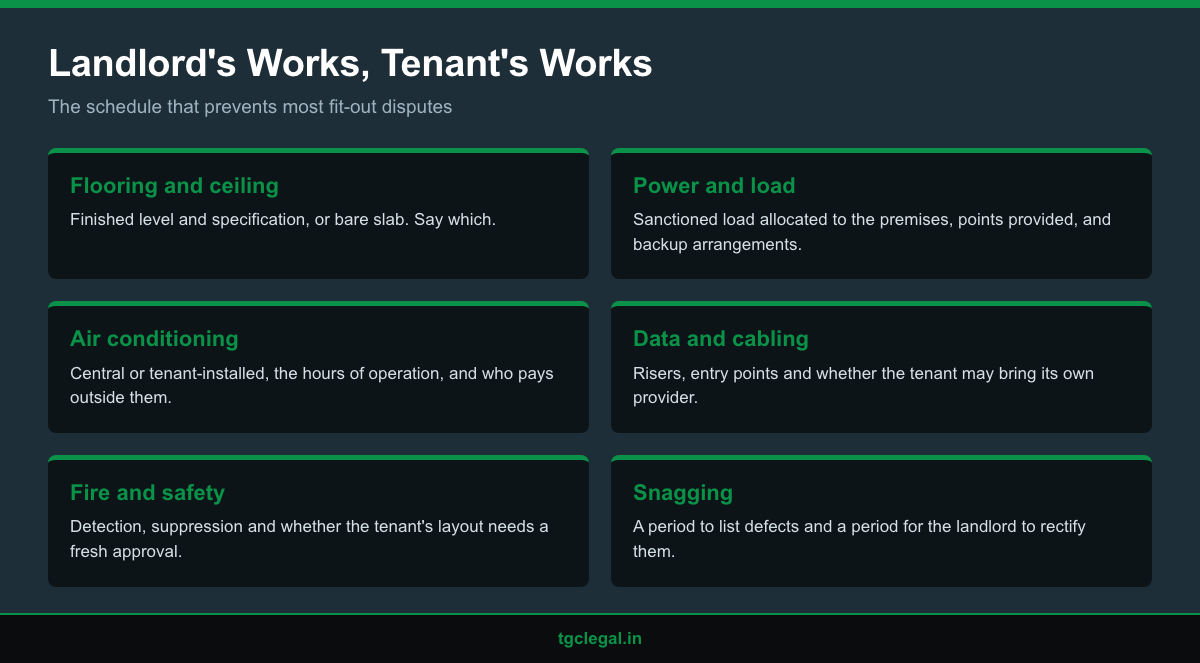
The answer is a schedule. Two lists, one of what the landlord will provide and one of what the tenant will do, each specific enough that a third party could tell whether it had been done. Flooring, ceiling, lighting, air conditioning, power points and load, data cabling, plumbing, fire detection and suppression, and the finished condition of walls are the items that recur.
Where the building is still under construction, tie handover to a condition rather than to a date. A lease that commences on a stated day whether or not the space is ready puts the entire risk of the developer's delay on the tenant.
Snagging deserves a mechanism. A short period after handover during which the tenant lists defects, and a period within which the landlord must rectify them, prevents the common outcome in which the tenant fits out around a defect and then argues about it at exit.
Where the tenant's works affect the structure or the building's services, the landlord will want approval rights and evidence of insurance from the contractor. Those are reasonable, and they should come with a response deadline so that approval cannot be withheld by silence.
Common Area Maintenance: Define, Apportion, Cap, Audit
Common area maintenance is the tenant's share of running the building: security, housekeeping, common lighting and power, lifts, generators, water, landscaping, building insurance and management. In a multi-tenant building it is unavoidable, and in a badly drafted lease it is unlimited.
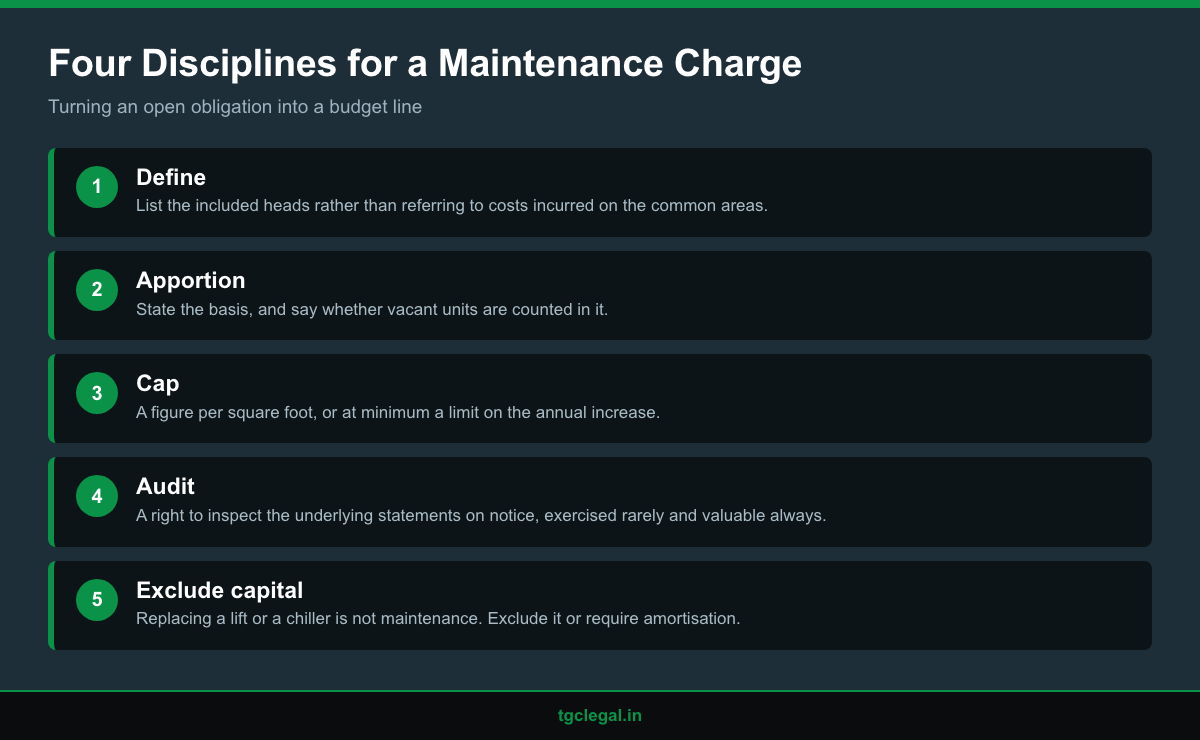
Four disciplines make it manageable. Define what is included, by listing the heads rather than referring to costs incurred in maintaining the common areas. Apportion on a stated basis, ordinarily the tenant's area as a proportion of the lettable area of the building, and be explicit about whether vacant units are counted, because a basis that spreads the cost only across occupied units passes the landlord's vacancy risk to the tenants.
Cap the amount. A stated figure per square foot per month, with a limit on annual increase, converts an open-ended obligation into a budget line. Landlords resist caps and frequently accept a limit on the rate of increase, which is most of the protection.
Give the tenant an audit right: the ability, on notice and at reasonable intervals, to inspect the statements underlying the charge. The right is exercised rarely and its existence improves the quality of the statements considerably.
Our note on the clauses that decide who carries which risk in a commercial agreement makes the same argument across contract types. Capital expenditure is the item to watch here. Replacing a lift or a chiller is not maintenance, and a lease that allows capital replacement to be recovered through the maintenance charge can produce a demand that dwarfs a year's rent. Exclude it, or require it to be amortised over the asset's life.
Reinstatement, and the Cost at the End
Reinstatement is the obligation to return the premises in a stated condition. It is a real cost, it falls due when the business is spending money on moving, and it is described in most leases in language too vague to price.
Bare shell is the clearest standard: everything the tenant installed comes out, and the space is returned as it was handed over. It is expensive and it is at least knowable. Good and tenantable condition is not a standard at all; it means whatever the party reading it wants it to mean, and it is where handover disputes begin.
The better approach is a photographic schedule of condition taken at handover, annexed to the lease, with the reinstatement obligation expressed by reference to it. That single annexure removes most of the argument.
Landlords sometimes want the fit-out left in place, particularly where it suits the next occupier. Where that is likely, the lease should give the landlord an election, exercisable by notice a defined period before expiry, with the tenant relieved of reinstatement for anything the landlord elects to keep. A lease that requires reinstatement and separately provides that installations become the landlord's property is internally inconsistent, and both clauses appear together more often than they should.
A matter on unauthorised alterations to premises shows the same issue from the landlord's side.
Services, Utilities and Building Rules
Beyond the three main heads sit a set of operational clauses that decide how the office works day to day.
Power is the first. The lease should state the sanctioned load allocated to the premises, whether additional load can be obtained and at whose cost, and what backup is provided. A business installing servers or laboratory equipment should confirm the load before signing, because upgrading it later depends on the building's total sanction rather than on willingness to pay.
Air conditioning hours matter for businesses that work outside ordinary office hours. Where the building's central plant runs from nine to six, a team working late is paying for supplementary cooling, and that should be priced at the outset.
Access and building rules govern signage, deliveries, contractor access and after-hours entry. These are usually in a separate document the landlord can amend, and a tenant should at least require that amendments be reasonable and not materially increase the tenant's cost or restrict its permitted use.
Finally, parking. The number of spaces, whether they are reserved or on a first-come basis, and whether they are included in the rent or charged separately. It is the operational term employees notice most and the lease addresses least. A matter on an office tenancy dispute in Kochi turned in part on facilities that were assumed rather than allocated.
What a Tenant Can Realistically Negotiate
Landlords in Kochi and Thiruvananthapuram have varying appetite depending on the building and the vacancy position, but some asks are routinely achievable.
A defined fit-out period tied to handover condition, rather than to a date. A schedule of landlord's and tenant's works. A cap on the annual increase in the maintenance charge, even where a cap on the amount is refused. An audit right. Exclusion of capital replacement from the maintenance charge. A photographic schedule of condition annexed to the lease. And a landlord's election on reinstatement.
Harder asks, which depend on the market, include a mutual lock-in, a rent-free period beyond the fit-out period, a landlord contribution to fit-out, and a cap on the maintenance charge in absolute terms.
The negotiating principle is simple: ask for certainty rather than for money. Most of the items above cost the landlord nothing and remove the tenant's largest unquantified exposures, which makes them the easiest concessions to obtain and the most valuable to hold.
The rent control practice page sets out how disputes on these terms are usually handled once they arise.
Conclusion
An office space rental agreement is priced on rent and settled on everything else. Fit-out that starts late, a maintenance charge with no cap, and a reinstatement obligation described in adjectives are the three exposures that turn a good deal into an expensive one.
All three are fixed by drafting rather than by litigation, and all three are cheapest to fix in the week before signature.
Frequently Asked Questions
When should the fit-out period start?

Who owns the fit-out at the end of the lease?
What should a common area maintenance clause contain?
Should vacant units be counted in the apportionment?
What is wrong with a reinstatement clause requiring good and tenantable condition?
Can the landlord require reinstatement and also keep the fit-out?
What should we check about power before signing?
Are building rules binding if the landlord can change them?
What is the single most valuable clause to negotiate?
Should snagging be dealt with in the lease?