Post
Probate and Succession Certificate in Kerala: When a Registered Will Is Not Enough
 Property Litigation Law Services
Families treat a registered will as the end of the matter. It is executed, it is registered, it is kept safely, and everyone assumes that when the time comes the property will simply pass. Then a bank asks for a succession certificate, a sub registrar asks for probate, and the family discovers that the document they relied on was the beginning of a process rather than the conclusion of one.
Our note on why a family business needs its succession documents in order covers the planning side. This one is about what happens afterwards: what probate does, when a succession certificate is the right instrument, what each process involves in Kerala, and how a will is contested.
Key Takeaways
- Registration of a will is optional and proves execution, not validity. It does not transfer anything on its own.
- Probate is a court grant establishing the will and the executor's authority. Its necessity depends on where the property is and which succession law applies.
- A succession certificate deals with debts and securities, not with immovable property. The two instruments answer different questions.
- Where there is no will, a legal heirship certificate from the revenue authorities handles routine matters, and a court certificate handles the rest.
- A will is contested on execution, capacity, undue influence and suspicious circumstances. The person propounding it carries the burden of dispelling suspicion.
What Registering a Will Does and Does Not Do
Registration of a will is optional. A will that is validly executed and attested is a valid will whether it is registered or not, and an invalid will does not become valid by being registered.
What registration achieves is evidentiary. It fixes the date, it records that the testator appeared before the sub registrar and acknowledged the document, and it produces an official copy that survives the loss of the original. Those are real advantages, particularly where a will is likely to be contested, and they are the reason registering a will is generally worth the small cost.
What registration does not do is transfer property. A will speaks from death. Until the testator dies it has no operation at all, and after death it operates only when the executor or beneficiary establishes it in the way the applicable law requires.
A second point families get wrong: a will can be revoked or replaced at any time before death, and a later unregistered will can revoke an earlier registered one. Registration confers no priority. Where a family assumes the registered document is the operative one, the discovery of a later will is genuinely disruptive.
Probate: What It Is and When It Is Needed
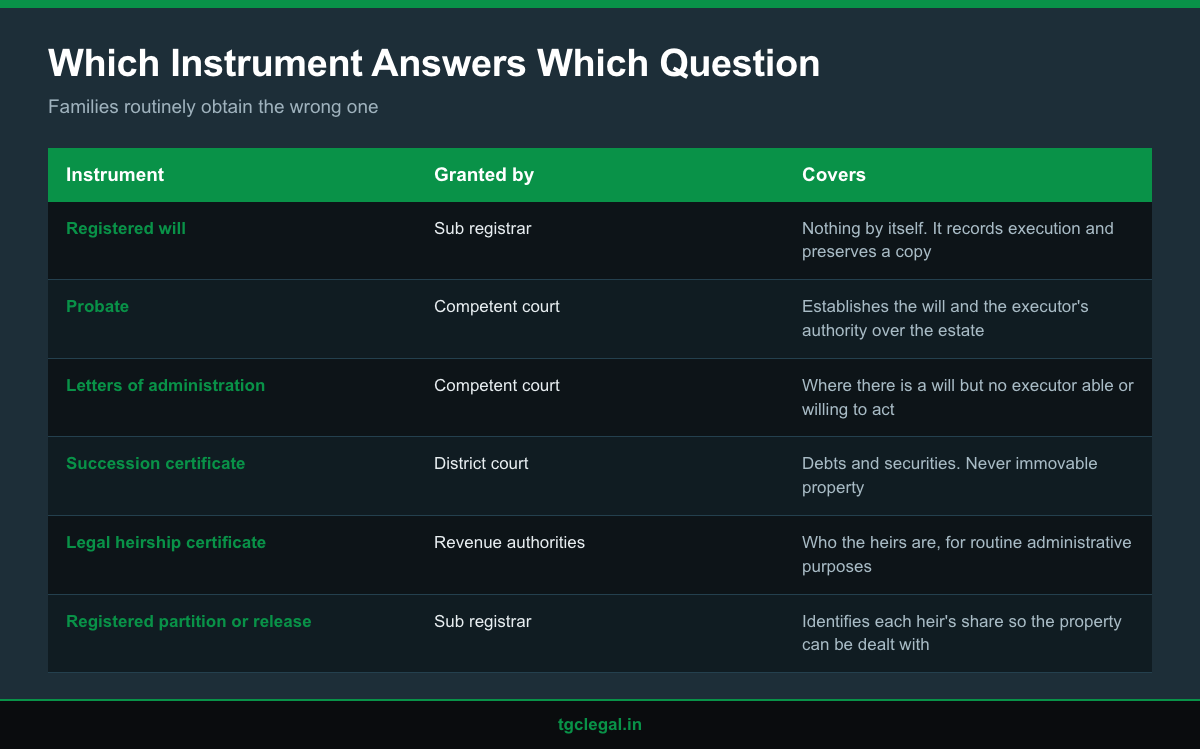
Probate is a grant by a competent court certifying the will and the appointment of the executor named in it. It establishes the will as the operative testamentary instrument and gives the executor authority to deal with the estate.
Whether probate is compulsory depends on two things: the personal law governing the succession, and where the will was made or the property lies. Under the general succession legislation, the requirement for probate attaches in defined circumstances tied to specific territories and to particular communities, and outside those circumstances a will may be acted upon without a grant.
In Kerala, the practical position is that probate is not universally required, but it is frequently required by the person on the other side of the transaction. A bank releasing a substantial balance, a company transferring shares, a sub registrar registering a conveyance by a beneficiary, or a buyer taking title from an estate, will each form their own view about the evidence they want. That is why families who expect the estate to be dealt with commercially often apply for a grant even where the law does not compel one.
The alternative where probate is unnecessary is letters of administration with the will annexed, which is the grant made where there is a will but no executor able or willing to act.
The Succession Certificate, and What It Cannot Do
A succession certificate is granted by a district court and authorises the holder to collect debts and securities belonging to a deceased person, and to give valid discharge for them. Bank balances, deposits, shares, debentures and money due under contracts fall within it.
What it does not cover is immovable property. A succession certificate does not establish who owns the deceased's land or house, and it is not the instrument to produce to a sub registrar on a conveyance from an estate. Families routinely obtain one and then find it does not answer the question they actually had.
The application identifies the deceased, the date of death, the applicant's relationship, the debts and securities in question and the other heirs. Notice is issued, objections are invited, and where there is no contest the grant follows in a matter of months. Where there is a contest, the court may require the parties to establish their claims, and the timeline extends considerably.
The certificate is granted subject to security in most cases, and it protects the person paying rather than conclusively deciding title. A bank that pays a certificate holder is discharged; that does not stop another heir claiming their share from the person who received it.
Where There Is No Will
Intestate succession is governed by the personal law applicable to the deceased, and the shares are fixed by that law rather than by agreement. The first practical step in Kerala is usually a legal heirship certificate from the revenue authorities, obtained through the village office or the taluk office, which records who the heirs are.
That certificate carries a long way in routine matters: transferring a revenue entry, dealing with an employer, claiming small balances, and effecting a mutation. It is administrative rather than judicial, and it is not conclusive where there is a genuine dispute about who the heirs are. Our note on how errors in the revenue entry affect an owner's rights covers what it takes to correct one.
Where the estate includes securities or substantial debts, the succession certificate route applies. Where the estate includes immovable property to be sold, the practical instrument is usually a registered partition or release among the heirs, so that the property is identified and each share is documented before any sale. A buyer will look for exactly that, as our note on spotting a defective conveyance in Kochi explains.
The failure mode here is familiar: the heirs agree informally, one of them sells, and the arrangement is never reduced to a registered instrument. Twenty years later a buyer's title review finds a chain that does not close. A matter involving competing claims among heirs in Kochi shows how long that can lie dormant.
How a Will Is Contested
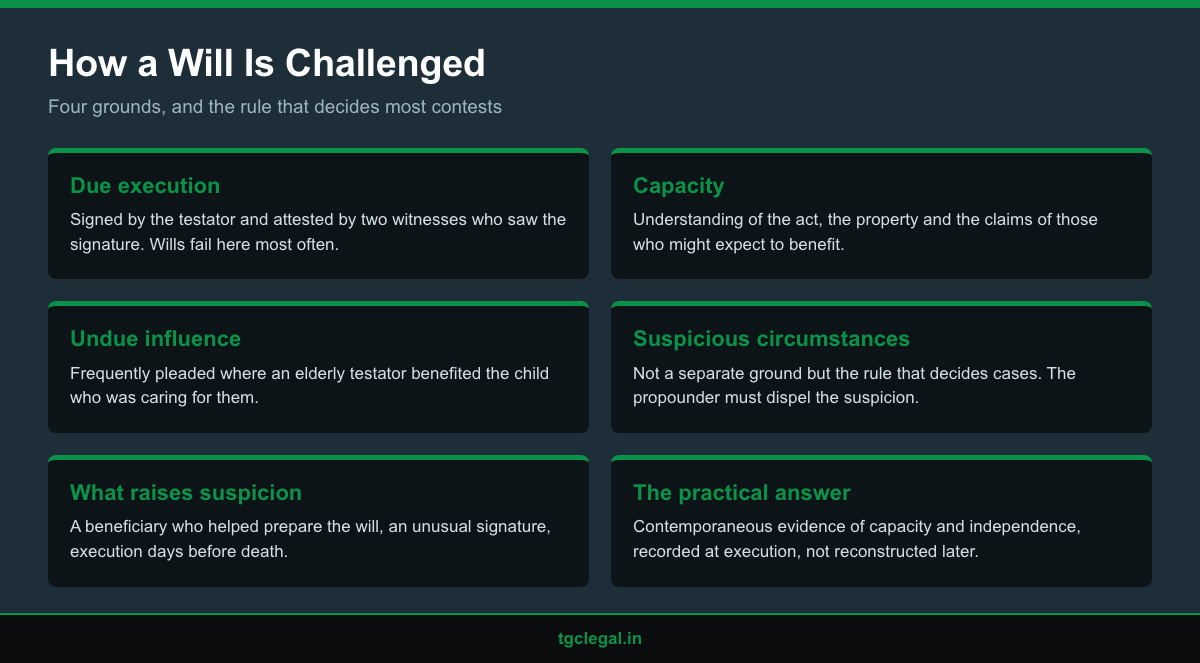
A will is challenged on a small number of grounds, and the way the burden works is what decides most contests.
Due execution comes first. The will must be signed by the testator, or by someone at their direction in their presence, and attested by two or more witnesses who saw the signature and signed in the testator's presence. At least one attesting witness must ordinarily be called to prove it. Wills fail on attestation more often than on anything else.
Capacity is the second. The testator must have understood the nature of the act, the extent of the property being disposed of and the claims of those who might expect to benefit. Age and illness do not by themselves defeat a will; incapacity at the moment of execution does.
Undue influence and fraud form the third group, and they are frequently pleaded where an elderly testator left everything to the child who was caring for them.
The fourth is not a separate ground but a rule that decides cases: where suspicious circumstances surround the execution, the person propounding the will must dispel that suspicion. A beneficiary who took an active part in preparing the will, a signature that differs from the testator's usual hand, a document executed days before death, an unexplained departure from an earlier will, all raise it. The practical protection is contemporaneous evidence, which means recording capacity and independence at the time of execution rather than reconstructing it afterwards.
What Families Should Actually Do
Executing a will is the easy part. Making it work is a matter of a few unglamorous steps taken while the testator is alive.
Name an executor, and name a substitute. A will with no executor produces a grant application that is harder than it needed to be. Describe each property by survey number, extent and boundaries as they appear in the revenue record, rather than as the family refers to it. Attach or list the title documents. Deal with the whole estate, because a residuary clause prevents a partial intestacy over the asset nobody remembered.
Register it, for the evidentiary reasons above, and tell the executor where the original is. A registered will whose original nobody can find is a recurring problem, and it is one of several reasons a family should keep a complete title file rather than a drawer of papers.
Where the testator is elderly or unwell, or where the disposition departs from what the family expects, arrange contemporaneous evidence of capacity and independence. This is the single most effective step against a later contest.
And revisit it. A will drafted before a property was sold, a child married or a business restructured describes an estate that no longer exists, and the gap between the document and reality is where the litigation starts.
Conclusion
Registering a will is worth doing and is not the finish line. Registration proves execution; a court grant establishes the will; a succession certificate deals with debts and securities but never with land; and where there is no will, the revenue authorities' heirship certificate handles routine matters while the estate still needs documenting properly before anything is sold.
Families who understand which instrument answers which question move through an estate in months. Families who assume the registered will does all of it usually find out otherwise at the worst moment.
Frequently Asked Questions
Does registering a will make it valid?

Can a later unregistered will override an earlier registered one?
Is probate always necessary in Kerala?
What is the difference between probate and a succession certificate?
We only need to release a bank balance. Which do we apply for?
What is a legal heirship certificate?
On what grounds is a will usually challenged?
What are suspicious circumstances?
How long does a grant take?
What should a family do before any of this arises?