Post
2027 IP Protection: Why AI-Generated Content Is Forcing a Rewrite of Trademark Strategy
 General
Generative AI tools can now produce a brand name, a logo and a tagline in under a minute, and that speed is colliding head on with copyright and trademark law. India's own working paper on generative AI and copyright, released by DPIIT in December 2025, shows how seriously policymakers are taking the question. For founders, the practical issue is simpler. Who owns the brand assets your team created with AI, and can you stop a competitor from copying them? If you already use AI in branding or product design, talk to the TGC Legal team before your next launch. An experienced IPR lawyer India businesses rely on can answer these questions before they turn into disputes. This guide explains why 2027 trademark strategy needs a rewrite and what to change now.
Key Takeaways
- AI-generated logos and copy may not earn copyright protection on their own, so trademark registration becomes the stronger shield for brand identity.
- A trademark and patent protection law firm 2027 plan should audit which assets were made with AI, document human input and file early.
- Infringement risk now runs both ways, so clearance searches and monitoring matter as much as filing.
Why AI-Generated Content Is Changing the IP Rulebook
Copyright law was built around human authors, and AI tools have exposed a gap that regulators are still working to close.
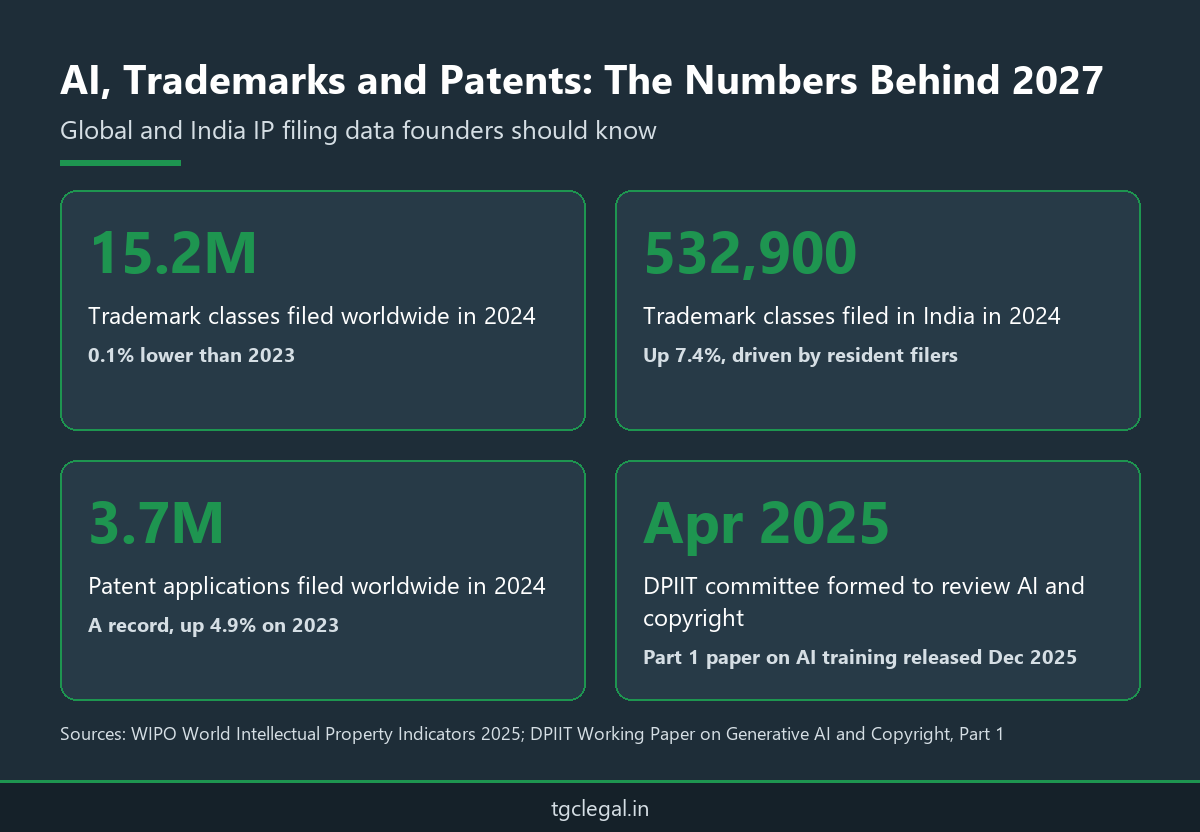
The U.S. Copyright Office report on copyrightability concluded that generative AI outputs can be protected only where a human author has determined sufficient expressive elements. Prompts alone did not meet that bar. India is taking its own route. DPIIT formed an expert committee on April 28, 2025 to review whether the Copyright Act, 1957 can handle AI. Part 1 of its working paper dealt with the use of copyrighted works to train AI models. The committee left copyrightability and authorship of AI outputs for Part 2, and it noted litigation on the issue pending before the Delhi High Court. The outlook for 2027 is clear enough: founders cannot assume that an AI-made logo or slogan is automatically theirs to protect under copyright.
This matters most where AI sits at the centre of the creative process. A design team that sketches a concept, uses AI for rough variations and then redraws the final mark is in a far stronger position than a team that simply accepts the first output. The difference lies in evidence of human choices. Businesses that cannot show those choices may find it hard to stop a rival who reuses a similar visual, because there may be no clear copyright to enforce.
Trademark Strategy Now Has to Carry More Weight
When copyright in an AI-made asset is uncertain, a registered trademark becomes the most dependable way to own a brand.
Trademark rights do not depend on who, or what, drew the logo. Under the Trade Marks Act, 1999, protection flows from registration and use in trade, and a registered mark gives its owner exclusive rights for the listed goods and services. That makes filing the natural fallback for AI-assisted brand assets. The register is also getting crowded. WIPO's World Intellectual Property Indicators 2025 reported 15.2 million trademark classes filed worldwide in 2024. India accounted for 532,900 classes, up 7.4%, and that growth came entirely from resident filers. More local filings mean a greater chance that an AI-suggested name clashes with a mark someone already owns.
A rewritten strategy also looks at what is filed, not just when. Word marks protect the name in any style, while device marks protect a specific logo. Filing in every class where the business plans to trade avoids gaps that competitors can exploit. Distinctive, invented names usually travel through examination more smoothly than descriptive ones, and generic AI suggestions often fall into the descriptive category. An IPR lawyer India startups consult at the naming stage can flag those weak options before money is spent on packaging, domains and advertising.
Five Updates to Make to Your 2027 Trademark Strategy
A modern IP plan treats AI as part of the creative process and builds evidence, contracts and searches around it.
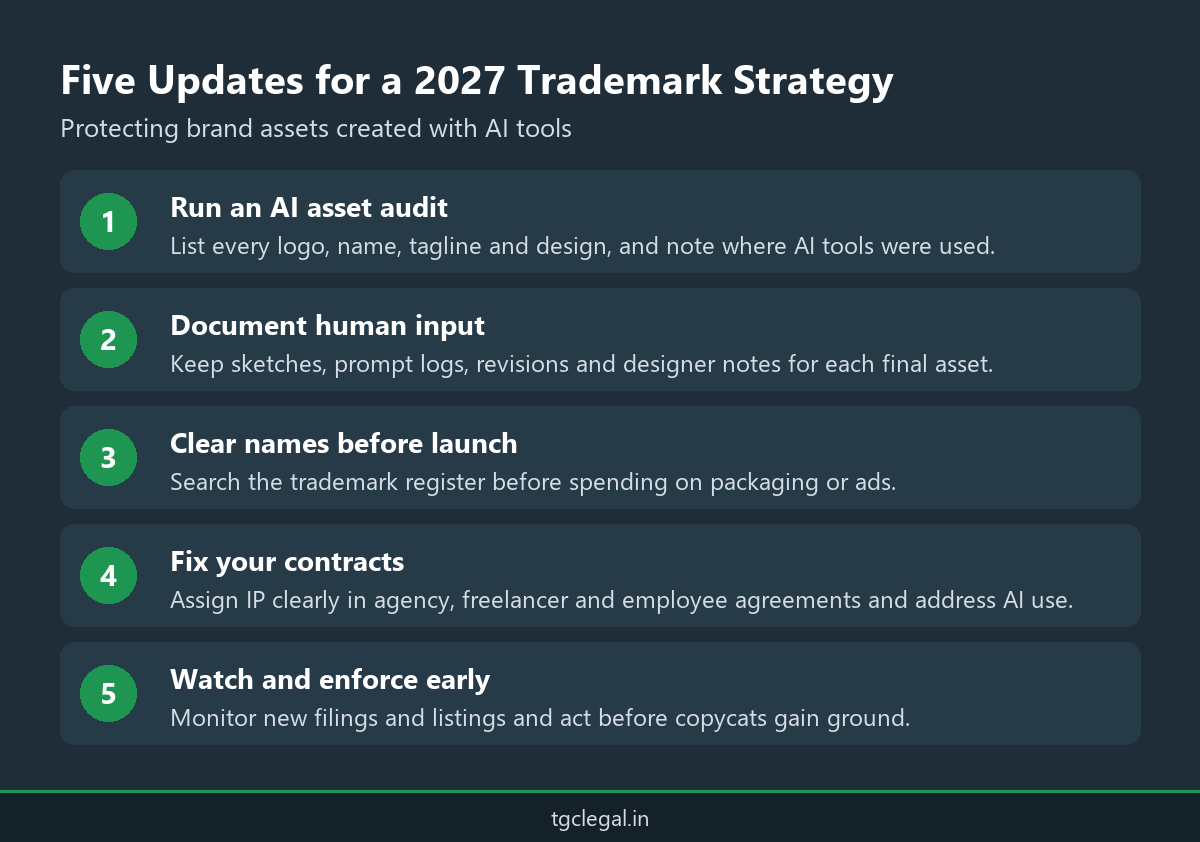
- Run an AI asset audit. List every logo, name, tagline, packaging design and piece of product copy, and record which ones involved AI tools.
- Document human creative input. Keep sketches, prompt logs, revisions and designer notes. These records help show the human contribution behind a final asset.
- Clear names before you adopt them. AI tools often suggest names close to existing brands. A proper search of the trademark register should come before any launch spend.
- Fix your contracts. Agency, freelancer and employee agreements should assign IP clearly and address AI use. Our guide on preventing employee IP ownership disputes covers the clauses that matter, and the same logic applies to IP clauses in vendor agreements.
- Watch the market and enforce early. Monitor new filings and online listings so that copycat marks are opposed or challenged before they gain ground.
Working with an IPR lawyer India founders can reach early makes each of these steps faster and cheaper than fixing gaps after a dispute. The audit itself rarely takes long. Most businesses can list their core brand assets in a single working session, and the gaps it reveals usually point straight to the filings, assignments or policies that should come first in the new year.
Patents, Designs and Trade Secrets in an AI Workflow
Trademarks protect the brand, but the products and processes behind it need patents, design registrations and confidentiality controls too.
Innovation filings are rising worldwide. WIPO counted a record 3.7 million patent applications in 2024, up 4.9% on 2023. For businesses building with AI, three questions now come up regularly. Is the invention disclosed clearly enough to support a patent? Does the product's visual appearance deserve a design registration, as one Kerala product launch case study shows? And are staff pasting confidential material into public AI tools? Trade secrets depend on confidentiality, so an internal AI usage policy and strong non disclosure agreements are now basic hygiene for any growing company.
Timing is the other lesson. Public disclosure of an invention before filing can damage patent prospects, and AI makes it easy to share drafts, demos and pitch decks widely. Founders should map what needs protection before a product is shown to investors or posted online, then decide which right fits each asset.
What to Do When an Infringement Dispute Arises
AI has made copying faster, so businesses need a clear response plan before a copycat brand or product appears.
Many founders first search for an IP infringement lawyer near me India only after a competitor launches a lookalike logo or listing. A better approach is to prepare in advance. Keep registration certificates, design files and evidence of first use in one place. When infringement appears, preserve screenshots, invoices and listing URLs immediately. A measured cease and desist notice often resolves the matter, and court action remains available where it does not. TGC Legal's IP dispute and litigation support covers patent, copyright and trademark suits, and our counterfeit products case study shows how early evidence shapes the outcome.
Speed matters as well. The longer a copycat trades, the more customers it confuses and the harder it becomes to argue urgency before a court. Registered owners start from a stronger footing, because the certificate itself is evidence of the right. Businesses relying only on unregistered use, or on uncertain copyright in AI-made artwork, usually face a longer and costlier fight to prove what they own.
Conclusion
AI-generated content is forcing a rethink of how businesses protect their brands. Copyright in AI outputs is limited abroad and still unsettled in India, so trademark registration, careful documentation and strong contracts carry more of the load. Filing numbers are rising, which raises the risk of conflicts with existing marks. Founders who audit their AI-made assets, clear names early and monitor the market will enter 2027 in a stronger position. A trusted IPR lawyer India startups and established firms work with can turn that plan into filings and contracts. Explore our IPR protection services to start your 2027 review.
Frequently Asked Questions
Can AI-generated logos be registered as trademarks in India?

Does copyright protect content created with AI tools?
What does an IPR lawyer India businesses hire actually do?
Why should startups file trademarks before launch?
How do I check whether an AI-suggested brand name is available?
Should contracts with design agencies mention AI use?
Can I patent an invention developed with the help of AI?
What should I do if a competitor copies my brand?
How is a trademark different from copyright for brand protection?