Post
Setting Aside an Arbitral Award Under Section 34: Which Grounds Actually Succeed
 General
An award lands, and the party that lost reads it twice looking for a way out. That instinct is understandable, and it is also where most of the money in a post-award fight is wasted. Section 34 of the Arbitration and Conciliation Act is not an appeal. It is a narrow supervisory jurisdiction, and a court hearing a challenge is not asked whether the tribunal decided the case correctly.
The gap between what parties expect from Section 34 and what a litigation and arbitration lawyer can actually do with it is wide enough to be worth setting out plainly. This note walks through the grounds the section lists, the two that carry almost all of the successful challenges, the ones that fail almost every time, and the timing rule that quietly disposes of more applications than any substantive argument. It sits alongside our wider guide to resolving commercial disputes in India.
Key Takeaways
- Section 34 is supervisory, not appellate. A court will not re-appreciate evidence or substitute its own view of the contract.
- Two grounds carry nearly every successful challenge: conflict with the public policy of India as narrowed in 2015, and patent illegality on the face of a domestic award.
- The clock is three months from receipt of the award, extendable by thirty days on sufficient cause and not one day beyond that.
- Filing a challenge no longer suspends enforcement. A separate application for stay is needed, and a court will usually impose conditions on it.
- Reasoning that is absent, internally contradictory or plainly outside the contract is the most reliable route in. Disagreement with the tribunal's conclusions is not.
What the Section Is, and What It Is Not
Section 34 allows a party to apply to set aside an arbitral award. It does not allow a party to ask the court to hear the dispute again. The distinction is not academic: it determines what material the court will look at, what arguments it will entertain, and how the application should be drafted in the first place.
A court exercising this jurisdiction reads the award to see whether the tribunal stayed inside the boundaries the parties and the statute set for it. Was there a valid agreement to arbitrate? Was each side given notice and a real opportunity to present its case? Did the tribunal decide matters actually referred to it? Was it constituted the way the contract said it would be? These are questions about the integrity of the process and the limits of the mandate, not about whether the tribunal read a clause the way the losing party would have preferred.
The consequence is that a challenge built on the merits reads as one however it is labelled. Applications that walk the court through the evidence and invite a different conclusion are dismissed with costs often enough that the exercise should be priced accordingly before it is started.
There is one further limit worth stating early. For most of the last decade the settled position, following the Supreme Court's decision in the NHAI matter of 2021, was that a court could set an award aside but could not rewrite it. A Constitution Bench revisited that in 2025 and recognised a narrow power to modify, confined to severable parts of an award, the correction of clerical or computational errors, and post-award interest in defined situations. It is a limited exception, not a general power to adjust an outcome, and a challenge should still be built on the assumption that the realistic outcome is the award standing or falling as a whole.
The Grounds the Statute Actually Lists
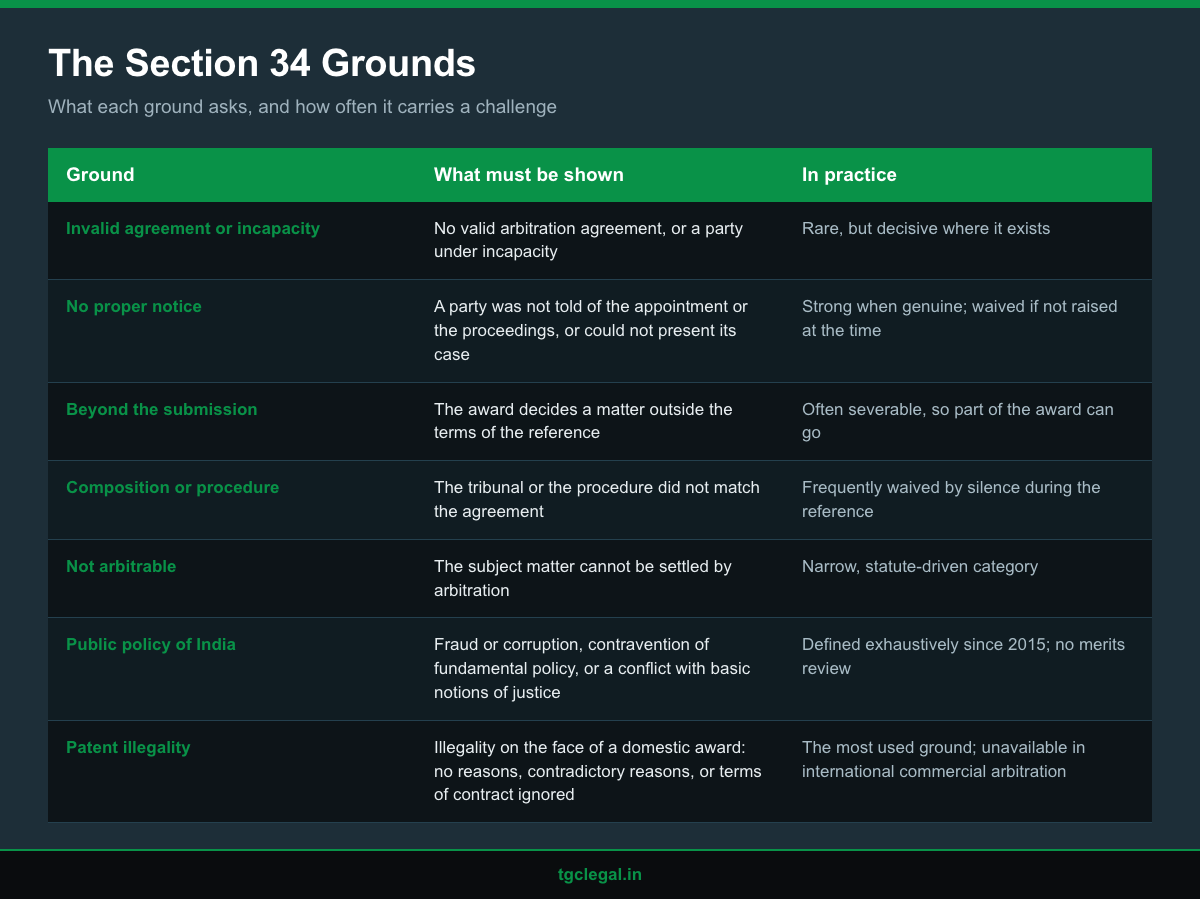
Sub-section (2) sets out the grounds a party must establish. A party under some incapacity. An arbitration agreement that is not valid under the law the parties chose. A failure to give proper notice of the appointment of an arbitrator or of the proceedings, or a party otherwise unable to present its case. An award dealing with a dispute not contemplated by or not falling within the terms of the submission. A tribunal or a procedure that did not match what the parties agreed. Separately, the court may set an award aside if the subject matter is not capable of settlement by arbitration, or if the award conflicts with the public policy of India. Where a tribunal has gone outside the terms of the submission and the excess is separable, the offending part can go while the rest of the award survives.
The first five are jurisdictional and procedural. They are the strongest grounds when they exist, because they do not require the court to look at the merits at all, and they are also the rarest. Where they do arise it is often because a party ignored a curable defect at the time and raised it only after losing, which draws in the waiver principle in Section 4 and generally ends the point.
The remaining two grounds, arbitrability and public policy, are where most contested challenges actually live, and public policy in particular has been reshaped so heavily since 2015 that any argument built on the older case law needs checking against the current text. The official text of central legislation is the place to start rather than a secondary summary.
Public Policy, After the 2015 Narrowing
Public policy was once the ground that swallowed the section. Courts read it broadly enough that almost any perceived error could be recast as a public policy violation, and awards were routinely reopened on the merits under that label. The 2015 amendment closed that door deliberately, and the Explanations added to the section now define the ground exhaustively.
An award conflicts with the public policy of India only in three situations. First, where the making of the award was induced or affected by fraud or corruption, or where confidentiality obligations attaching to conciliation were breached. Second, where the award contravenes the fundamental policy of Indian law. Third, where it conflicts with the most basic notions of morality or justice.
A second Explanation does the real work: the test of contravention of the fundamental policy of Indian law does not entail a review on the merits of the dispute. That sentence is what stops the ground expanding again. It means an argument that the tribunal misread a statute, misapplied a limitation period or reached a commercially odd result cannot be dressed as fundamental policy unless it engages something closer to the foundations of the legal system, such as a binding statutory prohibition or a breach of natural justice.
The third limb, the most basic notions of morality or justice, has been read as a high threshold reserved for awards that shock the conscience. The Supreme Court's 2019 decision in the Ssangyong matter is the clearest modern illustration: an award was set aside where the tribunal decided the case on a basis neither party had an opportunity to address, which is a due process failure rather than an error of judgment.
The practical filter a litigation and arbitration lawyer applies is simple. If the complaint can be stated without describing what the tribunal got wrong on the facts, it may be a public policy argument. If it cannot, it is an appeal.
Patent Illegality, and Why It Only Helps Some Awards
Sub-section (2A) gives a separate ground for domestic awards: the award may be set aside if it is vitiated by patent illegality appearing on the face of the award. The same sub-section immediately narrows it. An award will not be set aside merely on the ground of an erroneous application of the law, or by re-appreciation of evidence.
This ground is unavailable in an international commercial arbitration seated in India, which matters for cross-border contracts and is one of several reasons the seat clause deserves attention long before a dispute exists. Our note on choosing between the seat and the venue in cross-border contracts covers how that choice narrows the challenge routes available later.
What survives the narrowing is meaningful. An award that gives no reasons at all, or reasons so contradictory that the conclusion cannot be traced through them, is patently illegal. So is an award that ignores the terms of the contract entirely, because the tribunal's authority comes from that contract. So is a finding that no reasonable person could reach on the material, which is perversity rather than disagreement. The Supreme Court's 2021 decision in the Delhi Metro rail matter is the standard reference for how narrow this is meant to be.
Drafting this ground well means quoting the award against itself. The court is looking at the face of the document, so a challenge that needs the record, the pleadings and three witness statements to explain why the finding was wrong has already left the ground it is standing on.
The Clock, and the Applications It Ends
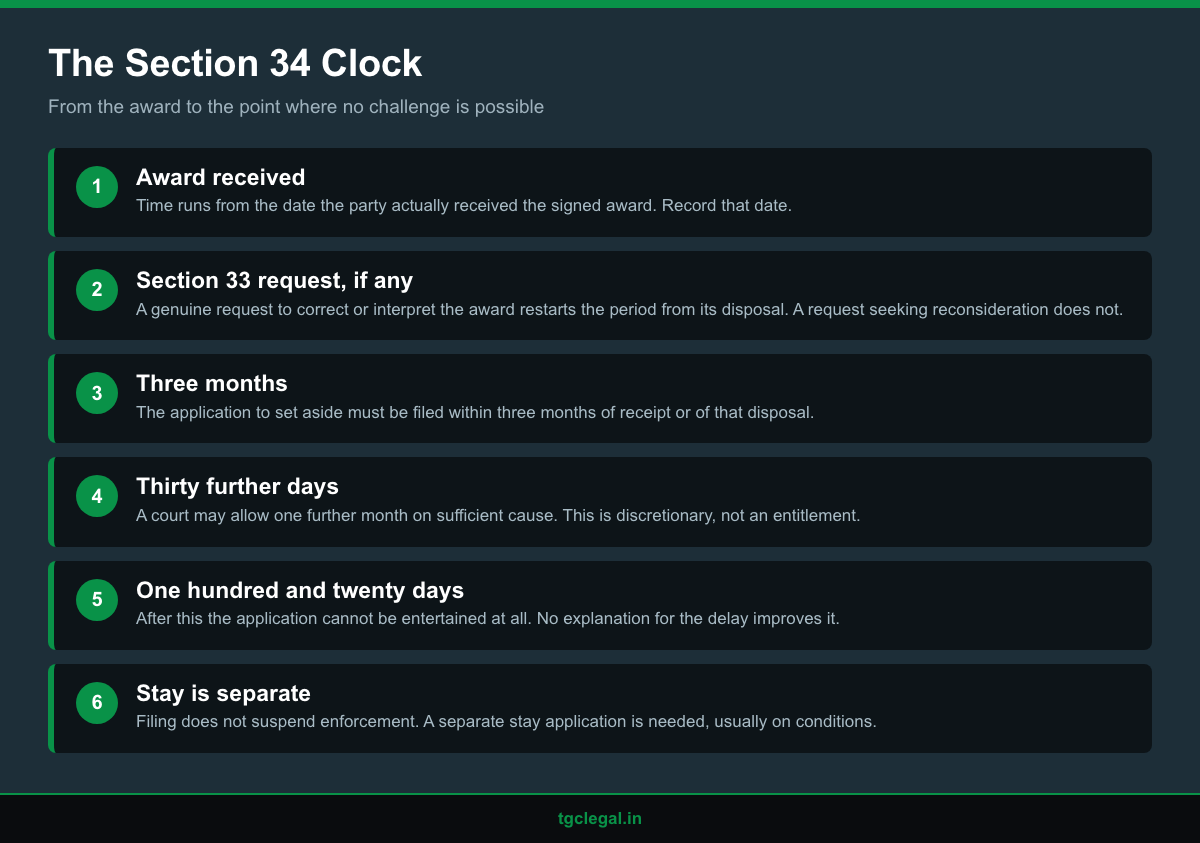
Sub-section (3) allows three months from the date on which the party received the award. Where a request has been made under Section 33 to correct or interpret the award, time runs from the disposal of that request. The proviso permits a further thirty days on sufficient cause, and then adds four words that decide a large number of cases: but not thereafter.
Courts have consistently read those words as excluding the general power to condone delay under the Limitation Act. Beyond one hundred and twenty days the application is not late, it is incompetent, and no explanation improves it. That makes the date of receipt of the award a fact worth recording carefully at the time, because it is frequently disputed later by a party that needs it to have been a fortnight after it actually was.
A related trap is the Section 33 request. Asking the tribunal to correct a typographical error is sensible. Asking it to reconsider a finding in the hope of restarting the clock is not, because a request outside the tribunal's Section 33 powers does not extend time.
Filing on time is also not the same as protecting the position. Since the 2015 amendment, a challenge does not by itself suspend enforcement of the award. A separate application is needed for a stay, and a court asked to grant one will normally require security or a deposit, especially where the award is for money. A party that files a challenge and assumes execution is frozen may find an execution petition proceeding in parallel. Our note on what happens between an award and actual recovery sets out that sequence from the other side.
Where the dispute is commercial and meets the specified value, the application is filed before the Commercial Court, with an appeal under Section 37 to the Commercial Appellate Division. Case status through that route can be followed on the national case information portal.
What a Challenge Worth Bringing Looks Like
Applications that succeed tend to share a shape, and any litigation and arbitration lawyer who has argued a few of them will recognise it. They identify a defect that can be described in a sentence without reference to the evidence. They point to the part of the award that shows it. They ask for a specific consequence, often the severance of one head of claim rather than the collapse of the whole award. And they are filed early enough that the timing point never arises.
Unsuccessful applications also share a shape. They open with the commercial unfairness of the outcome, run through the evidence, and reach public policy in the last few paragraphs as a label rather than an argument. They are frequently filed on day eighty-nine, which leaves no room to correct a defect in the papers.
There is a strategic question underneath this. A challenge that fails costs time, costs the stay conditions imposed along the way, and hands the other side a judicial endorsement of the award before enforcement. Where the realistic ground is thin, negotiating payment terms is often the better use of the same three months. A matter on how a commercial contract breakdown was worked through shows what that alternative looks like.
Conclusion
Section 34 does a narrow job well. It removes awards that were produced without jurisdiction, without a fair hearing, or without reasons that hold together, and it leaves everything else alone. Read that way, the question before filing is not whether the award is wrong. It is whether the defect can be shown on the face of the award, stated without arguing the merits, and filed inside a window that closes at one hundred and twenty days.
Parties that ask those three questions early usually reach a clear answer quickly, and the ones who decide not to file are often better off than the ones who do. Further reading on the arbitration route as a whole sits on the commercial disputes practice page.
Frequently Asked Questions
Is a Section 34 application an appeal against the award?

How long do we have to file a challenge?
Does filing a challenge stop the other side enforcing the award?
What does patent illegality actually cover?
Can a court change part of an award instead of setting it aside?
The tribunal decided a claim that was never pleaded. Is that a ground?
We did not object to the tribunal's composition at the time. Can we raise it now?
Which court hears the application in Kerala?
Does asking the tribunal to correct the award buy more time?
Is a challenge worth filing where the ground is arguable but weak?