Post
Copyright Attorneys on How Poor Drafting Causes IP Loss
 Business Corporate Law
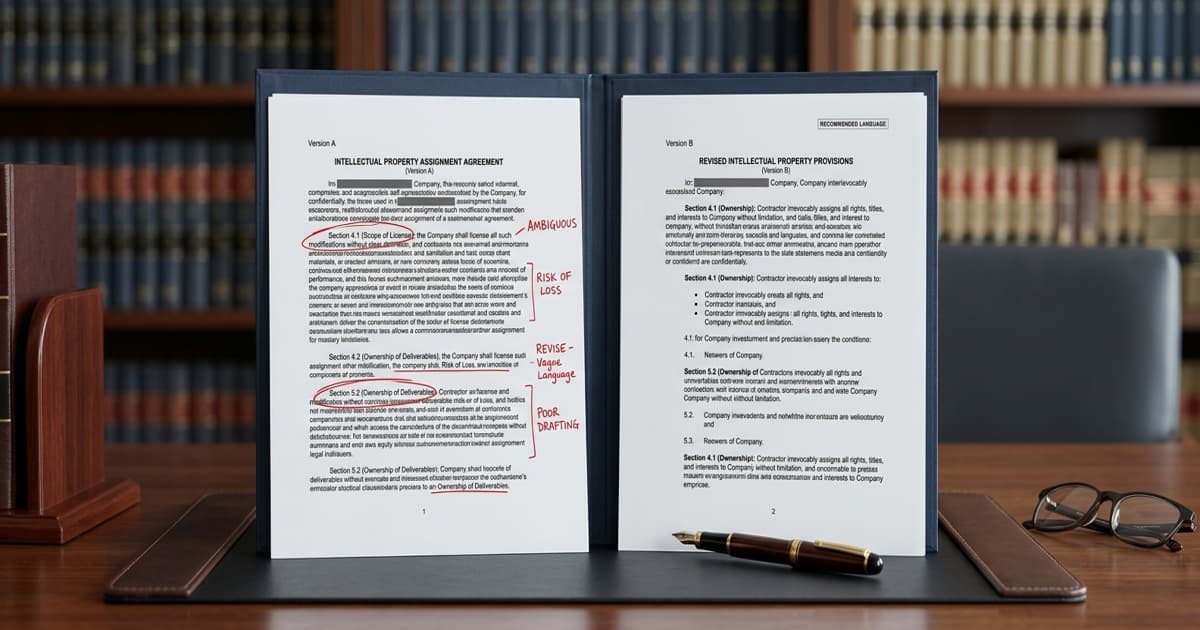
 Copyright attorneys handling intellectual property disputes regularly encounter a frustrating pattern: companies lose ownership of their own creative works not because of outright theft, but because of poorly worded agreements. When contracts, assignments, or licensing arrangements fail to clearly define IP ownership, scope, or rights transfer, the consequences can be severe and often irreversible. Research on intellectual property disputes shows that unclear drafting often leads to contested copyright ownership.
Clear written agreements are essential to defining and transferring rights. Understanding how drafting failures translate into IP loss is critical for any business managing Intellectual Property Rights. Information technology contracts and vendor IP agreements typically address ownership, scope, and usage rights in more structured terms.
Key Takeaways
Vague or incomplete IP ownership clauses in contracts are a primary source of copyright disputes that copyright attorneys and copyright infringement attorneys regularly handle.
Businesses working with vendors or collaborators face serious risk when Intellectual Property Rights are not explicitly addressed in written agreements, making structured drafting with dedicated IP counsel an essential business protection.
Reducing internal ambiguity in licensing scope, NDA provisions, and assignment clauses significantly lowers the probability of costly IP ownership disputes arising after contract execution.
What Are the Most Common Drafting Failures That Cause IP Loss?
Ambiguous Ownership Clauses in Copyright Agreements
One of the most damaging drafting failures is the absence of a clearly defined IP ownership clause. When an agreement does not explicitly state who owns the intellectual property created during or as a result of a contractual relationship, disputes become almost inevitable. This is particularly relevant in software development, creative services, and product design arrangements where multiple parties contribute to the final output.
Copyright attorneys frequently encounter contracts that use vague language such as 'the work product belongs to the client' without specifying whether this includes underlying code, pre-existing materials, or derivative works. Courts in India have interpreted such language inconsistently. This makes it difficult to predict outcomes in litigation. The absence of a 'work for hire' designation or an explicit assignment clause leaves businesses without enforceable ownership rights.
A well-drafted agreement must identify the specific type of IP being created, the point at which ownership transfers, and whether any residual rights are retained by the creator. Failing to address these elements creates the foundation for costly disputes that copyright infringement attorneys must then resolve.
How Poorly Defined Scope in IP Agreements Triggers Infringement Risks
Scope definition is just as critical as ownership language. When a licensing agreement lacks clear scope, it becomes a liability rather than protection. A business may believe it holds broad rights over a piece of software or creative content, only to discover that the agreement limits use to a specific territory or time period.
From the perspective of a product attorney advising on intellectual property compliance, scope ambiguity is a structural defect. It creates situations where a party inadvertently infringes on the very IP it believed it owned or licensed. This is particularly common in cross-border technology agreements where Indian businesses license content or software tools for use in multiple jurisdictions without adequate geographic scope language.
Why Do Copyright Attorneys See More IP Disputes Arising from Vendor Agreements?
Vendor Agreements and Intellectual Property Rights Gaps
Vendor and contractor agreements represent some of the highest-risk documents from an IP perspective. This is especially important in scaling businesses and M&A transactions. Businesses routinely engage external developers, designers, and consultants to create valuable IP, yet many agreements fail to include a formal IP assignment clause. Under Indian copyright law, the creator of a work retains ownership unless rights are explicitly transferred in writing. This means that without a signed assignment, the vendor may own the IP even if the client paid for its creation.
This gap is one of the most common issues that copyright attorneys for IP ownership disputes address. Even a general assignment clause can fail if the scope is vague. Uncertainty over future modifications and dispute resolution weakens enforceability. Businesses should ensure that every vendor agreement includes a comprehensive IP schedule detailing the assets covered, the scope of transfer, and any retained rights.
Inadequate NDA Provisions Affecting Intellectual Property Rights
Non-disclosure agreements are foundational tools for protecting Intellectual Property Rights. Yet their drafting quality is often inconsistent. An NDA that does not clearly define confidential information, carve out exclusions appropriately, or specify the permitted uses of disclosed materials may offer limited protection when a dispute arises. Copyright infringement attorneys frequently see cases where IP is disclosed under a poorly drafted NDA.
The agreement often fails to cover the specific type of information misused.
Without IP ownership or derivative work limits, NDAs may allow use of disclosed materials to create competing products without breach. NDAs are often considered within broader IP protection strategies in cross-border technology deals.
How Do IP Issues Impact M&A Deals?
M&A deals are driven by IP value, and weak contracts create significant deal risk during due diligence. Buyers review IP ownership, assignment history, and enforceability of rights, and any gaps in documentation quickly become red flags. These issues can affect valuation, delay closing, or require revised deal terms. Unclear vendor or employee IP ownership often results in indemnities or renegotiation of transaction structure.
Copyright Attorney for Intellectual Property Agreements: What Structural Elements Matter
A copyright attorney for intellectual property agreements will assess several structural elements before considering an agreement adequate. These include clear IP ownership and transfer clauses, with warranties on originality and non-infringement. They also cover indemnification for third-party IP claims and dispute resolution terms.
IP agreements should address IP treatment on termination and moral rights waivers. They should also define rights over post-execution improvements and modifications. Each of these elements, if missing or vaguely drafted, creates an opening for dispute.
How an IP Law Firm India Can Identify Drafting Vulnerabilities
An ip law firm india with a structured approach to contract review can identify drafting vulnerabilities before they become disputes. This typically involves a clause-by-clause review of existing agreements to flag missing ownership provisions, ambiguous scope language, and inadequate indemnification terms. For businesses with large volumes of vendor or licensing agreements, a systematic audit can reveal patterns of risk that may not be apparent from reviewing individual contracts.
The value of this process extends beyond litigation avoidance. Clear IP agreements also support business transactions, investor due diligence, and regulatory compliance. When a company can demonstrate clean IP ownership and well-structured licensing arrangements, it is better positioned for financing, acquisition, or international expansion.
Trademark Lawyers Near Me: Overlapping IP Drafting Concerns
While copyright and trademark protections serve different purposes, trademark lawyers near me and copyright counsel often advise on overlapping drafting concerns. Licensing agreements may cover both copyright and trademark rights. Failing to address each category specifically can create gaps in protection. For example, a brand licensing agreement that transfers the right to use a logo but does not address the copyright in the underlying artwork leaves room for third-party claims.
Product and distribution agreements must clearly define the IP rights being licensed and applicable quality controls. They must also specify consequences if the licensee breaches the agreement. A product attorney for IP compliance typically recommends separating IP categories into clearly labelled provisions. This avoids grouping all rights under a single general clause.
Conclusion
Copyright attorneys across India consistently trace IP loss to avoidable drafting failures. Whether the issue is an ambiguous ownership clause, an undefined scope of license, or a vendor agreement without an explicit assignment, the pattern is the same. Imprecise language creates disputes that erode the value of intellectual property. For businesses managing creative assets, software, branded products, or proprietary technology, the quality of IP-related agreements is a direct determinant of long-term ownership security and M&A readiness. Investing in structured, precise drafting with dedicated IP counsel is not a procedural formality. It is a foundational business protection.
Frequently Asked Questions
What do copyright attorneys typically identify as the biggest drafting mistake in IP agreements?

Copyright attorneys most commonly identify the absence of an explicit IP ownership clause as the critical drafting failure. Without a clear written assignment or work-for-hire designation, ownership defaults to the creator under Indian law. This leaves the commissioning party without enforceable rights over the IP they funded.
How does poor contract drafting lead to copyright infringement disputes?
When agreements use vague language about permitted uses, geographic scope, or duration of a license, parties frequently exceed the boundaries of what was actually granted. Copyright infringement attorneys often handle cases where a license unknowingly used IP beyond the agreed scope simply because the contract language was not precise enough to define the limits.
What clauses should a copyright attorney for intellectual property agreements prioritize?
A copyright attorney for intellectual property agreements should prioritize ownership transfer clauses, representations of originality, indemnification for third-party IP claims, scope and territory definitions, post-termination IP rights, and dispute resolution provisions. Each clause must be drafted with precision to avoid ambiguity that courts may interpret against the drafting party.
How can a product attorney help with intellectual property compliance in vendor contracts?
A product attorney for intellectual property compliance reviews vendor contracts to ensure all IP created during the engagement is formally assigned to the commissioning business. They also verify that indemnification clauses protect against third-party infringement claims and that confidentiality provisions cover IP-related disclosures adequately throughout the contractual relationship.
What are copyright attorneys for IP ownership disputes typically asked to resolve?
Can a poorly drafted NDA result in loss of intellectual property rights?
Yes. An NDA that fails to define confidential information broadly enough, or that omits restrictions on derivative works, can allow a recipient to use disclosed IP to develop competing products. The disclosing party may have no legal recourse if the NDA language does not explicitly prohibit the specific form of use that occurred during or after the engagement.
What role does an ip law firm india play in auditing existing IP agreements?
Why do trademark lawyers near me also advise on copyright-related drafting issues?
Brand licensing agreements frequently cover both trademark and copyright rights simultaneously. Trademark lawyers near me advising on such agreements must address both categories to ensure comprehensive protection. A logo license that omits the copyright in the underlying artwork leaves a significant gap that a third party could exploit, particularly in product and distribution arrangements.
How does ambiguous IP drafting affect a business during mergers or acquisitions?
What is the difference between an IP assignment and a license in copyright law?