Post
Property Title Verification and Registration in Kerala: A Buyer's Legal Due Diligence Guide
 General
A registered sale deed is a record that a transaction happened. It is not, by itself, proof that the seller owned what they sold, that the land can lawfully be used the way the buyer intends, or that nothing is charged against it. In Kerala that gap matters more than in most states, because ownership is evidenced across two record systems that are maintained by different departments and that do not automatically update each other.
This guide sets out the property registration details a buyer should verify before money moves, in the order a careful purchase actually follows: what to ask for, where each record lives, what the encumbrance certificate does and does not cover, what the registry costs and why the fair value system produces undervaluation notices, what happens at the sub registrar's office on the day, and what has to be done afterwards before the purchase is complete in any practical sense.
It is written for buyers of land, apartments and commercial premises in Kerala, and for families dealing with inherited property. Each section links to a fuller note where one exists.
Key Takeaways
- Clear title is a conclusion drawn from a chain of documents, not a single deed. Kerala practice looks back thirty years.
- Registry records and revenue records must agree. A sale registered but never mutated leaves the seller on the revenue roll and the buyer exposed.
- The encumbrance certificate covers registered transactions at that sub registrar's office. It will not show an unregistered lease, an oral mortgage, a pending suit or a family claim.
- Duty is charged on the higher of the consideration and the notified fair value, so a price below fair value invites a reference to the Collector rather than a saving.
- Land use restrictions, particularly on paddy and wetland, and building permits are checked before purchase, not after.
What Clear Title Means, and Why One Deed Cannot Show It
Indian law does not operate a conclusive title system. Registration under the Registration Act records the execution of a document; it does not certify that the person executing it had good title to convey. A buyer therefore proves ownership the long way, by tracing how the property came to the seller and satisfying themselves that each transfer along the way was valid, properly stamped and properly registered.
That is why a purchase is assessed on a chain rather than a document. The deed by which the seller acquired the property is the parent deed, and the deeds before it are traced back, conventionally for thirty years, because that period aligns with the limitation framework within which most competing claims must be brought.
The chain is also where the common defects appear. A property that passed through a partition among heirs where one heir was a minor and no guardianship permission was obtained. A gift that was never registered. A conveyance executed under a power of attorney that had already been revoked. A release deed signed by three of four siblings. None of these are visible on the seller's own deed, and all of them survive registration.
Our note on how a buyer spots a forged conveyance before completing a purchase in Kochi covers the document-level checks that sit underneath this.
The Core Document Set a Buyer Should Collect
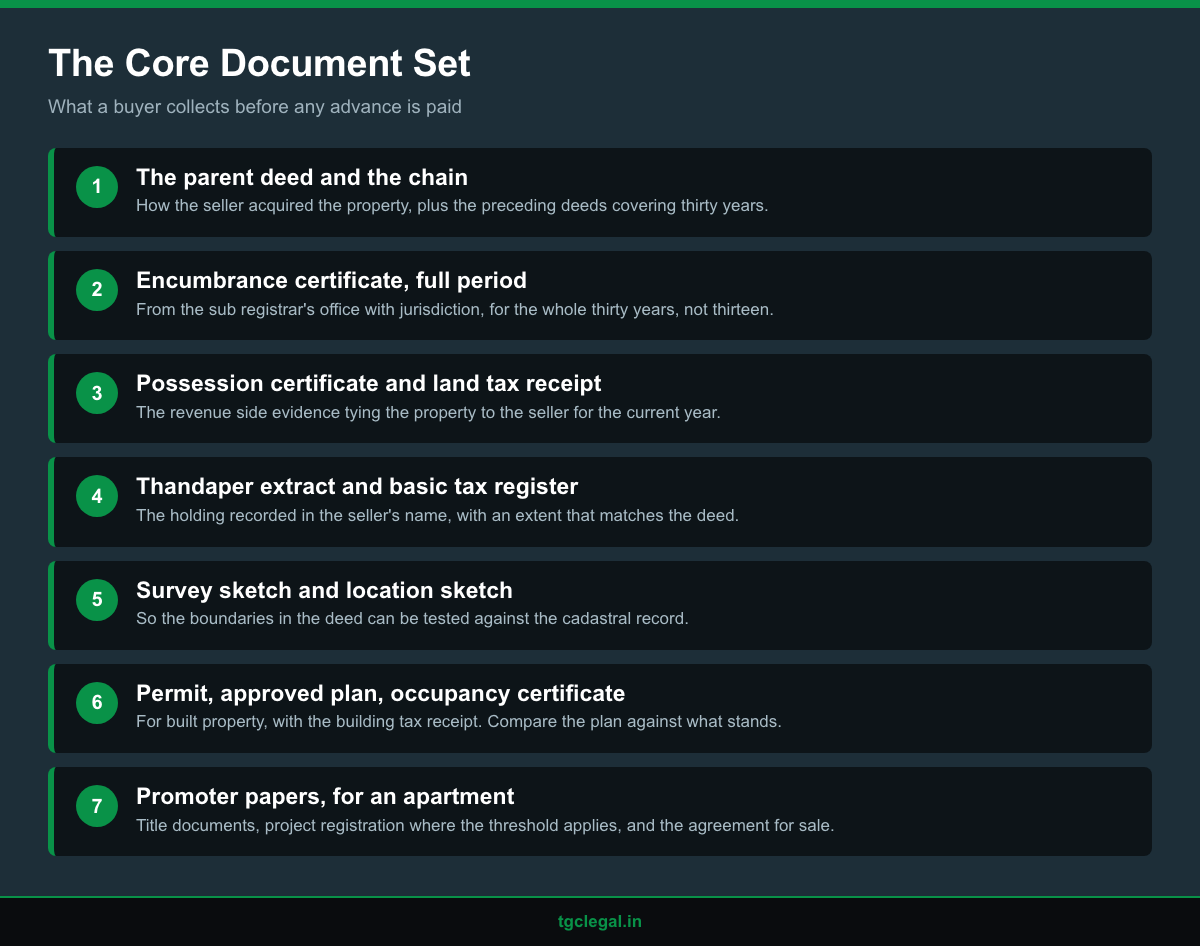
Before any advance is paid, the buyer should hold copies of the following and should read them rather than file them.
Where the seller is reluctant to hand over the earlier deeds, that reluctance is itself information. A seller with clean title has no reason to withhold the parent deed.
- The parent deed by which the seller acquired the property, and the preceding deeds covering thirty years.
- The current encumbrance certificate for the full thirty-year period, obtained from the sub registrar's office in whose jurisdiction the property lies.
- The possession certificate and the land tax receipt for the current year, which tie the property to the seller on the revenue side.
- The thandaper extract and the basic tax register entry showing the holding in the seller's name.
- The survey sketch and the location sketch, so that the boundaries in the deed can be matched against the cadastral record.
- For built property, the building permit, the approved plan and the occupancy certificate, plus the building tax receipt.
- For an apartment, the promoter's title documents, the project registration where the project falls within the regulator's threshold, and the allotment or agreement for sale.
Two Record Systems That Must Agree
Kerala keeps registration records and revenue records separately. The Registration Department, through the sub registrar's office, records deeds and issues encumbrance certificates. The Revenue Department, through the village office, maintains the basic tax register, the thandaper holding number and the land tax account, and it is the revenue record that the state actually treats as the working record of who holds the land.
Registration does not update the revenue record. The transfer of the revenue entry into the buyer's name is a separate application, known in Kerala as pokkuvaravu, and until it is made the seller remains the person shown as holding the land. That is not a formality. It affects who can pay land tax, who receives statutory notices, and how straightforward the buyer's own onward sale will be.
Both systems are now substantially online. Deeds and encumbrance certificates run through the Kerala registration department portal, while mutation and land tax are handled through the state revenue department's services. A buyer should confirm that the two describe the same property with the same survey numbers and the same extent before completing.
Mismatches are common and are usually historical rather than sinister: a resurvey renumbered the plot, an extent was recorded in a different unit, or a partition was reflected on one side only. They still need resolving, because a mismatch discovered at the point of resale is a mismatch that has to be fixed under time pressure. Our note on how errors in the revenue entry affect an owner's rights works through what that costs to correct.
The Encumbrance Certificate: Scope and Blind Spots
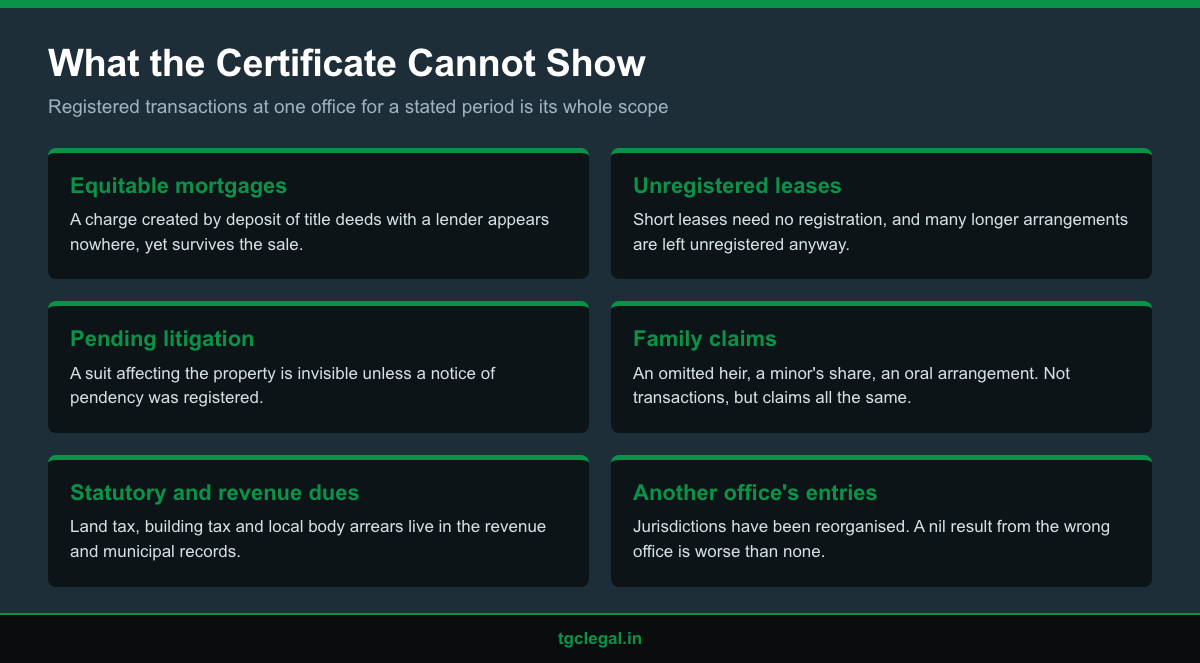
The encumbrance certificate is the single most requested document in a Kerala purchase and the most widely misunderstood. It is an extract of the registered transactions recorded against a property at a given sub registrar's office for a stated period. Where transactions exist, they are listed. Where none are found for the period, a nil certificate issues.
What it shows is genuinely useful: registered sales, registered mortgages, registered gifts, registered leases, partitions and attachments that have been registered. What it does not show is longer than what it does.
It will not show an unregistered lease, and leases of under twelve months are frequently unregistered. It will not show an oral or equitable mortgage created by deposit of title deeds, which is how a great deal of property-backed lending in India is actually secured. It will not show a pending suit unless a lis pendens notice has been registered. It will not show a claim by an heir who was left out of a partition, a tenancy under the land reforms framework, or an unpaid contractor's claim. It will not show anything registered at a different sub registrar's office, which matters where jurisdictions have been reorganised.
The practical response is not to distrust the certificate but to pair it with the other checks: a physical inspection, enquiries with neighbours and the local office, a search of pending litigation, and a direct question to the seller, in writing, about deposits of title deeds. Our fuller note on what the certificate leaves out treats this as a standalone subject.
Reading the Chain: Thirty Years of Parent Deeds
Reading the chain is the part buyers most often delegate and most often should not skip entirely. Four questions run through every link.
Was the transferor competent? A minor cannot convey. A person of unsound mind cannot convey. Property held by a guardian on behalf of a minor requires court permission for most dispositions, and a sale without it is voidable at the instance of the minor for years afterwards.
Was the whole interest transferred? Undivided family property conveyed by one coparcener transfers that coparcener's share, not the property. A release by some of the heirs leaves the others' shares outstanding. Where a document conveys more than the executant held, the excess simply does not pass.
Was the document properly stamped and registered? An instrument that is insufficiently stamped is not admissible in evidence until the deficiency and penalty are paid, and a document requiring registration that was not registered does not affect the property at all. Both defects are inherited by the buyer.
Was any power of attorney genuine, subsisting and wide enough? Powers are a recurring source of trouble in Kerala purchases, particularly where the owner lives abroad. The instrument should be examined for its date, its scope, whether it was registered where registration was required, and whether the principal was alive on the date it was used, because a power terminates on death. Our note on the risks that sit inside a power granted by an owner abroad sets those out.
Where a Written Opinion Fits
Buyers frequently ask whether a written opinion is worth commissioning on an ordinary purchase. The answer turns on what the opinion is being used for. A lender will insist on one because it is the lender's own risk assessment. A buyer paying cash is buying something different: a written record of what was examined, what was found, what could not be verified, and what conditions should attach to completion.
That last element is the useful part. A competent opinion does not simply say the title is clear. It says which documents were seen and which were not produced, identifies gaps in the chain, flags mismatches between the registry and revenue descriptions, states the land classification and any use restriction, and sets out what the seller must do before the balance is released. It converts a series of worries into a list of conditions that can be negotiated.
It also fixes the position in time. Where a defect surfaces two years later, the opinion establishes what was disclosed and what was not, which matters if the buyer needs a remedy against the seller. An oral assurance from an intermediary establishes nothing.
The scope should be agreed in advance. An opinion limited to the documents the seller chose to supply is a different product from one that includes searches at the sub registrar's office, a check of the revenue entries, a physical inspection and enquiries about pending litigation. Buyers who are surprised later usually commissioned the first and believed they had bought the second.
Inherited Land, Partitions and the Family Chain
A large share of Kerala property changes hands within families rather than on the open market, and those transfers produce their own defects. The instruments involved are settlement deeds, partition deeds, release deeds and gifts, and each does something different.
A partition divides jointly held property among the sharers and gives each an identified portion. A release operates where a sharer gives up an interest in favour of the others. A settlement transfers property, usually within a family and often with conditions such as a life interest reserved to the transferor. A gift is a transfer without consideration, accepted during the donor's lifetime.
The recurring problems are also predictable. A partition executed without one heir, who reappears years later. A settlement reserving a life interest that the buyer's advisers did not read, so the property cannot be conveyed free of it while the life tenant lives. A release described as a gift, or the reverse, with the wrong duty paid. An oral family arrangement acted on for decades but never reduced to a registered instrument.
Where any of these appear in the chain, the question is not whether the family regards the matter as settled. It is whether the instruments on record convey what the seller is offering to sell. A matter involving competing claims among heirs in Kochi shows how long an unresolved share can stay dormant before it surfaces.
Land Use, Building Permits and the Regulator
Title can be perfect and the purchase still be a mistake, because what the buyer may lawfully do with the land is governed by a separate body of rules.
The most consequential in Kerala is the framework protecting paddy land and wetland. Land classified as paddy or wetland in the statutory data bank cannot simply be filled or converted, and the permission route is narrow and specific. A buyer intending to build must check the classification in the data bank and the revenue record before purchase, not after, because a plot that cannot be converted is worth a fraction of what it is being sold for.
Beyond that sit the ordinary planning controls: the land utilisation framework, the zoning under the applicable master plan or detailed town planning scheme, and coastal regulation where the property is near the shore or a backwater. For built property, the buyer needs the building permit, the approved plan, and the occupancy certificate, and needs to compare the approved plan with what is physically standing. Deviations are common and are the buyer's problem once the deed is executed.
For apartments, a project of the notified size must be registered with the state real estate regulator before it is marketed, and the registration carries the promoter's declarations about title, encumbrances and completion. Verifying that registration is a five-minute check that regularly changes a buyer's mind. A matter on apartment ownership conflict in Kochi shows how the same issues surface after possession.
What It Costs, and Why Price Below Fair Value Backfires
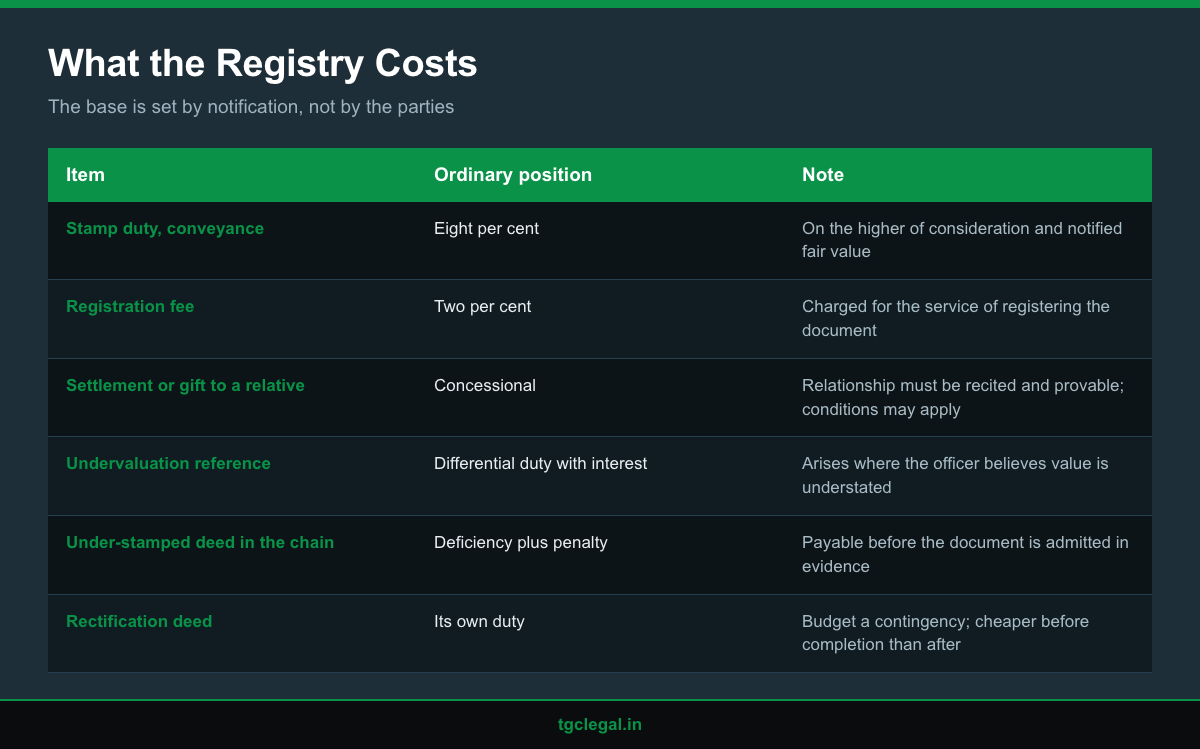
Two charges arise on a conveyance in Kerala: stamp duty under the state stamp legislation, and the registration fee. For an ordinary sale of immovable property these run at eight per cent and two per cent respectively, so a buyer should budget ten per cent of the value on top of the price, before legal and incidental costs. Concessional treatment applies to certain family transactions, including settlement and gift within a defined class of relatives, and those rates are materially lower.
The base on which duty is charged is not simply the price. Kerala operates a fair value system under which the government notifies a fair value for land by locality and classification, and duty is charged on the higher of the stated consideration and that fair value. Buyers who agree a price below fair value in the belief that it saves duty achieve nothing except a discrepancy on the face of the instrument.
Where the registering officer has reason to believe the value stated is below the true market value, the matter can be referred to the Collector for determination, and the buyer then faces a demand for the differential duty with interest. That process takes months, arrives long after possession, and is entirely avoidable. A matter on a company's dispute over what it owed at the sub registry shows how those references run.
Rates, fair value tables and concessional categories are revised. The figures above are the ordinary position and should be confirmed against the current notification for the locality before a budget is fixed.
Two further costs are routinely left out of a buyer's budget and should not be. The first is the cost of curing a defect found during the review, which can range from a rectification deed and its duty to an application to correct a revenue entry that has been wrong for a generation. The second is the differential duty exposure where the chain contains an earlier instrument that was itself insufficiently stamped, because that deficiency travels with the document and surfaces the moment it has to be produced in evidence. Both are cheaper to identify before completion than to discover during a resale.
Registration Day, and What Still Goes Wrong
The deed is presented at the sub registrar's office having jurisdiction over the property. The executants attend and admit execution, identity is verified, photographs and thumb impressions are taken, and the document is registered and returned. Presentation is subject to a time limit from the date of execution, with a narrow route for late presentation on payment of a fine, so a deed signed and then left in a drawer is a problem.
The recurring failures on the day are prosaic. A description of the property that does not match the survey record, so the deed conveys something the buyer cannot later identify. Boundaries described by reference to a neighbour's name that has since changed. An extent stated in a unit that does not match the revenue entry. A missing schedule. An executant who cannot attend and whose power of attorney is not in acceptable form. Insufficient stamp value on the instrument, discovered at the counter.
Every one of these is preventable by reading the draft against the survey sketch and the revenue extract a week before, rather than at the counter. Our note on the checklist a buyer works through before registering land in Kochi covers the mechanics in detail.
One further point applies to money. Payment should be traceable and should match the consideration recited in the deed. Cash components create a mismatch between the instrument and reality that helps nobody, least of all the buyer trying to prove what was paid.
After Registration: Mutation, Tax and the Title File
Registration is the middle of the process, not the end. Three things follow, and none of them appear in the property registration details a buyer is handed at the counter.
Mutation, so the revenue record shows the buyer as the holder. This is applied for at the village office or through the revenue services portal, supported by the registered deed and the earlier tax receipts. Until it is done the buyer is not on the roll.
Land tax, paid in the buyer's name for the current year, which is the practical evidence that mutation went through. Building tax and, where applicable, local body property tax follow the same logic.
The title file itself. The registered deed, the thirty-year chain, the encumbrance certificate, the revenue extracts, the survey sketch, the approvals and the tax receipts belong together in one place, in the buyer's hands. The single most common cause of avoidable difficulty on a resale ten years later is that nobody kept the file. Our note on why a registered will is not the whole answer to business succession makes the same point about family holdings.
A matter on clearing a defective title and securing the documentation in Kerala illustrates what rectification looks like when the file was never assembled.
Red Flags That Justify Walking Away
Some findings are worth negotiating around. Others are worth leaving.
A seller who will not produce the parent deed. A gap in the chain that nobody can explain. A property described differently in the deed and in the revenue record with no resurvey to account for it. A power of attorney whose principal cannot be contacted. A plot classified as paddy or wetland being sold as house plot. A construction that departs materially from the approved plan. A pending suit disclosed only after the advance is paid. An apartment in an unregistered project of registrable size.
The common feature is that each one shifts a known risk onto the buyer for no discount. Where a defect is curable, the cure should happen before completion and at the seller's cost, with the balance of the price held back until it is done. Where it is not curable, price is not the answer.
Pressure to complete quickly is itself a red flag worth naming. A seller who produces the deeds late, insists on an early advance, discourages enquiries at the village office, or explains a gap in the chain by reference to an understanding rather than a document, is asking the buyer to accept a risk the seller already knows about. The reasonable response is not suspicion but sequence: no advance until the chain has been read, no balance until the conditions have been met, and nothing agreed on the basis of assurances that are not written into the contract.
The title verification practice page sets out how that review is normally scoped, and the matter on due diligence that stopped a purchase in Kochi shows the value of doing it before rather than after.
Conclusion
Property registration details in Kerala are not one search but a set of them, run across two departments and read together. The buyer who collects the chain, reconciles the registry and revenue records, treats the encumbrance certificate as a starting point rather than a clearance, checks land use before price, and completes mutation afterwards, will have done what the system actually requires.
The clusters that sit under this guide take each of those steps further: what the registry charges and how undervaluation notices arise, what a legal opinion covers, how the certificate's limits play out, how apartments and inherited land differ, and how the online searches are run. Each one is written for a specific point in the same purchase.
Frequently Asked Questions
Does a registered sale deed prove that the seller owned the property?

How far back should the chain of deeds be traced in Kerala?
What will an encumbrance certificate not reveal?
Is mutation automatic once the deed is registered?
What does a purchase cost in stamp duty and fees in Kerala?
Can we state a lower price in the deed to reduce duty?
Why does the classification of the land matter so much in Kerala?
What should be checked before buying an apartment?
How long after signing must a deed be presented for registration?
What is the single most useful thing a buyer can do?