Post
Kerala RERA Due Diligence: Approvals, Delays and Agreement Clauses
 Property Litigation Law Services
Most flat buyers in Kochi meet the regulator only after something has gone wrong. Kerala RERA due diligence works better the other way round: the project record, the agreement for sale and the payment schedule are read before the booking amount leaves the buyer's account, while every point is still negotiable.
Our earlier note on how a legal opinion differs for land and for an apartment deals with title, approvals and the undivided share. This note takes the other half of the exercise: what the Real Estate (Regulation and Development) Act 2016 gives a buyer, where that protection sits in the documents, and what to check so that it is actually available when it is needed.
Key Takeaways
- A project above the notified size must be registered with the Kerala Real Estate Regulatory Authority before it is advertised or sold, and the project page is the promoter's own sworn record.
- Price is fixed on carpet area as the Act defines it. Super built up figures in a brochure are not the measure.
- The promoter cannot take more than ten per cent of the cost as an advance without first entering into a written agreement for sale and registering it.
- Where possession is delayed, the buyer may withdraw and claim a refund with interest, or stay and claim interest for every month of delay.
- Structural defects reported within five years of possession must be put right by the promoter without charge, and the agreement cannot cut that period down.
Start With the Project Page
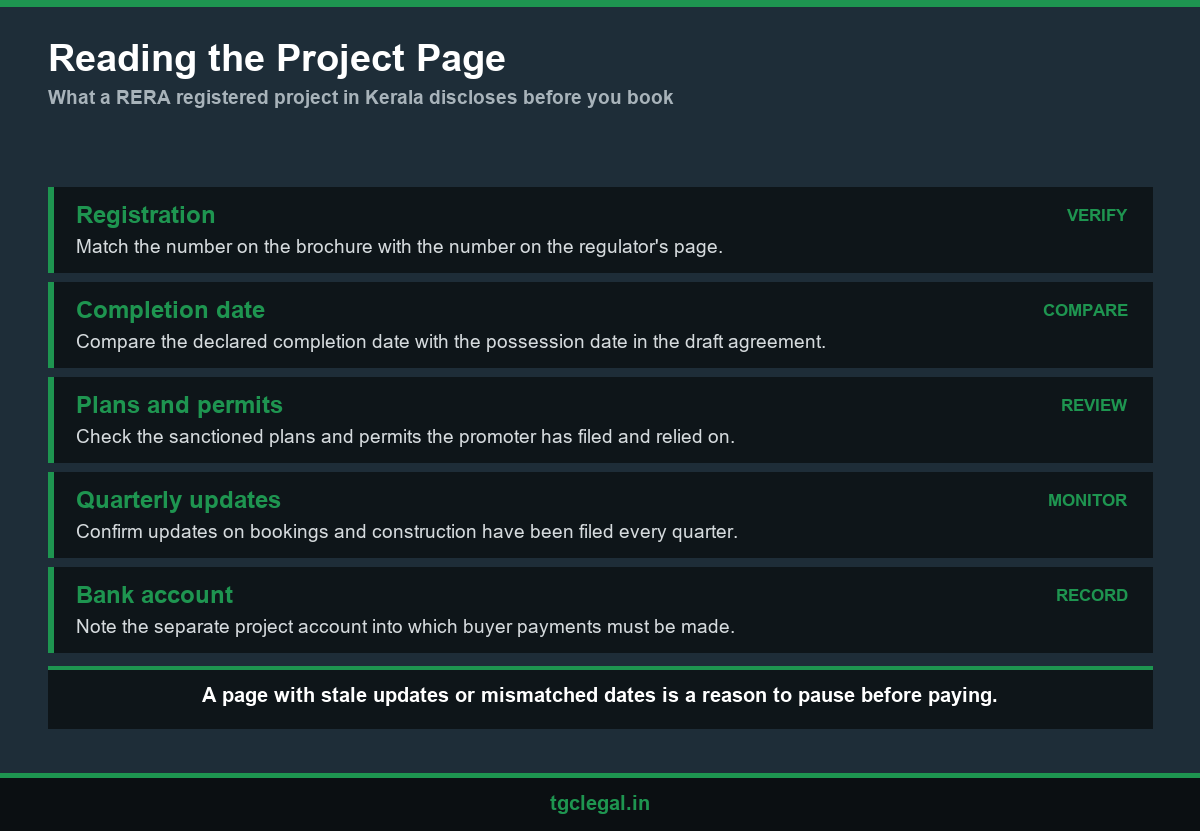
Every registered project has a page on rera.kerala.gov.in, and it is the most useful document a buyer can read before visiting a sales office. The promoter files it, the promoter is answerable for it, and it was prepared for the regulator rather than for a marketing campaign.
The page normally carries the registration number and its validity, the promoter's details and past projects, the sanctioned layout and building plans, the permits relied on, the declared date of completion, the number and type of apartments, and the details of the separate bank account into which buyer money is to be deposited. Section 11 of the Act also requires the promoter to keep the page updated each quarter with the bookings made and the status of construction and approvals.
A buyer should read the page with three questions in mind. Does the registration number on the brochure match the page. Does the completion date in the draft agreement match the date declared to the regulator. Have the quarterly updates actually been filed, and do they describe the progress the buyer sees on site.
A project marketed without registration, or a page whose updates stopped several quarters ago, is a reason to pause before paying anything.
Carpet Area and What You Are Paying For
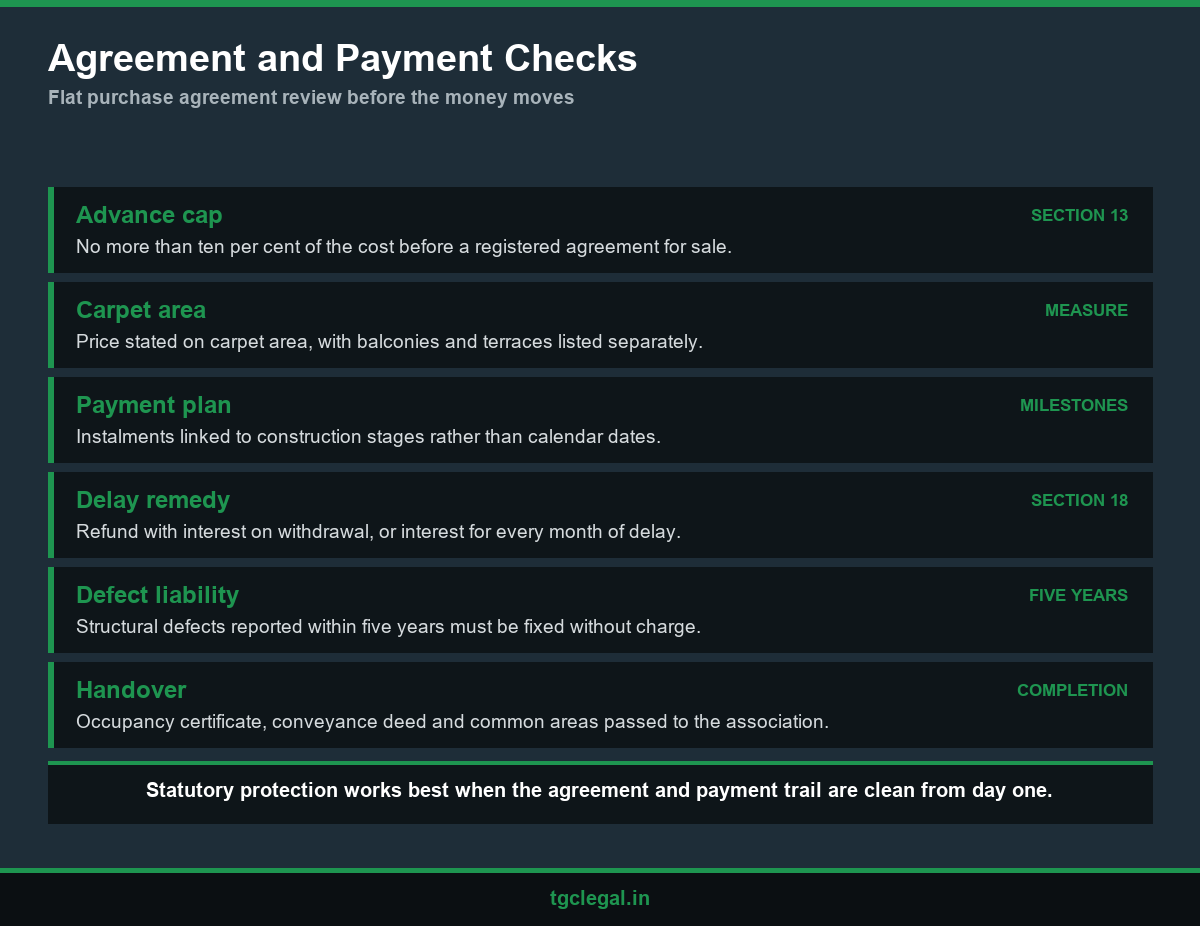
Section 2(k) of the Act defines carpet area as the net usable floor area of an apartment, excluding external walls, areas under services shafts, the exclusive balcony or verandah area and the exclusive open terrace area, but including the internal partition walls. The price of an apartment in a registered project is to be expressed on that basis.
The practical problem is that buyers in Kochi still receive brochures quoting saleable or super built up area, sometimes with the carpet area in small print or not at all. The two figures can differ substantially, and the per square foot rate looks very different depending on which one it is applied to.
The agreement should state the carpet area of the apartment, list separately any balcony, verandah or terrace allotted for exclusive use, and set out how the price is computed. It should also say what happens if the area delivered differs from the area agreed. A clause that adjusts the price in both directions within a stated tolerance is reasonable. A clause that only ever adjusts upwards is not.
Where a parking space is allotted, the agreement should identify it and its price.
The Agreement for Sale and the Ten Per Cent Cap
Section 13 of the Act prohibits a promoter from accepting more than ten per cent of the cost of the apartment as an advance or application fee without first entering into a written agreement for sale with the buyer and registering it. Bookings that demand twenty or thirty per cent against a receipt and a promise of paperwork later fall squarely on the wrong side of that rule.
The Kerala Real Estate (Regulation and Development) Rules 2018 prescribe a model form of agreement for sale. A promoter's draft may add project specific detail, but terms that dilute the buyer's statutory rights are not cured by the buyer's signature. A careful flat purchase agreement review compares the draft against the model form clause by clause and marks every departure.
The points that most often need attention are the following.
- The schedule of the apartment, the parking and the undivided share, described consistently with the sale deed to come.
- The date of possession, and whether it matches the date declared on the project page.
- Cancellation by the buyer, and how much of the money paid can be forfeited.
- Escalation clauses that allow the price to rise after signing.
- Maintenance charges and corpus deposits payable before handover.
Once registered, the agreement is the document on which every later claim is argued. Time spent on it before signing is time a buyer rarely has to spend in front of the Authority.
Paying in Step With Construction
The safest payment schedule is one linked to construction milestones rather than calendar dates. Foundation, each slab, brickwork, plastering, flooring and handover are the usual stages, and each instalment falls due only when the stage is complete.
A time linked plan transfers the risk of delay entirely to the buyer. The money is collected on schedule whether or not the building has moved, and the promoter's incentive to keep the site active falls with every instalment paid in advance of the work.
Where a stage is reported as complete, a buyer is entitled to ask for evidence, and an architect's or engineer's certificate is the normal document. Comparing the stage claimed with the quarterly update on the project page is a simple cross check. The Act also requires the promoter to deposit a prescribed portion of buyer money in a separate account and withdraw it only in proportion to the progress of the project, which is a further reason to keep demand letters and receipts in order.
Every payment should go through a bank to the account named in the agreement. A receipt that is not matched by a banking record is very difficult to prove later, and cash payments create problems for the buyer that no regulator can solve.
When the Builder Is Late
Section 18 of the Act sets out the remedy for delay. Where the promoter fails to complete or is unable to give possession in accordance with the agreement, the buyer may withdraw from the project and claim a refund of the amount paid with interest at the prescribed rate, together with compensation. A buyer who prefers to stay is entitled to interest for every month of delay until possession is handed over.
The choice between those two routes is commercial as much as legal. A buyer who needs the flat and is confident the project will finish usually stays and claims interest. A buyer who has lost confidence in the promoter, or whose own plans have moved on, usually withdraws. Either way, builder delay compensation is calculated from the date in the agreement, so a vague or open ended possession clause weakens the claim before it is made.
Drafts commonly extend the possession date for events beyond the promoter's control. That is legitimate in principle, but the definition should be confined to genuine events such as natural calamities, and should not extend to the promoter's own funding or labour difficulties.
Delay claims are proved on documents: the agreement, the payment record, the demand letters and the project page history. Our note on how delay and variation claims are proved in construction disputes explains why a well kept file matters so much.
Defects, Occupancy and the Handover to the Association
Section 14(3) of the Act places responsibility for structural defects, workmanship, quality and provision of services on the promoter for five years from the date of handing over possession. A defect brought to the promoter's notice in that period is to be rectified without further charge within thirty days, failing which the buyer is entitled to compensation. The agreement cannot reduce that period.
Before taking possession, a buyer should see the occupancy certificate, or the completion certificate where that is the document issued, for the building as constructed. A flat handed over without one may be difficult to register, to connect to permanent utilities, or to mortgage, and the absence usually points to a deviation from the sanctioned plan. A property due diligence matter in Kochi shows how much turns on documents of this kind.
Section 17 requires the promoter to execute a registered conveyance deed in favour of the buyer and to hand over the common areas to the association of allottees within the period the Act and the local law provide. A buyer should confirm early whether an association is to be formed, what records and funds will pass to it, and whether the maintenance deposit collected at handover will be transferred.
Finally, a reminder that the regulator records what the promoter declares and does not certify title. A RERA registered project in Kerala can still sit on land with a defective chain, which is why the regulatory checks here run alongside the title verification steps a Kerala buyer should follow, not in place of them. The overview of the Act is a useful starting point for the wider framework.
Conclusion
The Act gives a flat buyer real protection, but most of it depends on documents prepared at the very start: a registered agreement close to the model form, a possession date that matches the project page, a payment plan tied to construction and a clean banking record. A buyer who gets those right has a claim that is straightforward to make. A buyer who does not is left arguing about what was meant.
A property documentation legal review before booking is normally a short exercise, and it is far cheaper than a complaint to the Authority later. The property documents practice page sets out how that review is normally scoped.
Frequently Asked Questions
How do I check whether a Kochi apartment project is registered with RERA?

How much can a builder take as booking amount before the agreement?
What can I claim if my flat is handed over late?
Is the price of a flat based on carpet area or super built up area?
How long is the builder responsible for defects after handover?
Does RERA registration mean the builder's title is clear?