Post
E Registration Online in Kerala: Verifying the Property Registry
 Property Litigation Law Services
E registration online has changed how a Kerala property is first checked. A decade ago verifying a plot meant three offices and a week; a large part of that work now starts in a browser, and buyers reasonably ask how far the online record can be relied on.
The honest answer is that e registration online is excellent for finding out what to ask, and it is not a substitute for the certified documents a transaction runs on. This note sets out what each portal does, which property registration details it returns, what those results mean, and where the online position and the paper position diverge. It sits alongside the buyer's due diligence guide for Kerala, which covers the full title review.
Key Takeaways
- E registration online covers deed preparation, fee calculation, appointment booking and encumbrance certificate applications through the registration department.
- The revenue department's services cover the land tax account, the basic tax register position and mutation applications, which the property registry does not update on its own.
- Survey and cadastral information sits with the survey department and answers a different question from either of the above.
- Property registration details seen online are a starting point; certified copies and the certificate issued by the office remain the documents a transaction relies on.
- The fee calculation shows the base for stamp duty and registration fees before a price is agreed.
- Most apparent contradictions between portals are description problems: an old survey number, a resurvey, or an extent recorded in a different unit.
What E Registration Online Covers
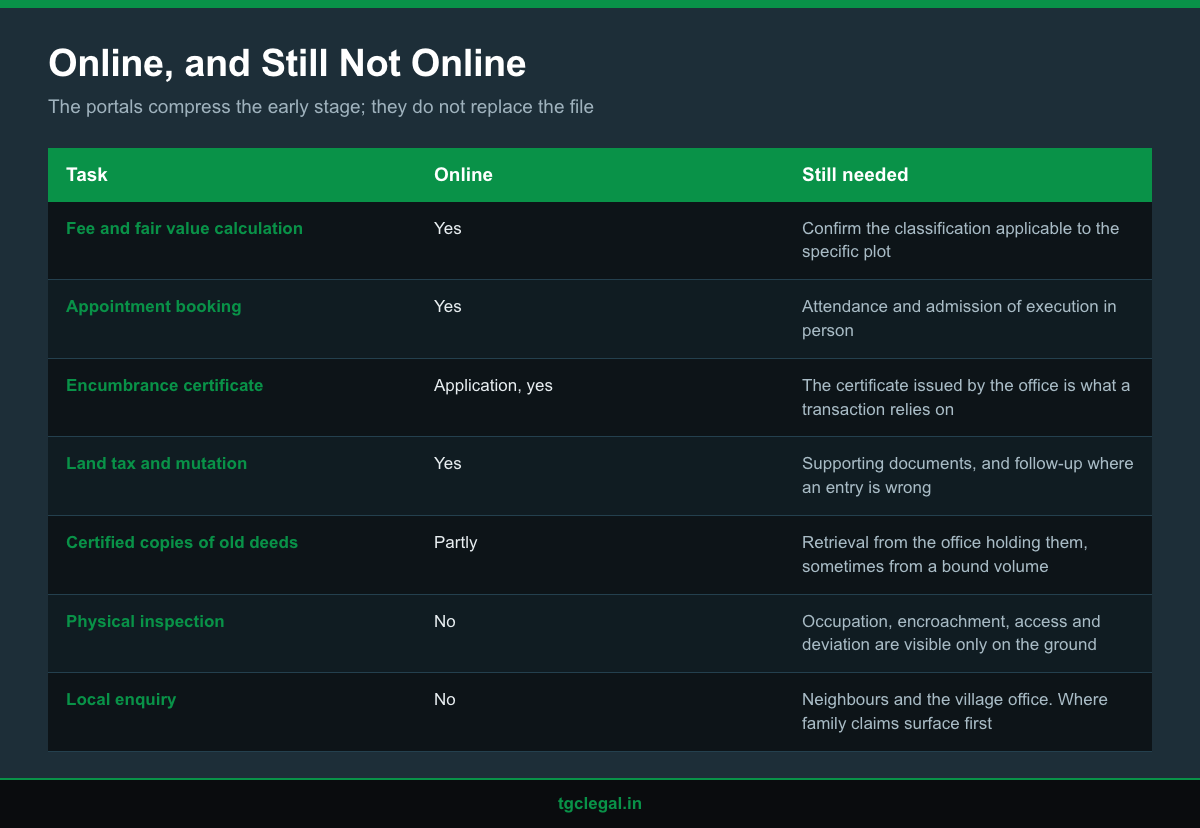
The state registration department's e registration online services handle the transactional side of a purchase. A draft deed can be prepared and validated, duty and fee can be calculated on the fair value applicable to the property, an appointment at the sub registrar's office can be booked, and an application for an encumbrance certificate can be filed.
The fee calculation is the most immediately useful function for a buyer, because it exposes the fair value applicable to the specific locality and classification before a price is agreed. Stamp duty and registration fees are assessed on that base, and a buyer who runs the calculation early is not surprised at the counter. Our note on how duty and the fee are worked out explains the calculation and the undervaluation notices that can follow.
The appointment function matters more than it sounds. Presentation is subject to a statutory period from the date of execution, and a deed executed on a date that leaves no room to book a slot creates avoidable difficulty.
What e registration online does not change is the substance. The parties still attend, execution is still admitted before the registering officer, identity is still verified, and the instrument still has to be correct on its face before it enters the property registry. The state registration department portal is the reference point for the current services and forms.
What the Revenue Services Cover
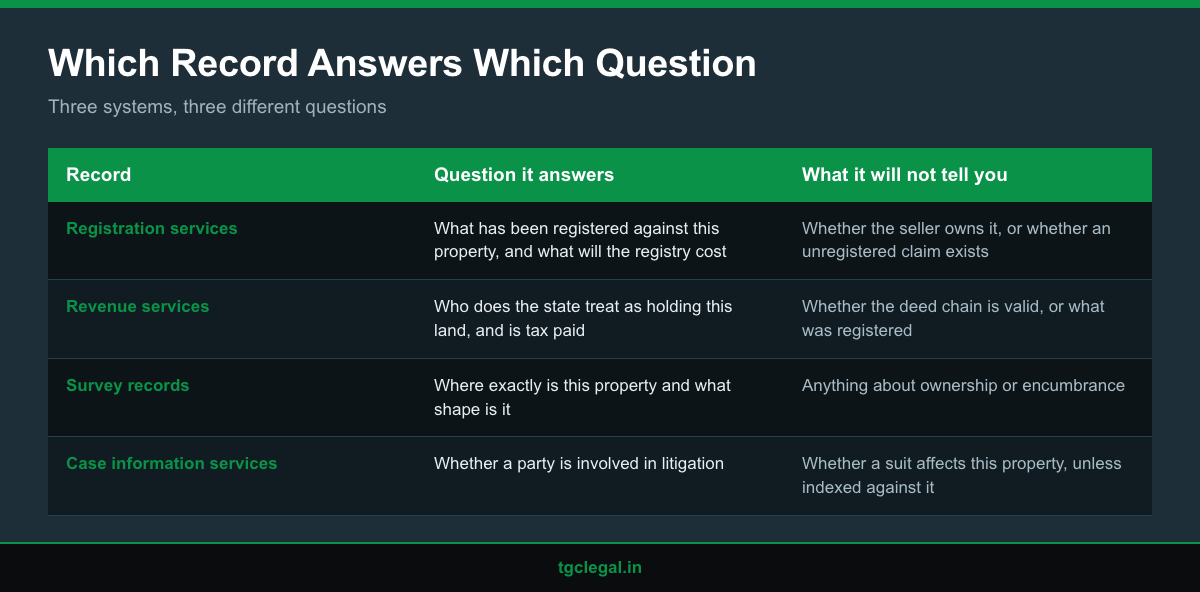
The revenue side answers a different question: who does the state currently treat as holding this land, and is the tax paid.
Land tax can be paid online, the tax account can be viewed, and mutation following a transfer can be applied for through the revenue department's services. For a buyer, the useful checks are that the holding is recorded in the seller's name, that the extent matches the deed, and that tax is paid to the current year.
An unpaid tax account is not usually a sign of anything sinister, but it is a sign that nobody has been attending to the property, which correlates with other gaps. An account in a name that does not match the seller is a different matter and needs explaining before anything else proceeds.
After completion, this is also where the buyer's own work happens. An entry in the property registry does not update the revenue record, and until mutation is applied for the seller remains on the roll. E registration online ends at the sub registrar's office; the revenue side has to be moved separately. Our note on how a defective revenue entry affects an owner's rights sets out what it takes to correct one that has gone wrong.
Survey Records and the Question They Answer
Survey and cadastral information sits outside e registration online altogether, and it answers the question the other two cannot: where exactly is this property and what shape is it.
For a buyer this matters where the deed describes boundaries by reference to neighbours, where an extent is disputed, or where a plot has been subdivided. The sketch is what allows the description in the deed to be tested against the ground.
It also explains a large share of apparent contradictions between records. A resurvey renumbers plots, and a property carrying an old survey number in the deeds and a new one in the revenue record looks like two different properties to anyone searching by number alone. Establishing the correspondence between the old and new numbers resolves most of these, and it is the step that makes property registration details from different offices line up.
Where the sketch and the physical position disagree, that is a finding rather than a formality. Encroachment, an access that does not exist on the record, or a structure standing partly on an adjoining plot are all discovered this way and not otherwise.
Reading Property Registration Details Correctly
Online results are compact and easy to over-read. Four rules keep the output of e registration online useful.
First, a nil result is a result about the search, not about the property. If the description used in e registration online was wrong, the search never reached the entries. Always search on the description as it appears in the revenue record, and where the chain shows an older survey number, search on that too.
Second, the period matters. An encumbrance certificate for thirteen years is a thirteen-year statement of the property registry. The working standard for a purchase is thirty, and even then it is worth knowing the limits of the certificate a buyer relies on.
Third, jurisdiction matters. Sub registrar office boundaries have been reorganised, and a transaction may sit at an office other than the one that serves the property today.
Fourth, an online view is not a certified copy. What a transaction runs on is the certificate issued by the office and the certified copies of the deeds, and where property registration details on screen differ from a certified document, the certified document governs, not the screen.
What Still Needs an Office, and What Needs Feet
Several things remain offline, and buyers who plan a purchase around e registration online alone are surprised by them.
Certified copies of older deeds are obtained from the office holding them in the property registry, and where a document is old enough the retrieval takes time. Where a deed is available only in a bound volume, a copy may need to be applied for and collected.
The physical inspection has no online equivalent, and nothing in e registration online substitutes for it. Occupation, cultivation, storage by a third party, a structure that does not match the plan, and an access that exists on paper but not on the ground are all visible only by walking the property.
Local enquiry has no online equivalent either. Neighbours and the village office know the history of a property in a way no record captures, and family claims, which are the most common defect in Kerala purchases, surface there first.
Litigation searches remain a mixed exercise. Some case information is available through the national case information services, but a suit affecting the property will not necessarily be indexed against it, and a search by party name is often the only practical route.
Two Failure Modes Worth Naming
The online record produces two characteristic mistakes, and both are avoidable once they are named.
The first is false comfort. A clean screen is read as a clean property. A nil certificate, a tax account paid to date and a matching name look like a complete answer, and they are three data points about registered transactions and tax, which is all e registration online and the revenue portal can show. The claims that most often defeat a Kerala purchase, a charge created by deposit of title deeds, an heir omitted from a partition, an occupier with an unregistered arrangement, appear on none of them.
The second is false alarm. A search returns an entry that does not match, a portal shows an extent that differs from the deed, or the property registration details on two records name different holders, and a buyer concludes the property is disputed. In the great majority of cases the explanation is administrative: a resurvey, a subdivision recorded on one side only, a mutation that was applied for and never completed, or an extent converted between units.
The distinction between the two matters commercially. False comfort causes buyers to complete on a property they should have investigated further. False alarm causes them to walk away from a property whose defect was a fortnight of paperwork. Neither is improved by staring at the screen for longer.
The way through both is the same. Treat every online result as a question rather than an answer, and resolve each question against a document. Where a portal and a deed disagree, the reconciliation is done by tracing the change through the property registry, not by choosing the record that suits.
A Sensible Sequence for E Registration Online
Used in the right order, the online tools compress the early part of a purchase considerably.
Start with the fee calculation to establish the fair value and the stamp duty and registration fees that will apply, before price is agreed. Then check the revenue position: holding, extent, tax paid. Then apply for the encumbrance certificate for the full thirty years, and while it is being prepared, obtain the survey sketch and reconcile the description across all three records.
Only then ask the seller for the chain of deeds, because by that point you know what the chain should contain and can tell whether what arrives is complete. A seller producing a bundle that does not match what the records imply is the most useful early signal there is.
The physical inspection and local enquiry follow, and the title review is written against all of it. Booking the appointment through e registration online is the last step rather than the first, and by then nothing about the property should be new.
A matter on due diligence that stopped a purchase in Kochi shows the value of running that sequence before an advance is paid rather than after.
Conclusion
E registration online has made the early stage of a Kerala purchase faster and cheaper, and it has not changed what a transaction relies on. Certified copies, the certificate issued by the office, a sketch reconciled against the ground and a chain read in full remain the substance, and the property registry is the record they are checked against.
What the online record does is tell a buyer which property registration details to ask for and where the gaps are, early enough to matter. Used that way, the online record is the most efficient hour in the whole exercise.
Frequently Asked Questions
Can a property purchase in Kerala be completed entirely through e registration online?

Which portal shows who owns the property?
Why does an online search return nil for a property that was clearly sold before?
Is an online view as good as a certified copy?
What is the most useful e registration online check before agreeing a price?
How long should the encumbrance certificate applied for through e registration online cover?
Can we check pending litigation online?
Does paying land tax online prove ownership?
Where do survey sketches fit?
What is the right order to run these checks?